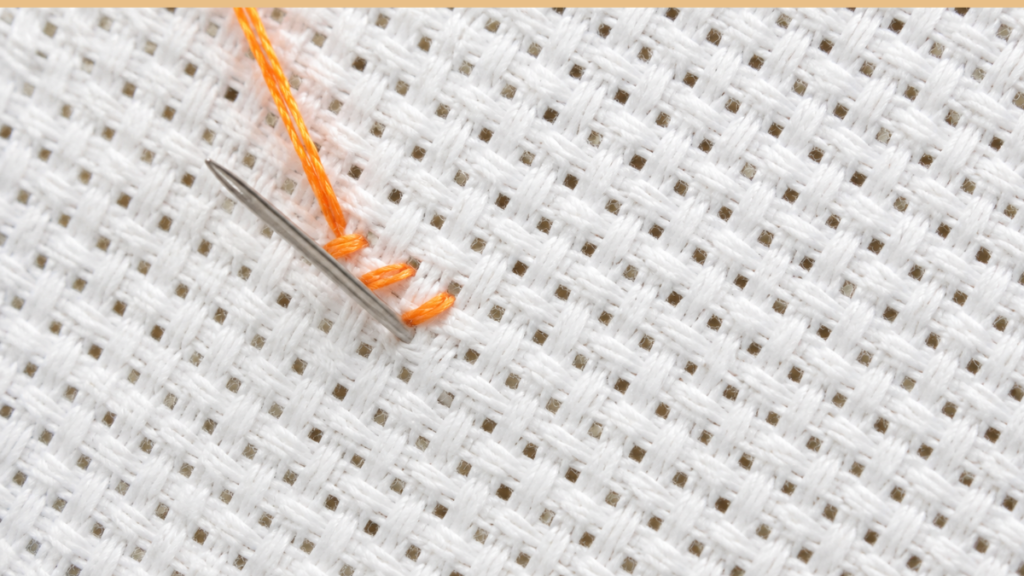
Does confetti stitching stress you out? Learn how to work scattered stitches without the frustration, with practical advice, tricks, and a bit of motivation so you can enjoy every stitch
If you’re reading this, you probably know exactly what I mean by “confetti” in cross-stitch. Those dreaded areas of the chart where every little square seems to be a different color, as if someone had thrown a bag of floss at your project at random. 😅
Scattered stitches, also called “confetti stitches,” can be maddening, but they’re also deeply rewarding, because they’re what give so many designs their detail, their shadows, and their realism. So today I want to share how to work them without frustration, with tricks, tips, and a little affection for this craft that gives us so much joy.
What is “confetti” in cross-stitch?
In cross-stitch, “confetti” refers to areas of a pattern where you have lots of single stitches in different colors, all very close together, without forming any defined block.
You’ll usually run into it in:
- Gradient backgrounds
- Faces and skin in portraits
- Furry animals and feathers
- Landscapes with complex textures (leaves, grass, water)
It’s a nightmare for some of us, but it’s an essential part of detailed designs.
Why you shouldn’t be afraid of confetti
Because those little scattered stitches:
- Add depth and realism to the design
- Are ideal for working in short sessions without losing your place
- Force you to stitch with more awareness and attention
- Teach you patience, organization, and consistency
I learned to love confetti when I saw how a chart with thousands of color changes eventually formed an image that looked like a photograph. Incredible! And all thanks to those blessed scattered stitches.
Practical tips for stitching confetti without the stress
1. Work in small areas
Mentally divide your work into sections of 10×10 squares (or use a grid), and focus on one at a time. Don’t try to take on the whole page at once.
2. Use a copy of the chart to mark off your progress
Print a copy and use a marker to cross off the colors as you stitch them. This helps you see your progress and avoid mistakes.
3. Use a hoop or frame with good tension
This matters for keeping your stitches even, especially when you’re jumping back and forth between so many colors.
4. Prepare your floss ahead of time
If you already know which colors you’ll need in a confetti area, cut short lengths and have them ready. Avoid long strands, since you’ll only be making one or two stitches per color.
5. Avoid knots
Use the loop start to begin, or anchor your floss under stitches you’ve already worked. The fewer knots you have, the cleaner the back will look.
6. Don’t be afraid to fasten off more often
In confetti areas you’ll sometimes work a single stitch and then have to fasten off. That’s fine. Do it carefully and trim the thread close so it doesn’t show.
7. Use a magnifier or good light
Don’t underestimate how much good lighting matters (natural light or a lamp with a magnifier). Confetti demands sharp eyes and precision.
My technique for working scattered stitches
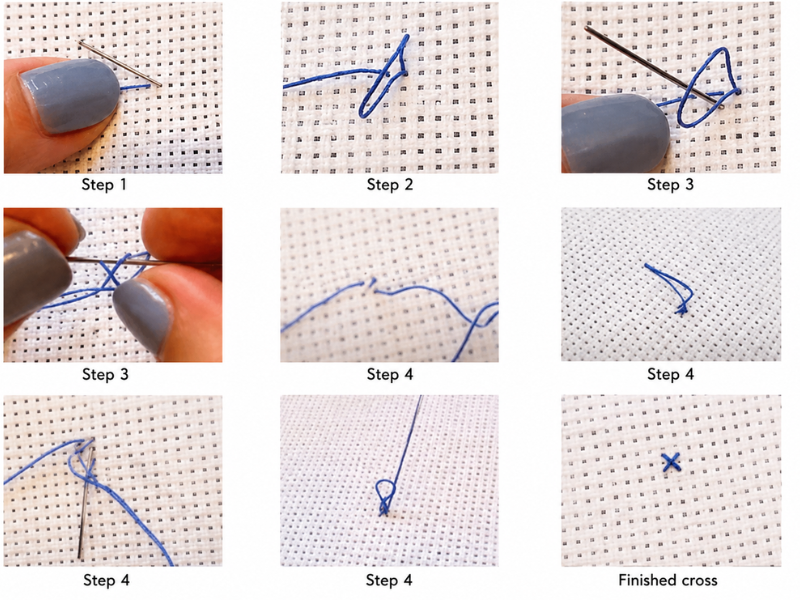
- Start by bringing the needle down from the front, but don’t pull the floss all the way through. Leave a tail.
- Bring the needle up through the hole right next to it, then back down through that same hole, again without pulling the floss all the way through. Leave a loop.
- Come up through the hole directly below the first one you used, and cross diagonally, passing through the loop you just made. That completes the first diagonal of the cross.
- Now begin the second diagonal of the cross, again without pulling the floss all the way through. This time the loop sits at the back.
- Finish the cross, and as you take the floss to the back, pass it through that second loop.
- Once your scattered (confetti) stitch is done, you can take a couple of stitches on the back to secure the floss.
If you’d rather, watch it on video
How to keep your head in the right place
Some days confetti can feel like an impossible task. It happens to me too. Here are a few things that have worked for me:
- Breathe and remember there’s no rush. You aren’t competing with anyone.
- Celebrate every section you complete, even if it’s only ten stitches.
- Look at the back of your work with kindness. Yes, even with all those fastened-off ends.
- Let yourself take a break. If the confetti is overwhelming you, stitch a different part of the design that day.
Bonus trick: the traveling thread or two needles
Some people prefer to keep two needles threaded in different colors so they aren’t constantly switching. Others use a “traveling thread”: one long strand you use across several stitches in different areas before fastening off.
A word of warning! This takes practice to avoid tangles, but it can be very handy.
My own experience with scattered stitches
I remember one of the first big patterns I did was a landscape at sunset. When I saw the key and the sheer number of different symbols in one single square, I nearly gave up. But I started slowly, five or six stitches a day.
Then one day I stepped back from the hoop and boom! The silhouette of a tree appeared, crisp, with shadows, highlights, purples and ochres… all thanks to that blessed confetti.
Ever since, I’ve taken it more calmly, like a puzzle I solve one stitch at a time.
The benefits of stitching confetti (even if it doesn’t feel like it)
- It sharpens your attention to detail
- It teaches you to work without immediate results
- It builds patience and your ability to focus
- It makes the sense of accomplishment even stronger
Besides, there’s nothing like saying “I made this” and knowing that every stitch, however small, was part of something wonderful.
How to work scattered confetti stitches in cross-stitch
Total Time: 2 minutes
Leave a tail at the start
Start by bringing the needle down from the front, but don’t pull the floss all the way through.
Make the first loop
Bring the needle up through the hole right next to it, then back down through that same hole, without pulling the floss all the way through. Leave a loop.
Work the first diagonal
Come up through the hole directly below the first one you used, and cross diagonally, passing through the loop you just made.
Close the cross through the second loop
Begin the second diagonal of the cross without pulling the floss all the way through. This time the loop sits at the back.
Finish the cross, and as you take the floss to the back, pass it through that second loop
Materials: fabric needle floss
Conclusion: confetti is stitched with love (and organization)
Working scattered stitches can look like a challenge at first, but with practice and the right attitude it becomes just another part of the creative process. Sometimes even the most satisfying part.
Every stitch is like a small brushstroke that, joined with the others, shapes something bigger.
If you want your work to look even better, don’t miss this post on the most common mistakes we make in cross-stitch, or learn how to start your work without knots!
So how do you get along with confetti?
Do you love it? Hate it a little but stitch it anyway? Do you have a foolproof trick I haven’t mentioned?
Tell me in the comments! I’d love to read you and keep learning alongside you.
And if this post was useful, share it with a stitching friend or save it for later. Because when there’s thread involved, we always understand each other!