The First Step Toward Flawless Stitching
One of the fundamentals of polished, professional-looking cross-stitch is knowing how to start your work without tying a knot in the thread. Knots are common in home stitching, but they create unsightly bumps, make the thread harder to manage against the fabric, and can affect how well the piece holds up over time.
Starting without knots improves the look of your finished piece and also helps the fabric stay in better condition as the years go by. The technique takes a little more attention and practice, but it quickly becomes an essential habit for anyone who wants to refine their work.
The key to avoiding knots lies in handling the thread correctly from the start, securing it discreetly on the back of the work. That keeps the thread firmly in place with no risk of it coming loose, and leaves the surface of your stitching smooth and even.
This method also makes it easier to change threads as you go, and lets you work with different weights and types of thread without a knot getting in the way. Stitching becomes more comfortable, and the work goes faster.
Another important advantage is that the back of your work stays cleaner, which matters when a piece isn’t framed or when it’s used on clothing where the reverse might show or sit against skin.
In short, avoiding knots when you start a cross-stitch project is a practice that may look small but makes a real difference in the quality of the finished piece. Learning it and sticking with it is a key step for anyone who wants to take their work up a level, with results that look more professional and last longer.
There’s something deeply special about that first thread passing through the fabric. That moment, full of quiet and concentration, is much more than a single stitch: it’s the beginning of a story woven with patience, creativity, and feeling. Many of us start out of habit with a small knot, so today I want to tell you why starting without knots can change the way you stitch forever.
In this post I’ll walk you step by step through starting your cross-stitch without knots, and I’ll also talk from the heart about what stitching means: a practice that calms, heals, and beautifies not only the fabric, but something in you too.
Why avoid knots when you stitch?
They look harmless enough, but knots can cause a few problems in your work:
- They create bumps on the back of the piece
- They can tangle or work loose over time
- They get in the way of a clean, professional finish
Starting without knots improves how the piece looks, and it also connects you with a more deliberate, precise way of stitching. It’s an act of love toward your own work.
Techniques for starting cross-stitch without knots
Here are three easy, effective methods for starting your work with no knots at all:
1. The loop start
Ideal when you’re stitching with two strands:
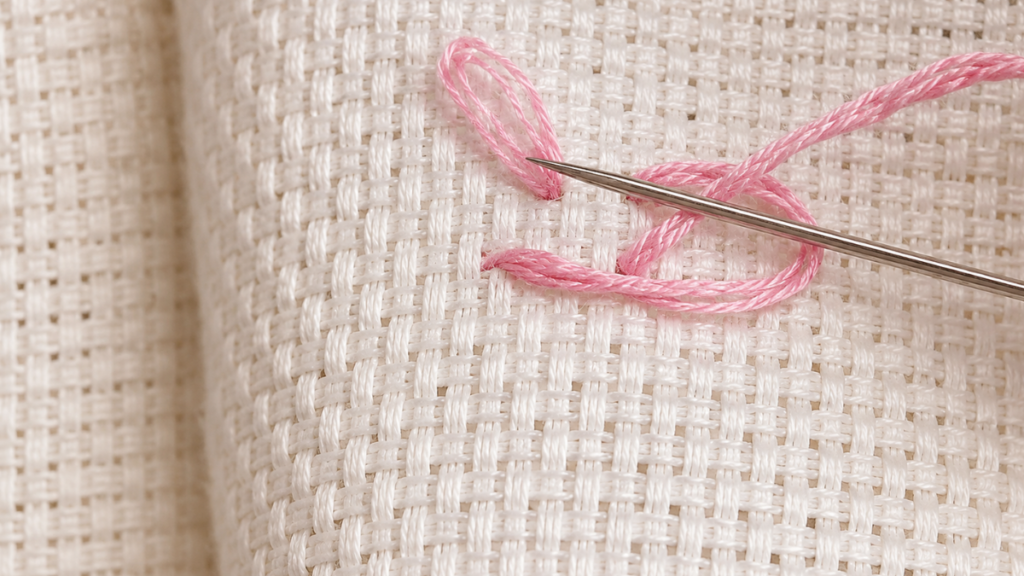
- Cut a strand twice as long as you normally would.
- Fold it in half and thread both ends through the needle, leaving the loop at the opposite end.
- Take the needle down from the front of the fabric through the first hole.
- As you bring the needle back up, pass it through the loop and pull. Done! A clean, secure start.
⚠️ This technique only works when you’re using an even number of strands.
2. The buried thread method
Ideal for more delicate work or metallic threads:
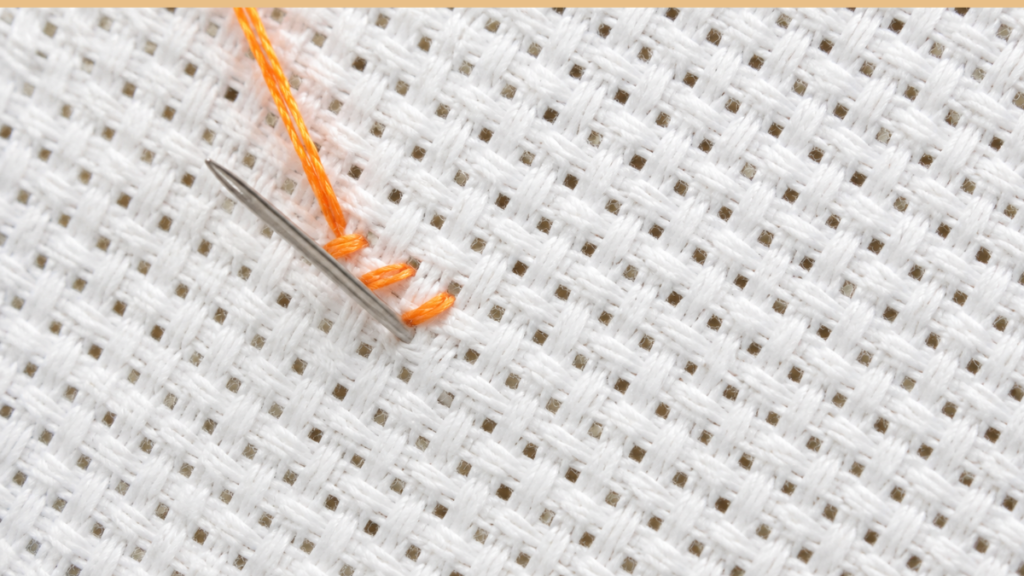
- Thread your needle as usual.
- Make your first stitch, leaving a small tail of thread on the back.
- As you work the next few crosses, make sure you catch that tail with your stitches.
- After three or four crosses the tail is secure, and you can trim it flush.
3. Anchoring with tiny invisible stitches
If your project calls for real precision or you’re working on very fine fabric:
- Take one or two tiny (almost invisible) stitches on the back, right in the area where you’re starting.
- Make sure the thread is held firmly before you begin your crosses.
- With time, you’ll get good at doing this without leaving a trace.
See all the details in the video
Stitching without knots, and without rushing
Deciding to stitch without knots isn’t only a technical choice. It’s a way of telling yourself, “I’m taking the time to do this carefully, with love, with attention”.
Every time I start a piece without knots, I feel like I’m giving myself permission to begin with order and purpose. As if each stitch were a small act of respect toward my own time and my own peace.
The emotional benefits of stitching
Whether you’ve been stitching for years or just discovered this wonderful activity, cross-stitch has something magical about it. These are some of the gifts it has given me:
-Inner connection
When I stitch, everything else fades away. It’s my time of quiet, my active meditation.
– Calm and focus
The repetitive rhythm of the stitches quiets my mind, slows me down, and gives me back my serenity.
– Creativity in bloom
Even when I’m following a chart, there’s always room to play with colors, textures, ideas. It’s like painting with thread.
-Pride and gratitude
Seeing a finished piece, no knots, no rushing, made with real dedication, is a genuine source of confidence.
Extra tips for a perfect start
- Use natural light or a stitching lamp so you can see clearly.
- Choose good-quality fabric to make knotless anchoring easier.
- Start at the center of the design for better symmetry.
- Store your work with care. A beautiful project starts with how you look after it.
how to start your stitching without knots
Thread your needle as usual.
Make your first stitch, leaving a small tail of thread on the back.
As you work the next few crosses, make sure you catch that tail with your stitches.
After three or four crosses, the tail is secure.
Tools:
- needle
- scissors
- hoop
Materials: fabric thread
Conclusion: Start beautifully, continue with love
Starting your cross-stitch without knots is much more than a stitching trick. It’s a conscious decision to do things with care, to look after every detail from the very first stitch.
It’s an invitation to begin well, to enjoy the journey, and to find in every crossing of threads a pause from the world. If you’ve never tried it, I’d encourage you to give it a go on your next project. I promise you’ll notice the difference, not only in the result, but in how you feel while you’re working.
A good way to practice cross-stitch is with fruit, like this apple, or with simple flowers.
How about you?
Have you tried stitching without knots? Do you have a favorite technique?
Leave me your experience in the comments.
If this post inspired or helped you, share it with your stitching friends or on your social media! ✂️✨
If this article helped you and you’d like to say thanks, you can buy me a virtual coffee here.