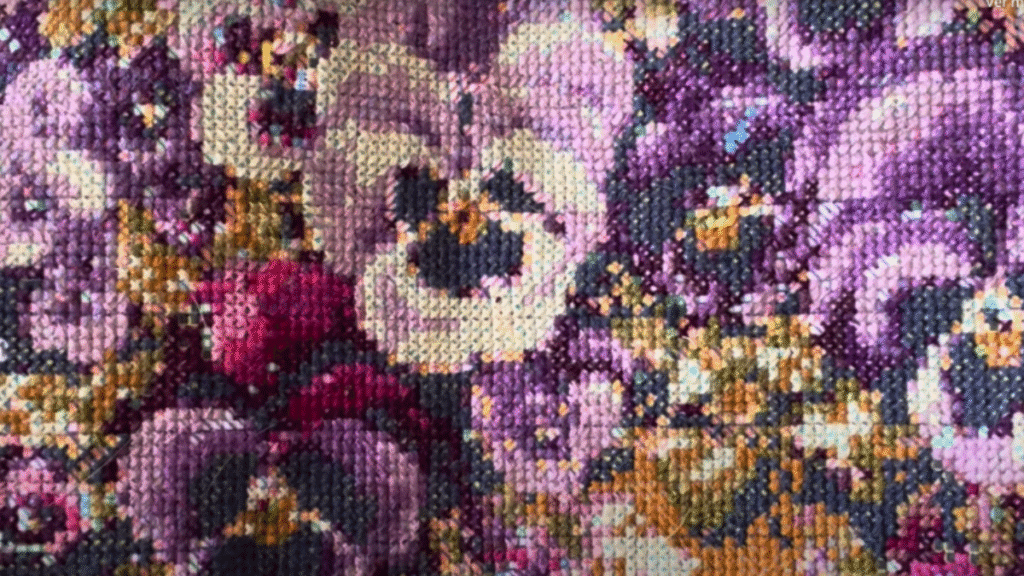
Cross-stitch is one of the oldest and most widespread embroidery techniques in the world, with a history stretching back thousands of years. Its origins turn up across many cultures, from the ancient civilizations of Egypt, China, and Persia to medieval European traditions. The technique involves forming small X-shaped stitches on an evenly woven fabric, which makes it possible to create geometric, floral, and figurative designs with striking detail and color.
Over the centuries, cross-stitch has evolved and adapted to different artistic and cultural styles, becoming both a form of artistic expression and a traditional household craft. In the Middle Ages and the Renaissance, for example, it was used to decorate garments, table linens, and tapestries, carrying religious, social, and family symbols. Today cross-stitch remains a hugely popular craft, blending classic techniques with modern designs and letting people of all ages connect with an ancient tradition while making pieces that are entirely their own.
Cross-stitch is one of the oldest and best-loved embroidery techniques anywhere in the world. Over the centuries it has crossed borders and survived wars, revolutions, and technological upheaval, holding on as a form of artistic expression, a family tradition, and a personal kind of therapy.
In this post, we’re going to dive into the history of cross-stitch across different historical periods, from its humble beginnings to its boom in the digital age.
Antiquity: The First Traces of Embroidery (before the 5th century AD)
No exact starting point can be traced, but traces of embroidery resembling cross-stitch have been found in textiles from several ancient civilizations:
Egypt: Textile fragments from pharaonic tombs show decorative stitching worked on linen, possibly with symbolic or protective intent.
China: During the Han and Tang dynasties (3rd century BC to 9th century AD), sophisticated forms of embroidery were already being practiced, some of them featuring similar grid-based patterns.
The Byzantine Empire: The use of gold thread and symmetrical patterns influenced embroidery across the eastern Mediterranean.
Cross-stitch as such hadn’t taken shape yet, but this embroidery on evenly woven cloth laid the groundwork for its development.
The Middle Ages (5th to 15th centuries): Embroidery as a Cultural Language
During the Middle Ages, embroidery became a tool of visual and symbolic communication, especially in Eastern Europe and Central Asia.
Eastern Europe: in countries like Ukraine, Romania, and Russia, women embroidered protective and folk symbols onto shirts, blankets, and headscarves. Crosses and geometric patterns were starting to look like modern cross-stitch.
The church and the nobility: embroidery served religious and social purposes. In convents, nuns embroidered altar cloths, banners, and liturgical ornaments.
Passed down by women, by word of mouth: the knowledge traveled from mother to daughter, with no printed patterns. Every region and every family had its own motifs.
The Renaissance and Baroque (15th to 17th centuries): The Sampler Is Born
This period marked a crucial shift: embroidery stopped being purely functional or ritual and became art.
The first samplers appear: pieces stitched by young girls to practice alphabets, floral borders, and Bible verses.
Education for girls: embroidery was an essential part of a noble girl’s upbringing. Knowing how to embroider mattered as much as reading or playing music.
Influences from the New World: Indigenous American motifs began appearing in European embroidery through colonial exchange.
Cross-stitch starts to take shape as a standardized technique, particularly in the geometric motifs that suited this style of embroidery on linen so well.
The 18th and 19th Centuries: Industrialization and Democratization
The Industrial Revolution radically changed who had access to embroidery:
The birth of printed patterns
Women’s magazines began publishing cross-stitch charts.
Books of transferable designs appeared, which meant anyone could reproduce a motif without having to inherit it by word of mouth.
Cross-stitch in the Victorian home
In the Victorian era, decorative embroidery turned up on pillows, framed pieces, and table linens.
It came to be associated with feminine virtues such as patience, devotion, and domestic dedication.
The World Wars (1914–1945): Embroidery as Refuge and Patriotism
World War I
Women embroidered to raise funds or to send messages to soldiers.
Some made “war samplers” recording names and dates.
–World War II
Under rationing, embroidery became a source of distraction and comfort.
In camps and shelters, women embroidered in secret as a form of psychological resistance.
They stitched handkerchiefs, hidden messages, and symbols of hope.
The Postwar Years and the Cross-Stitch Boom (1945–1990)
After World War II, cross-stitch entered its golden age:
The 1950s and 60s: magazines, kits, and patterns flooded the European and American markets.
The 1970s and 80s: an explosion of popularity thanks to brands like DMC, Anchor, and Bucilla.
Stitched phrases like “Home Sweet Home” became a fixture of home decor.
It became part of movements around women’s identity and alternative artistic expression.
The Digital Age (1990 to today): A Virtual Revival
Today cross-stitch is enjoying a new boom, thanks to the internet and social media:
Digital influence
Platforms like Pinterest, Etsy, and Instagram showcase thousands of custom designs.
Programs like Pattern Keeper and Stitch Fiddle let you create your own digital patterns.
Plenty of contemporary artists use it to push back against stereotypes about “women’s art.”
Online communities
Forums along with Facebook and Discord groups let stitchers share progress, ask questions, and promote the craft online.
Conclusion: An Art That Threads Together History and Emotion
Cross-stitch isn’t only an embroidery technique. It’s a mirror of human history: of our conflicts, our creativity, our resilience, and our need for beauty.
From pharaonic tombs to stitched memes, this art form is still alive thanks to generations of hands that chose to preserve it, transform it, and pass it on.