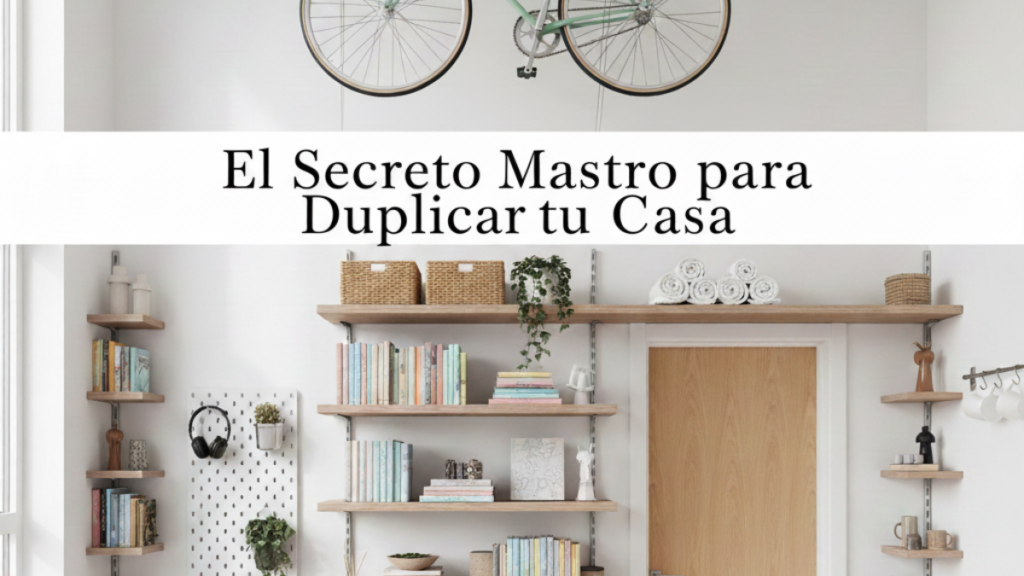
Learn how to make the most of every inch of your walls with this master guide to vertical storage. Discover foolproof tricks for gaining space in a small apartment, almost like magic, and with style.
People sometimes ask me why I get so excited talking about shelving or wall hooks. The answer is simple: order gives you mental freedom. Once you stop fighting with your home, you start enjoying it. In a 300, 400, or 500 square foot apartment, the only logical direction to grow is up.
If your stuff feels overwhelming, if your home feels like it’s closing in on you, get ready. We’re going to break the conventional rules and discover how all that air doing nothing right now is about to become your salvation. It isn’t magic, it’s strategy, and I promise that after reading this you’ll look at your walls with a wild urge to start drilling (with your landlord’s permission, of course).
The philosophy of vertical thinking: rewire your brain
The first thing I want you to do is an exercise with me. Stand in the middle of your living room or your bedroom right now and forget that furniture exists. Look at the walls from floor to ceiling. See all that empty space? It’s like an undeveloped lot in the middle of the city.
As humans, we tend to put things at eye level or within arm’s reach. That’s why most furniture stands somewhere between 30 inches and six feet tall. What about those last 16 to 24 inches up to the ceiling, though? That’s where the real treasure of a small apartment is hiding.
Making the most of vertical storage isn’t just about putting up shelves. It’s a way of understanding the architecture of your life. It’s deciding which things you need within reach and which ones can live up high, waiting for their moment to shine. Ultimately, it’s letting the floor breathe so you can breathe too.
Shelves that touch the sky: the power of continuity
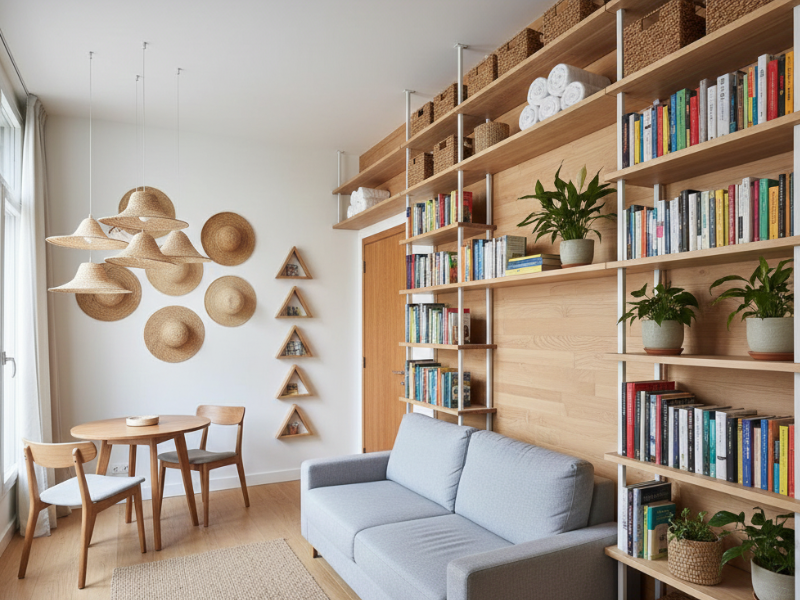
One of the best investments I’ve ever made was swapping my standard shelves from a certain Swedish store for ones that literally reached the ceiling. There’s something almost psychological about it. When a bookcase stops halfway up, your eye cuts the wall in two and the space looks smaller and more fragmented.
Floor to ceiling shelving
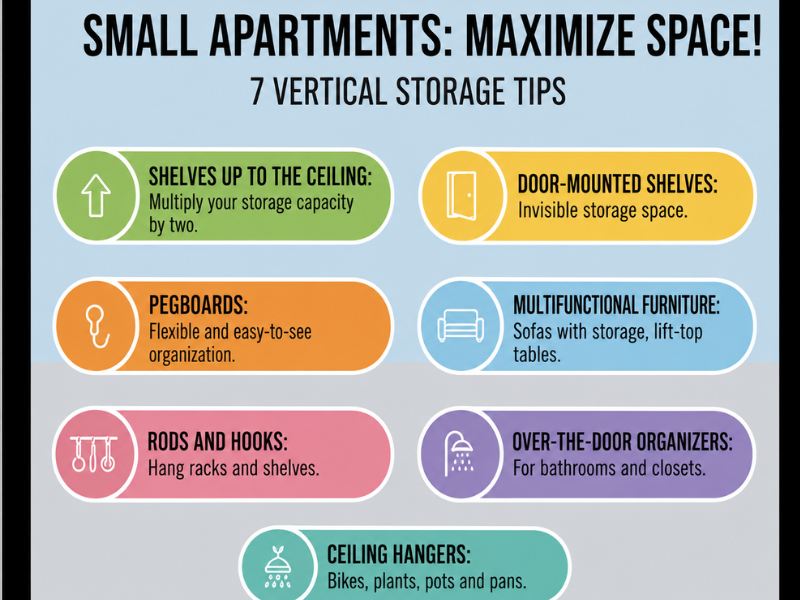
When you install shelves that cover the entire wall vertically, a visual miracle happens. Vertical lines draw your gaze upward, which tricks your brain into thinking the ceiling is higher than it really is. Your storage capacity multiplies dramatically too.
On the top shelves you can stash everything you use once a year: off-season clothes, holiday decorations, paperwork from five years ago, or that camping gear you love that eats up half a closet. If you use pretty, matching boxes in the same color as the wall, the effect is total order, almost as if the vertical storage were part of the home’s architecture.
Floating shelves: light and functional
If you don’t want to fill a whole wall with a heavy structure, floating shelves are your best friends. They’re perfect for those dead corners where no conventional piece of furniture fits. Think of that twelve-inch gap between the window and the corner.
What I love about floating shelves is that they have no visible brackets crowding the view. They feel wonderfully light. You can arrange them in a staircase pattern, asymmetrically, or in long lines that run the length of a room. Picture a single shelf running the entire perimeter of the living room about a foot below the ceiling. It’s the perfect spot for all your books without stealing space from a sofa or a walkway.
The space above the door: a hidden treasure
This is easily my favorite trick, and the one that surprises my friends most when they come over. If you look closely, almost every door in a standard home has 12 to 16 inches of empty space above it. It’s dead space. Nobody looks at it, nobody uses it. Until today!
Installing a simple shelf above the door frame is a stroke of genius. In the bathroom, for instance, it’s the ideal place for backup toilet paper or rolled clean towels. In the bedroom, it can hold memory boxes or off-season shoes.
The best part about this kind of vertical storage is that it’s practically invisible. When you walk into a room, you don’t usually look back and up, so you can keep a ton of things stashed there without affecting how open the room feels. It’s like having a secret storage unit in every room.
Pegboards: versatility turned into furniture
If you haven’t discovered pegboards yet, get ready to fall in love. They come from the world of workshops and tools, but they’ve made their way into interior design with astonishing elegance.
What makes these boards magical is their flexibility. You get a surface full of little holes where you can add hooks, small shelves, clips, or containers. Best of all, you can change the configuration whenever you want.
In the home office
If you work from home in a corner of the living room, a pegboard on the wall in front of you keeps every pen, notebook, headset, and cable perfectly organized without taking up a single inch of your desk. The desk stays clear so you can actually work, and everything you need floats right in front of you, within arm’s reach.
In the kitchen or entryway
In the kitchen, a pegboard lets you hang pans, ladles, spices, and even paper towels. In the entryway, it’s the ultimate organizer for keys, leashes, sunglasses, and hats. It’s a solution that takes up barely any depth (an inch or so), yet it solves the chaos of a thousand small objects that usually end up rolling around in drawers or on countertops.
The kitchen, where every vertical inch counts double
If your kitchen is so small you have to step out of it to change your mind, this section is going to save your life. We usually make the mistake of filling the counter with things: the coffee maker, the toaster, the knife block, the utensil crock. Wrong! The counter is for working, not for storing. Let’s move it all up.
The revolt of the cabinet undersides
Have you ever really looked at the underside of your upper kitchen cabinets? There’s a lovely pocket of air down there that usually goes completely to waste. You can get metal racks that slide onto the shelf and let you hang mugs by the handle. Suddenly you have ten mugs floating and you’ve freed up half a shelf inside the cabinet.
Don’t stop there, though. There are also racks for hanging wine glasses by the stem, or paper towel holders that clip right underneath. Anything hanging is space you gain on your work surface. The feeling of freedom is incredible when you finally have room to chop an onion without knocking over the salt shaker.
Magnetic strips: way more than knives
You’ve surely seen the classic magnetic strips for chef’s knives. They’re great, but did you know you can use them for a thousand other things? I have a small magnetic strip on the side of the fridge for spices. I bought little metal tins, added a cute label, and there they all are, organized vertically. They take up zero space and I can see them while I cook.
You can even use these strips to hold the lids of glass jars under a shelf. Stick on the strip, and your jars of nuts or pasta hang below it. It looks really cool and you’re using an area that would otherwise be nothing but air.
The inside of doors: your secret pantry
Open your pantry door or any kitchen cabinet and you’ll see a flat, wonderful surface that’s begging to be used. Stores sell very slim wire racks that stick or screw onto the inside.
That’s where I keep my food container lids (which are always rolling around loose), aluminum foil, plastic wrap, even cutting boards. Close the door and it all disappears from view, perfectly organized and easy to grab. It’s a smart way to use the depth of the cabinet with a vertical storage system.
The bathroom, or how to work magic in 20 square feet
The bathroom tends to be the forgotten room in decorating, but in a small apartment it’s where the clutter shows most. Between shampoo bottles, lotions, the hair dryer, and the towels, it can start to look like a jungle. Don’t worry, we’re going to tackle it.
The area above the toilet: prime vertical storage real estate
Plenty of people leave the wall above the toilet completely bare or, at most, hang a picture there. What a waste! That spot is perfect for a ladder shelf or a few pretty wooden shelves.
You can keep rolled clean towels there (they take up less room and look like a luxury hotel), woven baskets with toilet paper, or your daily beauty products. Using baskets cuts the visual noise of a thousand differently colored bottles, so the bathroom feels much more zen and orderly.
Shoe organizers for the shower and the door
I haven’t lost my mind. Those fabric or clear plastic shoe organizers that hang over a door are the invention of the century for small bathrooms. I have one behind my bathroom door and I put everything in it: the hair dryer, the flat iron, backup body wash, the first aid kit.
If you have a small shower, look for the waterproof mesh versions. You can hang them from the curtain rod or the shower door, facing in, and keep all your shampoo bottles and loofahs stored vertically. That way you don’t have to bend over or pile everything in the corners of the shower pan, where it always ends up growing mildew.
Mirrors with a secret
If you’re going to replace the bathroom mirror, please look for one that doubles as a cabinet. Modern versions are super slim and barely stick out from the wall, yet they hold all those little bottles of perfume, medicine, or lotion that usually clutter things up. Keeping the sink area clear completely changes the energy you carry into your morning routine.
Bedrooms that feel like clouds
In the bedroom, the goal is a relaxed atmosphere. If there are a thousand boxes on the floor, your brain never switches off. That’s why vertical storage in here has to be discreet but powerful.
The headboard as command center
If you don’t have room for nightstands, don’t force them in. A headboard with side shelves, or a single shelf running along the wall above the bed, does the same job in half the footprint. You can mount a reading light on the wall or on the shelf itself, freeing up room for your current book and a glass of water.
Some especially clever people install bridge shelving that wraps around the bed. It’s a fantastic way to get an enormous library without losing a single square foot of the room. Sleeping surrounded by your favorite books is one of the coziest feelings there is.
Wall hooks and hanging rods
If your closet is tiny (welcome to the club), put your walls to work. A simple metal rod hung from the ceiling or the wall is great for laying out tomorrow’s outfit, or for hanging the prettier pieces that practically double as decor.
I use individual hooks a lot for bags and hats. Instead of having them piled up and losing their shape at the back of the closet, I keep them on the wall in a little arrangement. It’s practical and it gives the room personality.
In a small apartment, the bedroom usually becomes the “storage unit” for everything we don’t want guests to see. That ends now. If you want to sleep well, you need the air to flow.
The closet that grows inward and upward
If you have a built-in closet, chances are it has one rod and a top shelf that’s hard to reach. Here are three tricks to double its capacity:
- Double rod: Install a second rod at mid-height for pants and skirts. You’re using the gap that sits below your shirts.
- Vacuum bags on the top shelf: Anything that isn’t in season belongs at the highest point, compressed as much as possible.
- Hanging fabric organizers: They’re great for shoes or folded sweaters, taking advantage of the closet’s height with no carpentry required.
Beds with “superpowers”
If you’re still choosing a bed, a storage bed with built-in drawers is non-negotiable. If you already have a bed on legs, don’t get rid of it. Stores sell bed risers that lift the frame 4 to 6 inches, just enough for storage bins that wouldn’t fit before. That’s 20 square feet of space that was practically begging to be used.
Hallways and corners, the art of the narrow
We sometimes think hallways exist only for walking, but in a small apartment a hallway is a luxury you need to monetize. The same goes for corners. How many corners do you have at home right now that only collect dust bunnies? Let’s give them a real job.
Hallways that are more than a path
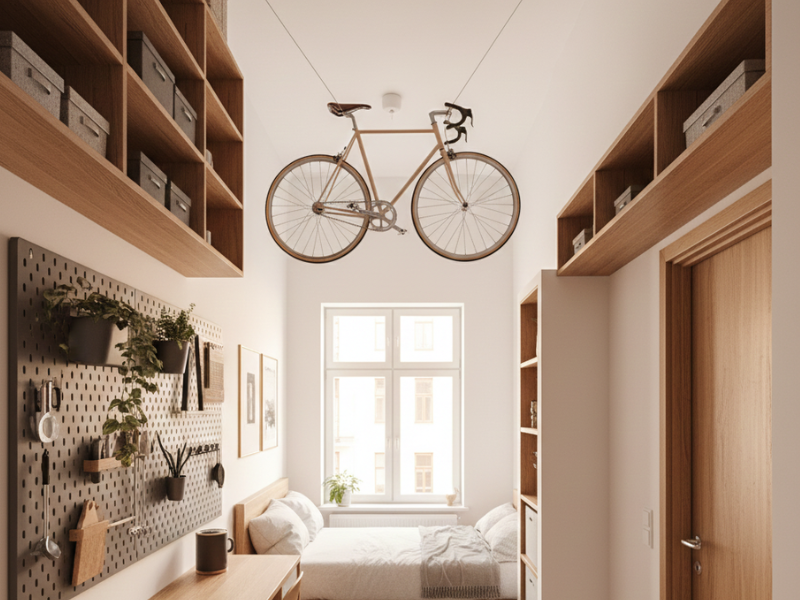
If your hallway is at least three feet wide, you can afford to put something there. I’m not talking about a huge cabinet, but about super narrow shelving, the kind that’s only 6 to 8 inches deep. It’s perfect for books, for movies, or even for creating a little photo gallery with picture ledges.
Another hallway idea I love is installing a row of pretty hooks at mid-height. Done tastefully, you can hang the coats you wear most, your bag, or even the folding chairs you pull out when guests come over. Since everything stays in a line against the wall, it doesn’t block the path, and you free up a huge amount of room inside the bedroom closets.
Corners used down to the inch
Corners tend to be black holes of space. There are corner units out there that work beautifully, though. In the living room, a top-to-bottom corner shelf can house your entire plant collection, creating a gorgeous green column that takes up no usable space.
In the bedroom, a small corner shelf can replace a nightstand if space is truly critical. In the entryway, a corner coat rack lets you use that dead angle for umbrellas and jackets. The idea is to soften the angles of your home and make them work for you.
The ceiling, the final frontier of vertical storage
I know what you’re thinking: hang things from the ceiling? Won’t that look weird? I promise that, done with style, it looks incredible and it’s the definitive solution for bulky objects.
Ceiling hoists for bikes and more
If you’re someone who bikes around the city but hates having it in the way by the front door, ceiling hooks or pulley systems are your salvation. You hoist the bike up, it sits flush against the ceiling, and the floor is completely clear. It’s a piece of home engineering that makes you feel like you live in a New York loft.
In the kitchen, if you have high ceilings, a hanging pot rack over an island or a table isn’t just practical. It gives the room a professional-kitchen feel that I love. Just make sure the anchors are strong, because we don’t want any accidents!
The hanging garden
This isn’t storage exactly, but if you love plants and have nowhere to put them without losing table space, hang them. Use macramé planters or metal hangers that drop from the ceiling. Freeing up your surfaces makes the whole place look visually cleaner while you keep enjoying your personal jungle.
How to keep all this vertical storage from overwhelming you
This is the most important part. We don’t want your home looking like a warehouse or an overstuffed furniture showroom. We want a home. The secret to making vertical storage work is visual balance.
The color and uniformity trick
If you’re putting up a lot of shelves or boxes up high, try to match them to the wall color. If your wall is white and you add white shelves with white boxes, the whole thing blends into the structure of the home and disappears from view. That’s what I call invisible vertical storage.
If instead you want it to be a decorative feature, use natural materials like wood or metal, but keep things strictly tidy. Clutter up high is far more overwhelming than clutter at floor level, so use baskets and boxes to hide the chaos of small objects.
Less is more, even in vertical storage
Don’t saturate every wall. Leave empty spaces so the eye can rest. The key to a successful small apartment is the contrast between heavily used zones and completely clear ones. That alternation is what creates the sense of openness and of everything being under control.
Working from home in miniature: the vertical office
These days, just about everyone needs a corner for the computer. In 400 square feet, though, fitting in an office desk sounds like an impossible dream. Grab a notebook, because here comes my favorite solution.
Wall-mounted desks (or how to work on air)
Forget four-legged tables that swallow half the living room. The answer is a fold-down desk or a desk shelf. They anchor to the wall, and when you finish working you fold them up, or they simply blend in without stealing visual space from the floor.
Pair it with shelving above and you have your entire office in less than three feet of wall. It’s also a way to separate work from personal life: when the desk closes, the workday is over. That peace of mind is priceless.
Turn the inside of a closet into an office
Do you have a spare closet (we should all be so lucky, right?) or a nook between two columns? You can create a “cloffice” (closet plus office). Take the closet doors off, install a deep shelf as a desktop and a few higher ones for books. The result is a built-in office that never invades your living room.
The entryway, where first impressions count
The entryway is usually a narrow hall where we walk in with a coat, keys, and a bag. If you’re not careful, it turns into the dumping ground of the whole house the second you cross the threshold.
Ultra-slim shoe cabinets: your best allies
There are wall-mounted shoe cabinets barely six inches deep. They’re wonderful because you can put them behind a door or in the narrowest hallway in the world. Above that cabinet, add a pretty tray for keys and a mirror. Now you have a functional entryway that doesn’t block the path.
Hooks at different heights
If you have kids, or simply a lot of accessories, put hooks at different levels. Coats up high, bags at mid-height, dog leashes or backpacks down low. You’re using the wall’s full verticality and keeping everything from piling onto one rack that ends up looking like a mountain of clothes.
The aesthetics of order (so it doesn’t look like a warehouse)
After all this talk of shelves, hooks, and boxes, it’s worth remembering that your home isn’t a hardware store. To keep all this vertical storage pleasant to look at, follow these three golden rules:
- The 70/30 rule: don’t fill shelves to the brim. Leave 30% of the space empty or occupied by something purely decorative (a plant, a photo). The air between objects is what creates a sense of luxury and ease.
- Repeat your materials: If you use wooden crates, make them all the same wood. If you use woven baskets, keep the same weave. Visual uniformity calms the brain and makes the space feel bigger.
- Strategic lighting: Add a light source to your vertical storage zones. An LED strip under a shelf or a spotlight aimed at a tall bookcase eliminates the dark shadows that tend to make small apartments feel like caves.
The finishing touch: your home, your rules
Living in a small apartment is a master class in self-knowledge. It forces you to decide what matters and what doesn’t. Making the most of vertical storage is really a way of prioritizing yourself, of giving yourself room to move and to think.
I hope this guide leaves you buzzing with the urge to change everything. It doesn’t have to happen tomorrow. Start with one shelf, just one, then notice how differently that room feels when you walk in.
Frequently asked questions about vertical storage in small apartments
What if I rent and can’t drill into the walls?
This is the million dollar question. Don’t despair, there are solutions. Tension rods that run from floor to ceiling let you add shelves or hooks without making a single hole. There are also heavy-duty adhesive strips that hold a fair amount of weight, ideal for hanging art or very light shelves in the bathroom. You can always go with tall pieces that rest on the floor while still using the vertical space, like ladder shelving.
Doesn’t a lot of dust collect up high?
Being honest with you: yes, dust gets everywhere. My advice is to store things in closed boxes in the highest zones. That way you only have to run a duster over the box now and then, and everything inside stays spotless. Avoid leaving small loose objects way up high unless you want to spend your life on a step stool cleaning.
Doesn’t having so much on the walls feel claustrophobic?
Only if you do it without a plan. If you fill every wall to the ceiling, yes, you’ll feel boxed in. The trick is to choose one feature wall per room for vertical storage and keep the others lighter. Using light colors and keeping things visually organized also removes that stifling feeling.
How do I know if my wall will hold a bookcase full of books?
Knowing what your walls are made of is essential. With drywall, you need special anchors, and you can’t load excessive weight without finding the studs behind it. With masonry, you have far more freedom. When in doubt, ask at your local hardware store, where they usually know a ton, and never exceed the weight the shelf manufacturer recommends.
Is it expensive to make all these changes?
Not at all. Most of the ideas I’ve shared, like the kitchen rails, the hooks, or basic shelves, are very affordable. What they require is more time and ingenuity than money. You can go slowly, a shelf this month, a pegboard the next. The investment pays for itself with the peace of mind vertical storage gives you.
Is it better to leave shelving open or close it off with doors?
It depends on how tidy you are. If you’re very meticulous, open shelving feels more spacious. If you tend to accumulate things in assorted colors and shapes, go with doors (ideally in the same color as the wall) to hide the “visual noise.”
How do I clean shelves that are close to the ceiling?
Use an extendable duster. You don’t need to climb a ladder every week. As I mentioned earlier, store anything very high up in closed boxes, so the object itself never gets dirty, only the box.
Which plants work best on high shelves?
Trailing plants are the queens here. Pothos and Ceropegia woodii (string of hearts) are perfect because they grow downward, emphasizing the verticality and giving the upper reaches a fresh, living touch.
Can I install vertical storage on drywall?
Yes, but be smart about it. Always use anchors made for drywall (the toggle type), and avoid excessive weight like encyclopedias. For light things like clothes, towels, or decor, this kind of vertical storage won’t give you any trouble.
Well, friend, we’ve reached the end of this mega guide to vertical storage. I truly hope these tips help you see your home with fresh eyes, so that every time you look at an empty wall you see an opportunity instead of a limit.
Your home is your refuge, the place where you recharge to take on the world, and you deserve for it to feel freeing rather than cramped. You’ll see that as soon as you make the first change, that energy takes hold and you won’t want to stop until every corner of your place feels right.
What did you think of this whole vertical storage adventure? Was there a trick that left you speechless, or one you’re already itching to try today? I’d love for you to tell me down in the comments. It makes me so happy to know these ideas are coming to life in your homes. Go ahead and comment, let’s share more tricks with each other!
Are you starting with that gap above the door, or would you rather dive into the hallway shelving? Tell me everything!