A step-by-step guide to creating a warm, cozy bedroom. Real, simple, no-nonsense ideas to build the retreat you need to truly unwind and rest.
Have you ever walked into a room and, without quite knowing why, felt an irresistible urge to just flop onto the bed and stay there for hours? For me, the opposite used to happen until not that long ago.
I’d open my bedroom door and feel like it was more of a hallway than a haven. A place where clean laundry piled up on a chair for days, where my laptop sat on the nightstand reminding me of everything I still had to do, and where the overhead light made me feel like I was in an interrogation room.
If you’re also chasing that feeling of home and refuge in your own bedroom, you’re in the right place. I’m going to share everything I’ve learned, researched, and put into practice in my own home to transform a cold, soulless bedroom into a true oasis of peace.
The images in this post were generated for illustrative purposes
This post contains affiliate links; see the disclosure for details
The psychology of space and why your body is begging for a change
We live in a world that moves at a hundred miles an hour. Between work, screens, constant notifications, and the daily grind, by nighttime our brains are asking for just one thing: a break. Your bedroom should be the temple of that break.
Yet we often neglect this space because we figure that since we’re only going to sleep there with our eyes closed, it doesn’t matter how it’s decorated.
Big mistake. The environment where you spend your resting hours directly affects how you feel when you wake up, and it may even impact your health.
Visual stress and how it affects us without us realizing
When your room is a chaotic, cluttered, or visually cold space, your mind keeps processing stimuli even as you try to relax. The human brain is wired to scan its surroundings for information.
If you have stuff lying around, clashing colors that don’t go together, or piles of objects without a designated home, your brain reads all of that as unfinished tasks or noise.
On the flip side, when you walk into a room designed for winding down, where the tones are gentle, the textiles invite you to touch them, and the lighting is soft, your body automatically understands that it’s time to let go.
That’s what experts call sleep hygiene, and it starts long before you get under the covers. It starts the moment you set foot in the bedroom.
The human need to build a nest
Over the years I’ve come to understand that creating a cozy space isn’t about following the latest trends in design magazines, or buying crazy expensive furniture you’re then afraid to use because it might get scratched. It’s about listening to what your body and mind need in order to feel safe.
Since the beginning of time, humans have sought out sheltered, secure places to sleep. We want to feel protected. That’s why rooms that are too large, too empty, or have super-high ceilings can sometimes feel cold.
We need to create the feeling of a nest. You achieve that by paying attention to the small details, playing with proportions, materials, and light.
The first step: declutter before you decorate
Before we start talking about colors, throw pillows, or gorgeous lamps, we need to do the dirty work. Speaking from experience, there’s no point in buying the softest duvet cover on the market if you’re going to put it on a bed surrounded by chaos.
For a bedroom to feel cozy and inviting, it needs to breathe. For it to breathe, you have to get rid of everything that doesn’t belong.
My stress-free method for clearing out the excess
I used to be the kind of person who kept everything just in case. The ticket stub from that concert, the face cream that doesn’t work for me but I feel bad throwing away, the sweater that’s itchy but was a gift. Until I realized all those things were stealing my mental space.
Here’s what I suggest: pick a day when you have some energy and put on some good music. Grab a couple of big bags and bring them to your room. Start with the visible surfaces, like nightstands, the top of the dresser, that chair you’ve been using as a makeshift clothes rack.
Pick up each item and ask yourself whether it really needs to be in your bedroom. The bedroom is for sleeping, getting dressed, and being intimate. Anything that doesn’t serve one of those three purposes goes somewhere else.
Work papers, bills, exercise equipment you’ve been using as a coat hanger, books you’ve already read that are just collecting dust. Get it all out of there. I’m not saying throw it away, but move it to another part of the house where it actually makes sense.
The clean surfaces rule and its calming effect
Once you’ve removed what doesn’t belong in the bedroom, we’re going to apply the clean surfaces rule. It means keeping only what’s necessary and decorative out in the open.
On your nightstand, for example, there should only be a lamp, the book you’re currently reading, maybe a glass of water, and not much else. If you need hand cream, earplugs, or a charger, tuck them inside a drawer.
The effect of walking into a room and seeing clear surfaces is an immense relief. It’s as if there’s suddenly more air. That visual cleanliness is the foundation we’re going to build all the warmth of your new retreat on. Without this step, any decorating effort will get lost in the clutter.
The power of a color palette: how to choose tones that radiate calm
If I had to pick a single factor that makes the difference between a room that welcomes you and one that pushes you away, it would be color, hands down. Colors have a direct impact on our nervous system.
If your walls are a bright, stark white, the kind that bounces light like fresh snow, chances are the space feels closer to a clinic than a place of rest.
Warm neutrals as your base
To achieve that enveloping, welcoming atmosphere we’re talking about, the move is to go with a color palette that speaks of earth, nature, and calm. Think sand tones, linen, soft beiges, very light tans, or even warm grays if you prefer a slightly more restrained vibe.
Let me tell you what I did. For years I had my room painted pure white because I thought it would make it brighter. Sure, it was bright, but it was a cold brightness that didn’t make me want to stay.
When I finally decided to paint the walls a very soft sand tone with a hint of warmth, I noticed the difference that same afternoon. The sunlight stopped bouncing off the walls harshly and became diffused and gentle instead.
These stone or sand colors have the ability to pull a space in. They make the walls feel like they’re drawing a little closer, instead of just standing there marking off square footage. Plus, they’re the perfect canvas because they go with absolutely everything.
How to add pops of color without breaking the restful mood
Having a neutral base for your room doesn’t mean you have to live in a boring, personality-free space. Quite the opposite: a neutral base gives you room to play. I love swapping little things around, trying new combinations, and adapting the room to the season, and that’s only possible when you have a neutral backdrop.
The key to keeping color from overwhelming the eye is choosing tones that still convey calm, what I call dusty or washed-out colors. A sage green, a muted terracotta that calls to mind clay, a grayish blue, or a toasty mustard all work beautifully.
Introduce these colors in small doses. If the walls, the wardrobe, and the bed frame are all neutral, use that sage green in a few throw pillows, in a blanket draped at the foot of the bed, in the mat of a framed print, or in a ceramic vase on the dresser.
This way, you bring depth and character to the room without overwhelming it. If two years from now you’re over the green, all you have to do is swap out the pillow covers and you’ll have a completely new room for very little money.

Textiles: the invisible key to turning a cold, soulless room into a sanctuary
Now that we’ve cleared the space and chosen a calm color palette, the next step is, for me, the most fun part and the one that changes how a room feels the most.
You can have the prettiest, priciest furniture from the store, but if the textiles miss the mark, the room will always feel like a lifeless catalog page. Fabrics are what bring texture, warmth, and that plush, snuggly feeling we’re all after when we picture a retreat.
The art of layering the bed for maximum comfort
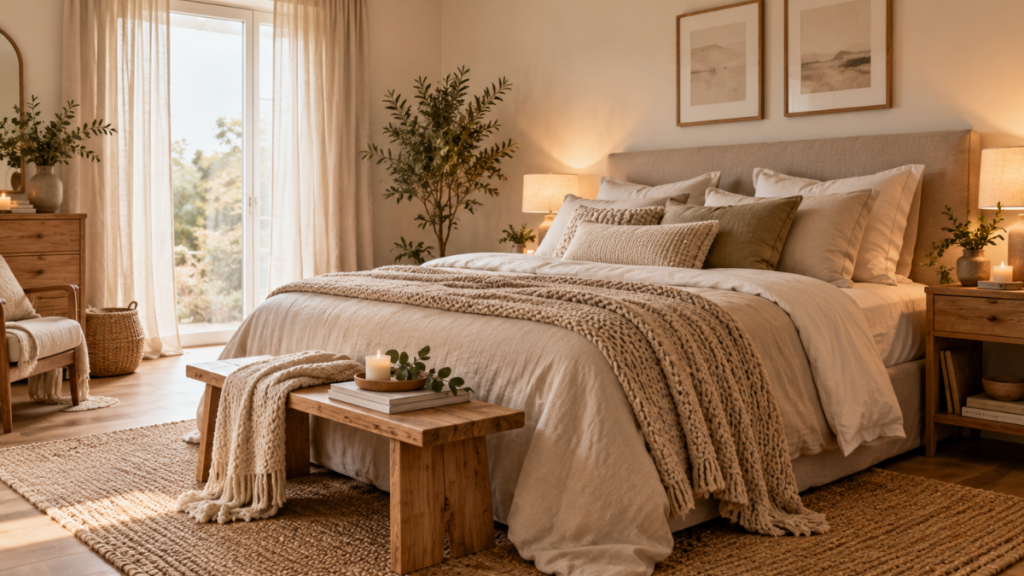
One of the best decisions I made a while back was to stop seeing the bed as just a mattress with a stretched-out sheet and a flat duvet cover. To get that inviting, sink-right-in look that calls your name when you’re tired, the secret lies in the art of layering. It’s not about piling things on for the sake of it; it’s about building volume.
Start with great sheets. I’ve tried plenty of options, and in the end, the quality of the fabric touching your skin changes everything. Washed linen is a fantastic choice because it breathes beautifully, feels cool in the heat, keeps you warm when the temperature drops, and has a natural crinkled texture that removes any trace of stiffness from the room.
If you prefer cotton because you like a smoother feel, look for a high-quality one, ideally percale or sateen cotton.
Next comes the comforter or the duvet cover. It’s the centerpiece and the most visible element. Go for fills that are lightweight but fluffy, the kind that give you a cloud-like feel. I usually use solid-color covers that match the sand or earth palette I mentioned earlier.
Here’s where the finishing touch comes in: throws and blankets. Place a chunky knit throw, a soft wool blanket, or something with a lot of texture at the foot of the bed. Don’t fold it perfectly like they do in a store; let it drape a little casually.
This isn’t just for when it gets chilly at midnight. It also visually breaks up the monotony of the duvet cover and adds an extra layer that makes the bed look so much more inviting.
Throw pillows: the sweet spot between style and everyday comfort
Throw pillows always spark debate. Some people pile on so many they don’t know where to put them at night, while others skip them entirely and the bed ends up looking bare. I’ve found a middle ground that works really well for me and doesn’t feel like a chore at bedtime.
A pair of large euro shams propped against the headboard for height, your regular sleeping pillows in front of those, and one smaller rectangular pillow at the very front is more than enough. The trick is mixing textures.
If your duvet cover is plain linen, add pillows with a subtle pattern, or ones in cotton velvet, or a fine wool. That contrast of materials is what enriches the decor without needing any bold colors.
Rugs that transform the way you step and anchor the space
Stepping onto a cold floor first thing in the morning or right before climbing into bed is a feeling that instantly kills any trace of relaxation. Placing a good rug completely changes the room’s acoustics, absorbs noise, and brings an enormous amount of warmth.
You have two main options. You can place a large rug that tucks under the bed and extends out on the sides and foot, or you can set two runner rugs, one on each side of the bed.
If you like natural materials, jute or sisal are beautiful and give the room a very laid-back feel, though they’re not the softest underfoot. If pure barefoot comfort is what you’re after, a short-pile wool or washable cotton rug in neutral tones will be your best friend.
When your brain registers that the floor is soft and warm, your entire body relaxes just a little bit more.
Curtains that filter light and soften the windows
Leaving windows bare or relying only on a half-lowered shade makes any room feel unfinished. Curtains aren’t just about keeping neighbors from seeing in; they’re a top-tier decorating element that softens the hard lines of the walls.
I’d recommend staying away from heavy, dark fabrics that make the space feel smaller. Dress your windows with lightweight curtains that fall all the way to the floor. I actually like it when they puddle an inch or two for a more relaxed look.
A linen-cotton blend drapes with the perfect weight, creating gentle waves that soften the entire atmosphere. These fabrics let natural light through during the day while filtering it just enough so the sun doesn’t come in too harshly.
Ambient lighting: the best-kept secret for calming the mind
If there’s one common mistake almost all of us make at first, it’s relying on a single light fixture stuck in the center of the ceiling. That overhead light, direct and evenly illuminating the entire room, is the number one enemy of rest.
Picture yourself at a spa or a massage place. You’ll never see a powerful spotlight pointing straight down from above.
For a bedroom to feel truly cozy, the lighting has to be indirect, very warm, and spread across several strategic spots.
Ditching the interrogation-room ceiling light
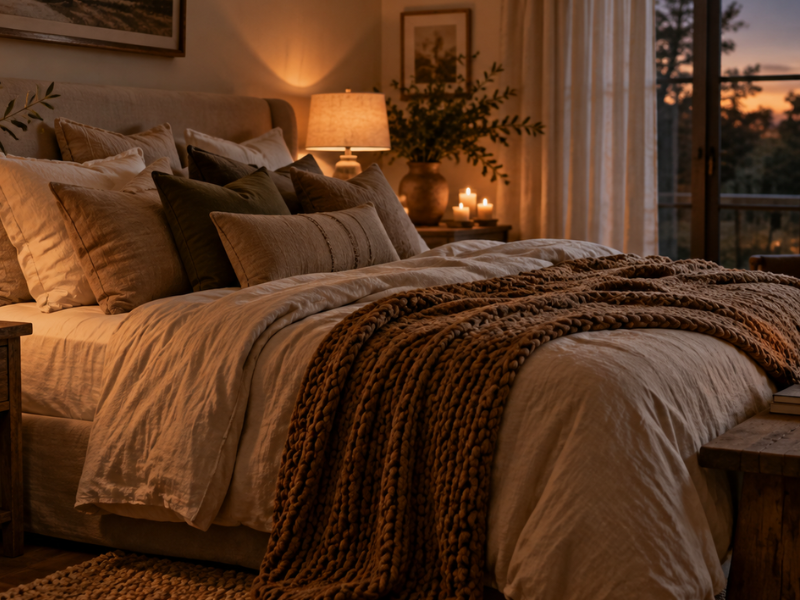
I used to have a beautiful ceiling fixture, but I’d put in a bright white bulb so I could see well while getting dressed. The result? If I turned it on at night, I was wide awake instantly. Cool, powerful light suppresses melatonin production, which is the hormone that helps us fall asleep.
The first step is to swap out every bulb in your room. Look for bulbs labeled warm light; check the box for 2700 Kelvin or lower. That’s the color temperature that mimics the light of a sunset or a fireplace, warm orange tones that tell your brain the day is over.
The three-point soft lighting rule
When you’re designing or rethinking the lighting in your room, try to create small pockets of light instead of lighting the entire room all at once.
Your main level will be your nightstands. Lamps with a fabric shade, or made of opal glass, diffuse the light beautifully. If you don’t have space on the nightstand, wall-mounted sconces installed on either side of the headboard are a super practical solution that looks incredibly clean.
The second point can be a small floor lamp in a corner, or a low-profile lamp on the dresser. The third point, the most atmospheric one, can be candles. Lighting a candle for a while before getting into bed is a wonderful ritual.
The soft flicker of the flame relaxes your eyes, and if it has a gentle, natural scent like lavender or cotton blossom, it helps you disconnect from the entire day’s hustle. If you’re worried about falling asleep with a real candle burning, there are LED candles that mimic the flickering effect and look surprisingly convincing.
Natural materials that ground you in calm
There’s something deeply instinctive in us that makes us feel good when we’re surrounded by natural elements. Plastics, excessive shine, and overly synthetic furniture might be practical, but they don’t stir any emotion.
Wood, clay, linen, or wicker, on the other hand, bring an organic texture that comforts us on a subconscious level.
Wood as an endless source of warmth
If your bedroom feels cold, take a look at how much visible wood you have. Introducing touches of natural wood completely changes the visual temperature of the space. You don’t need to replace all your furniture; sometimes all it takes is a bench at the foot of the bed with oak legs, a floor-length mirror with a wooden frame leaned against the wall, or a simple headboard.
Personally, I stay away from very dark or high-gloss lacquered woods because they harden the space. Medium- or light-toned woods with matte finishes, where you can feel the grain when you run your hand across them, are the ones that bring the biggest sense of home.
Ceramic accents and natural fiber details
Finally, the little objects count, too. Swapping out plastic planters for terracotta or handmade ceramic ones, or using a beautiful wicker basket to store throw pillows at night, are very simple gestures that rack up serious points on the coziness scale.
Anything that looks handmade, with small imperfections, will give your room that lived-in, human character that turns it into a true retreat.

Visual order and storage solutions to keep the space from feeling cluttered
We spend a lot of hours in the bedroom, and even though most of that time we’re asleep, the last few minutes before turning off the light and the first moments when we open our eyes shape our state of mind.
When the space is crammed with objects, clothes waiting to be hung up, or papers piled everywhere, the feeling of overwhelm shows up almost automatically.
Closets and drawers: organize the inside so calm can reign on the outside
A lot of us make the mistake of thinking that being organized is simply cramming things into drawers under pressure so they’re out of sight. But knowing that chaos lives behind the closet door creates a low-grade sense of unease.
When you open the closet in the morning to get dressed and you’re met with a monumental mess, your day starts with rushing and frustration.
To avoid that, it’s worth dedicating an afternoon to simplifying. Empty the drawers completely, clean the inside, and sort your clothes. Keep only what you actually wear and what makes you feel good.
For storing smaller items like underwear, socks, or t-shirts, fabric drawer organizers are a game-changer. They let you see everything at a glance without rummaging around.
As for hangers, replacing a mismatched collection of plastic or wire hangers with a uniform set of wooden or velvet ones dramatically changes the look inside your closet. This one small detail creates a sense of order and care that brings a lot of peace every morning.
Baskets, storage benches, and dual-purpose furniture
If your bedroom is small and storage is tight, dual-purpose furniture is your best bet. An upholstered bench or storage trunk placed at the foot of the bed gives you a spot to sit while putting on your shoes while also offering generous hidden space for extra blankets, pillows, or off-season clothes.
Natural fiber baskets made of wicker, jute, or rattan are another fantastic resource. Besides adding that organic texture we talked about, they’re super affordable and incredibly practical.
You can set a large basket in a corner as a landing spot for your decorative pillows when you go to sleep, keeping them from ending up scattered on the floor.
Aromatherapy and plants: the ultimate sensory touch for your sanctuary
Creating a cozy space isn’t just a visual or tactile experience. Your sense of smell has a direct connection to the limbic system, the part of the brain responsible for processing emotions and memories. That’s why a certain scent can instantly transport you to a state of deep relaxation.
Scents that promote relaxation and how to use them
For the bedroom, go with soft, clean, comforting scents. Stay away from overly sweet or intense synthetic air fresheners, which can end up giving you a headache.
Lavender is the undisputed champion when it comes to promoting rest. Multiple studies support that its scent lowers heart rate and helps you fall asleep faster.
You can use an ultrasonic essential oil diffuser for half an hour before bed, or try a pillow mist made with natural extracts.
Other fantastic scents for the bedroom include cotton blossom, chamomile, sandalwood, and orange blossom. If you prefer scented candles, always look for ones made with soy wax or beeswax and a cotton wick, since they burn cleaner without releasing harmful substances.
The best plants to purify and decorate the bedroom
Adding a touch of green to the room brings life and connects the space to nature. Beyond the aesthetic value, some plants actually help purify the air by filtering out harmful substances.
If you don’t have much of a green thumb or your room doesn’t get a lot of natural light, don’t worry. There are incredibly hardy varieties that need minimal care:
The snake plant, also known as sansevieria, is one of the most recommended options for the bedroom. It handles low light like a champ and barely needs any water.
Pothos is another all-around winner that looks gorgeous trailing from a shelf or a nightstand. Its heart-shaped leaves in shades of green and yellow bring a fresh vibe to the room.
The peace lily is perfect if you want a plant with delicate flowers. It helps regulate humidity levels and thrives in indoor spaces.
Frequently asked questions about creating a cozy bedroom
What can I do if my bedroom is very small and dark?
In small rooms with little natural light, the main goal is to maximize brightness without making it feel cold. Paint the walls in a light cream or sand tone instead of stark white. Hang mirrors strategically across from windows to reflect incoming light. Choose lightweight furniture with visible legs so the floor looks continuous, and avoid overloading the walls with oversized artwork or bulky shelving.
Is it a good idea to have a TV in the bedroom?
From a rest standpoint, it’s best not to have a television in the room. Screens emit blue light that suppresses melatonin production, making it harder to fall asleep. The bedroom should be mentally associated with rest and quiet, not active entertainment. If you do decide to keep one, try to store it inside a cabinet with doors so you can hide it at night.
How can I make my bed look fluffy like the ones at hotels?
The trick to a fluffy-looking bed combines a good duvet insert with layered textiles. Choose a medium- or high-weight comforter with plenty of loft. When making the bed, fold the top of the duvet cover down about twelve inches to expose the sheets. Add a throw or a folded blanket lengthwise across the foot of the bed, and arrange several pillows in different sizes propped against the headboard.
What type of curtains are best for getting a good night’s sleep?
Ideally, you should combine two layers if you need total darkness to sleep. You can hang a woven curtain or a linen sheer that filters light during the day while still letting brightness through, paired with a roller shade or a completely blackout curtain for nighttime if your window doesn’t have exterior shutters.
Your turn to build your personal retreat
Creating a comfortable, beautiful, warm bedroom is all about making conscious decisions about how you want to feel when you’re in your most private space. Take a look at what you have, clear out what doesn’t belong, embrace gentle textures, and take care of the lighting.
I’d love to hear what you think and find out where you’re going to start. Is there a particular corner of your bedroom that’s been bugging you, or any questions about how to combine colors and textiles in your specific situation?
Drop me a comment below and let’s talk it through together.