
Discover how to turn your house into a cozy home with a complete, down-to-earth guide full of practical ideas. Learn to create a warm, relaxing space with real soul, without spending more than you need to.
Let me tell you something that might sound familiar. For a long time I lived in homes that were fine. They had the basics, they served their purpose, they were pleasant enough. But they never felt like a refuge. They didn’t give me any sense of peace or warmth, none of that feeling where your shoulders drop the moment you walk through the door. Something was missing, and I couldn’t put my finger on what.
Then I discovered the concept of cozy, and I don’t mean seeing it on Pinterest or Instagram. I mean feeling it, understanding it from the inside, experiencing what happens in your body when a space is built to hold you. A space that invites you to breathe, to slow down, to settle in and enjoy your own company.
That’s when I understood that a cozy home isn’t a trend. It’s a way of living, of caring for yourself, of building surroundings that keep you company. It has nothing to do with spending money recklessly or filling your house with objects. It has to do with intention, with feeling, and with small decisions that completely change the energy of your everyday life.
What Having a Cozy Home Really Means: The Emotion Behind Spaces That Embrace You
Before we talk about lamps, blankets, or colors, we need to go to the root of it, because cozy isn’t a decorating style you apply and check off. Cozy is a sensation that starts on the inside. When a space is cozy, your body knows. It relaxes, it breathes better, it feels safer.
I’d love for you to hold onto this idea. Cozy isn’t pretty, it’s comforting. It isn’t visual, it’s emotional. It isn’t a trend, it’s home.
We sometimes think a space has to look like the ones we see online to feel welcoming. Genuine coziness imitates nothing, though. It emerges when your home starts reflecting who you are, what you need, and how you want to live. It’s a dialogue between you and your space, and once that dialogue happens, everything changes. You feel calm even on chaotic days. You want to come home. Your rest improves. Suddenly, being at home stops being an errand and becomes an experience.
That’s why cozy has no strict rules. It isn’t about buying certain pieces or following a mandatory order. It’s about building an atmosphere that wraps around you, and that atmosphere is created through intention, through a search for well-being, and through connection with your own essence.
Where to Start If You Want a Cozy Home: A Transformation That Begins Slowly
I know a certain anxiety can creep in when you decide to change your house, and that’s normal. You picture yourself moving furniture, buying things, changing colors. I promise there’s no need to go that fast. Cozy doesn’t appear all at once, it appears in layers.
The first layer is always this one: clear things out.
Step one: declutter before you decorate
Maybe you’re looking at your living room, your bedroom, or your kitchen right now and something feels off. There’s a certain noise to it. It doesn’t flow. Very often, the problem isn’t the furniture, the colors, or the light. It’s the excess.
Living surrounded by objects that serve no purpose drains mental energy even when you don’t notice it. It makes the space feel saturated, and it makes you feel the same way. So before you add anything, it’s time to let go. I’m not asking for a radical purge, only that you observe.
Look at every surface. Tables, shelves, counters, nightstands, sideboards. Ask yourself whether everything you see gives you something, or whether it’s simply there because you never stopped to move it. Then try something very simple. Put a few objects away for a few days. Take things off. Leave space. You’ll find that cozy begins when your house can breathe.
Step two: choose the emotion you want your home to convey
Before adding colors, textures, or lights, think about how you want to feel in your home. That emotion becomes your guide for every decision. Maybe you want calm, or warmth, or intimacy, or freshness, or some mix of several.
A cozy home isn’t the same for everyone, and that’s the beautiful part. For you, cozy might be dim light. For someone else, earth tones. For another person, absolute order. For another, blankets and pillows. Your cozy is yours.
Once you’ve decided on the emotion, choosing becomes far easier, and every element you add builds that atmosphere.
Cozy Lighting: What Transforms Your Home Most, with the Least Effort
Light is the soul of cozy, and I’d argue it’s the element with the biggest impact and the one most often neglected. We sometimes change furniture and paint colors without realizing that what’s bothering us is the lighting. Warm light embraces us, cool light activates us. It’s that simple.
If one single element could completely change the energy of your house without moving a stick of furniture, it would be light. Light is that invisible presence wrapping around everything. It settles you or it speeds you up. It invites you to rest or forces you to stay alert. I’ve come across plenty of beautiful spaces that never quite worked because the lighting was cool, direct, or too intense. Change the light and suddenly everything starts feeling kinder.
That’s why I always say that if you want somewhere to start, start here. Cozy lighting isn’t only an aesthetic question, it’s well-being, it’s emotional warmth, it’s almost therapeutic.
Warm light or cool light: the difference your body notices even when you don’t
Most of us have lived under cool lighting for so many years that we no longer register the effect it has on our emotional state. White, intense, almost office-grade. That kind of light wakes you up, activates you, keeps your brain on alert. It works for offices, hospitals, and technical spaces. It doesn’t work for your living room at eight in the evening, when all you need is to relax.
Warm light, on the other hand, has something deeply human about it. It resembles fire, candles, sunset. It tells your body it can shift down a gear. That’s why a simple change of bulbs can turn a sterile space into a refuge. If you’ve ever felt your home wasn’t welcoming and couldn’t say why, the answer may have been right above your head.
When it comes to cozy lighting, the ideal is choosing bulbs with a color temperature around 2700K, or even slightly lower. That soft yellowish tone that doesn’t bother you, doesn’t glare, and doesn’t tire your eyes. That alone will make an enormous difference.
Building layers of light: the simplest and most effective secret
One of the most wonderful things about cozy is that it requires no major structural changes, only a bit of intention. This is where the concept of light layers comes in. Some homes rely entirely on the ceiling fixture. You flip the switch and the whole space is lit exactly the same way. Practical, certainly, but not welcoming. Overhead light tends to be flat, too strong, and short on atmosphere.
Now picture a living room lit by several small sources. A table lamp in the corner, a soft light on the shelves, a floor lamp casting light indirectly, a lit candle, or even a warm string of lights around a window. Not all at once, but according to the time of day and the mood you want. When you use pools of light scattered around the room, the space gains depth and emotional texture. It’s as though the room were embracing you in several ways at once.
The best part is that it takes very little investment. One small table lamp can be an enormous change. What matters is that the light doesn’t come only from above, but from different points at different heights.
Light for every time of day: creating atmosphere effortlessly
Something I love about cozy is its flexibility. You can adapt the lighting to how you’re feeling. In the morning you might prefer something brighter that wakes you up without being cold. Mid-afternoon, as the day winds down, warm light invites you to pause. At night, when you’re already in rest mode, a couple of very soft lights are enough for your body to start preparing for sleep.
I found that once I understood lighting as emotional accompaniment, my relationship with my home changed. I started feeling that my house adjusted to me rather than the other way around. On plenty of days, the first thing I do when I get home is switch on one small warm lamp, and in that gesture, minimal as it seems, I’m already entering home mode.
Cozy Textures: The Art of Embracing a Space Without Words
If light is the soul of cozy, textures are the physical embrace. They’re what let you feel your home rather than only see it. The lovely thing about textures is that they don’t need to shout to transform your cozy home. A soft blanket, a linen pillow, a plush rug, a wooden tray, a matte ceramic vase. Every one of those brings warmth without overdoing anything.
We sometimes believe a space feels empty because objects are missing, when what’s actually missing is sensation. Sensation is built with textures that invite touch and calm.
Why mixing textures is essential to a welcoming home
You don’t need many things, but you do need materials that complement each other. When you combine a chunky blanket with a soft pillow, a natural fiber rug, and a wooden piece, the space gains depth. It doesn’t look flat, it looks alive.
It’s as if each texture brought its own energy. Linen conveys quiet freshness, chunky knit conveys warmth, wood conveys naturalness, fibers like rattan or wicker bring approachability. When they all live together, your house starts feeling more personal, more yours.
You’ll notice that genuine coziness doesn’t come from filling your house with things, but from choosing materials that create sensation and connect with your body. In the end, cozy is felt as much with your hands as with your eyes.
Textures room by room: choosing with intention for each space
The living room usually welcomes layers of softness, like blankets and pillows, along with natural materials on tables, trays, or baskets. In the bedroom, what matters is direct contact with your skin. Soft bedding, quiet colors, curtains with a light drape, and dim lighting already change the energy completely.
The kitchen can take on a cozy touch with textiles in natural materials, visible wood, and small details that break up the coldness typical of appliances. In the bathroom, a plush towel, a soft mat, and a candle create the feel of a simple spa, unpretentious yet deeply pleasant.
Every room can be cozy in its own way, with its own personality. There’s no single formula, only a shared intention: creating well-being.
Cozy Colors: Choosing a Palette That Makes You Feel at Home
Choosing colors for your home isn’t a purely aesthetic question. Colors have a very subtle way of influencing our emotional state. Some tones wrap you up, some settle you, some expand a room, some agitate it. When you want to create a cozy home, colors aren’t simple decoration, they’re an emotional tool.
We sometimes think cozy means painting everything beige, and it doesn’t. Cozy isn’t determined by any particular color, but by how that color makes you feel. Earth tones give me serenity, for instance. Soft greens or warm grays might make you feel more held. What matters is that the color supports the emotion you’re building.
When you walk into a room, your body reacts before your mind does. A good cozy palette wraps around you without your having to think about it. Suddenly you notice there’s calm in the room, that the space is resting, that you’re resting.
How to build a cozy palette without overcomplicating it
One of the simplest ways to get it right is choosing a base color that acts as your canvas, usually a warm neutral like a soft cream, a beige with natural undertones, or an off-white that doesn’t read as cold. That color will have the strongest presence in your home and will set the sense of spaciousness and softness.
Then choose two complementary colors that add depth without breaking the harmony. Plenty of people feel good with muted greens, gray-blues, or soft browns, because they convey stability and a connection to nature. These tones work beautifully in textiles, pillows, curtains, prints, or details you might want to swap out now and then.
Finally, pick one accent color with a bit more intensity for personality. It could be a terracotta that evokes fall, a warm ochre, or even a deep green. The idea is to introduce that color in small doses that stand out without taking over.
Combine these with natural materials like wood, linen, cotton, or matte ceramic and the result starts feeling like a refuge. No major renovation required. Adding layers consciously is enough.
Cozy Layout: The Arrangement That Changes How Life Flows at Home
Layout is one of the most overlooked aspects when we’re trying to create a welcoming home, and yet it’s one of the most impactful. You can have a gorgeous sofa and a wonderful color palette, but if the layout doesn’t support them, the space won’t flow.
A cozy layout rests on something very simple. Furniture should invite conversation, calm, and comfort. You need corners that draw you in, that you actually want to use, that make you feel like you belong. We sometimes believe a space isn’t working because something is missing, then realize all it needed was one piece of furniture moved a few inches.
A cozy home always favors easy circulation. Nothing should feel abrupt, nothing should block the way, nothing should feel uncomfortable. It’s as though the space were guiding you without imposing anything.
Creating micro-spaces that tell a story
Something lovely about cozy is the idea of dividing your home into small corners full of intention. I like calling them micro-spaces. A reading nook by a window. A side table with a lamp and a mug in the living room. A small bench by the door where you can leave your shoes, or breathe for a few seconds before coming in. A corner of the kitchen where you slice fruit with soft music playing.
This isn’t about filling your house with things, it’s about giving soul to the corners that already exist. When you look at your home as a collection of small refuges inside one larger refuge, the energy shifts. You start feeling that every zone has a purpose, that your home genuinely accompanies you through your routines.
A cozy corner costs nothing. Sometimes all it needs is a chair, a warm light, and one detail that connects you to yourself.
Avoiding cold layouts so your house can breathe
A few mistakes make a space less welcoming without our meaning to. Pushing the sofa flat against the wall, for instance, can make a room feel rigid. Using only one central ceiling fixture leaves the room too flat. Piling large furniture into a single area makes the space feel heavy.
A cozy layout seeks balance, seeks flow, seeks to make you want to stay once you walk in. When something bothers you visually or gets in your way as you move, that’s a sign you can experiment with a different arrangement.
The nice part is that cozy also invites you to play, to try things, to move along with the space. Shift a side table, swap a chair, adjust an angle, and suddenly the room fits you. Sometimes it really is that simple.
Cozy Scents: The Invisible Language of a Calm Home
If anything defines a truly cozy home, it’s how it smells. You can close your eyes and recognize someone’s house by its scent. That aroma speaks before anyone says a word, and the same is true of your own home. Scents have an impressive capacity to shift your emotional state. A soft smell can make you feel that you’ve finally arrived, that you’re where you belong.
That’s why cozy scents matter so much. They don’t need to be intense or attention-grabbing. Cozy leans toward the subtle, toward what suggests rather than imposes.
Scents that wrap around you rather than take over
The coziest scents tend to lean on warm, natural notes. Soft vanilla gives a feeling of emotional shelter. Cinnamon and spice evoke quiet afternoons. Woody scents like cedar or sandalwood awaken a sense of refuge. Lavender invites rest. Soft citrus adds freshness without breaking the calm.
Every scent tells a story, and the beautiful part is pairing one for daytime and another for night. In the morning you might want something fresh and light. In the afternoon, a warm note can help you slow down. At night, herbal scents prepare your body for sleep.
Scenting your home isn’t decoration, it’s self-care. It’s letting the space speak through the air as well.
Cozy Sound: The Ingredient Nobody Talks About That Changes Everything
Sound is one of those elements that transforms a space without your noticing. Sometimes a living room looks perfect and still feels empty or cold, and the only thing missing is an audio backdrop that bridges you and your surroundings.
There’s no need for loud music or a house full of noise. Cozy is subtle here too. The murmur of a fireplace, even a recorded one. Soft rain in the background. A quiet piano. Jazz so hushed it seems to be breathing nearby. Those sounds aren’t after your attention, they’re after your company.
What happens to me is that when I leave a soft sound playing, I feel the house is awake alongside me. There’s no cold silence, only warm presence, and that creates a very particular sense of well-being.
Nature Indoors: Bringing Life Home Without Losing Simplicity
Nature has that ability to connect, to balance, to make a space beat again. There’s no need to fill your house with plants, but there is value in bringing in natural elements that add serenity. Plants purify, brighten, and keep you company. Wood connects, natural fibers soften, handmade ceramic adds soul.
Then there’s natural light. We sometimes underestimate how much a room changes simply by opening the curtains a little wider. Natural light softened by a sheer curtain can become the best cozy filter in the world. Cozy isn’t all dimness, it’s also gentle brightness, that quiet glow that never bothers you.
Ritualizing Your Cozy Home: When Your House Becomes a Place That Holds You
There’s a moment in the cozy process when you start to realize you aren’t only decorating your house. You’re creating an emotional experience, designing a more conscious and kinder way of living. That comes about through rituals. I don’t mean rigid routines, but small gestures that help you feel your home is with you and gathering you in. Over time, these rituals become anchors, moments that remind you that you can stop, breathe, and come back to yourself.
Ritualizing your home isn’t about writing an instruction manual for living, it’s about giving yourself moments that connect you to your own well-being. They’re details so ordinary they seem insignificant, yet they create an emotional atmosphere that gradually transforms your relationship with your space.
The arrival ritual
The moment I close the door behind me, I feel something shift in my body, and for a long time I couldn’t say why. Then I started building a simple ritual that turned into a kind of emotional welcome. Sometimes I switch on a warm light in the entryway. Sometimes I drop my keys in the same bowl every time, to avoid wasting time and mental energy. Sometimes I take off my shoes and change into comfortable clothes that help me release the tension.
When you create a ritual like that, however simple, your mind understands you’re entering a safe space. It’s as though your home were saying, you can slow down now. That’s where the deepest kind of cozy begins.
The morning ritual: starting the day lightly
Some mornings start at a sprint before you notice. Bring in a cozy ritual and the day softens. Opening the windows for a few minutes, letting the light in, making a hot drink calmly, putting on music that keeps you company without demanding attention, and spending a few seconds straightening the bed can completely change the tone of everything that follows.
This isn’t about doing a thousand things. It’s about letting yourself start the day gently. A cozy home doesn’t only embrace you when you come back, it also sends you off with some affection when you leave.
The evening ritual: preparing body and mind for rest
At night, cozy takes on a particular quality. The light goes dim, the sound softens, the colors warm, and you become more aware of the day’s tiredness. An evening ritual can be as simple as turning off harsh lights, switching on a soft lamp, scenting the room with lavender or something warm, doing a five-minute tidy, or reading a few pages of a book.
The goal here isn’t productivity, quite the opposite. It’s letting your body understand that the day is ending. Once this ritual repeats, you stop fighting sleep and start giving yourself over to it calmly.
A Cozy Home Through the Seasons: Changing Without Changing Houses
One of the loveliest things about cozy is that it adapts to the weather without requiring major transformations. Your home can feel warm in winter, light in spring, fresh in summer, and enveloping in fall. The key is adjusting textures, colors, and scents intuitively. It’s as though your home kept its own annual rhythm.
When you align your house with the season, the energy flows better. It feels natural and it accompanies your daily life with far more harmony. No renovations or new furniture needed. Sometimes swapping a blanket, changing a candle scent, or adjusting the lighting is enough.
A cozy home in fall: the season that embraces
Fall is probably the season most connected to the cozy spirit. The days shorten, the cold starts showing up, and the body asks for emotional shelter. Earth tones, soft blankets, and chunky textures take center stage. Candles with warm scents become nearly essential, and low lighting turns any afternoon into a refuge.
It’s the perfect time to rediscover the pleasure of being home. To cook slowly, to read, to enjoy the quiet. Fall turns your home into a friendly den you want to stay in.
A cozy home in winter: the search for refuge
Winter brings the deepest kind of cozy. Anything that warms, wraps, and protects makes more sense than ever. Long nights invite you to switch on soft lamps, put on warm music, or let the sound of a fireplace fire up your imagination.
During this season, your home can become a genuine emotional refuge. You don’t need much, only layers of softness, more intense scents, and lighting that suits the stillness of the evening. It’s a season that invites you inward, toward self-care and small quiet pleasures.
A cozy home in spring: light renewal
Spring arrives with the energy of things being reborn. Cozy turns fresher, lighter, brighter. Heavy textiles give way to fabrics like linen or washed cotton. Colors soften into pale greens, sand tones, and the occasional floral note.
It’s a good moment to open the windows, air out the house, do a small emotional cleanout, and let go of what you no longer need. Spring cozy invites you to feel that the house is breathing with you, that everything is renewing itself, and that the soft light is keeping you company without imposing.
A cozy home in summer: gentle freshness
We sometimes think cozy is only for cold weather, but summer has its own magic. Summer cozy rests on lightness, on soft brightness, and on cool fabrics that graze the skin without adding heat. Light colors and clean scents help a great deal. Even warm lighting can stay in the picture if you use it very gently at night, once the heat drops.
It’s the season when you most appreciate a home that doesn’t overwhelm you, that isn’t saturated. A home that offers emotional shade.
Cozy in Every Room: Creating Spaces That Support Your Day
Every room in your house can become a refuge in its own way. They don’t all have to share the same aesthetic or follow exactly the same rules. Cozy adapts to each space because each one serves a different emotional function. Once you understand what you need in each room, creating balanced spaces full of intention gets much easier. The beautiful part of this approach is that your house starts talking to you. It offers calm where you need it, energy where you ask for it, and serenity where you retreat.
We sometimes think cozy only applies to the living room or the bedroom, when it can actually be present everywhere, including the entryway, the bathroom, and the kitchen. Cozy doesn’t depend on square footage or budget, but on the feeling with which you build each corner.
The Cozy Living Room: The Warm Heart of the Home
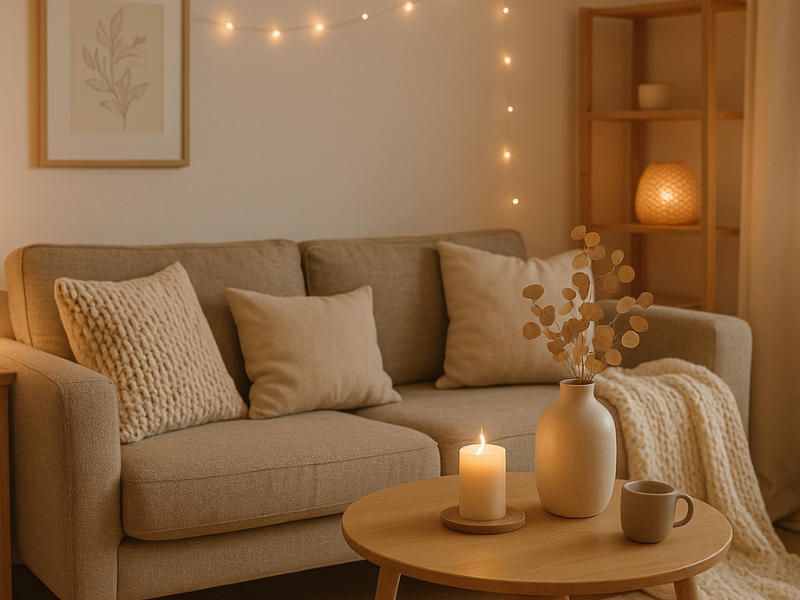
The living room tends to be the first place we try to make welcoming, since it’s where we spend the most time resting or sharing moments with other people. A cozy living room is one that invites you to sit down, that embraces you with the right light, that keeps you company with soft textures, and that offers immediate calm the moment you walk in.
For a living room to feel welcoming, the layout needs to encourage conversation and rest. Warm light is fundamental, especially placed at various points to create an enveloping atmosphere. Soft blankets, natural textures, and a pleasant rug underfoot bring the sense of a space that’s been cared for. Personal objects like a favorite photo, a book you love, or a handmade piece add soul without cluttering. A cozy living room isn’t a perfect space, it’s a space that receives you as you are.
The cozy bedroom: your most intimate refuge
The bedroom is where cozy runs deepest, because here you’re after rest, quiet, and presence. A cozy bedroom isn’t a bedroom full of things, it’s a bedroom that breathes calm. The bed should be the emotional center of the space. Your bedding ought to convey softness at a glance. Gentle colors help enormously in creating tranquility, as do light textures that graze without weighing you down.
Warm lighting on the nightstands, a soft scent like lavender, and a sense of visual order all help your body prepare naturally for rest. In a cozy bedroom, hurry doesn’t enter, noise doesn’t enter, the day doesn’t enter. Here there’s only you, your calm, and your rest. Once you understand that, the bedroom becomes a sanctuary.
The cozy kitchen: the practical and emotional soul of the home
It may not seem like it, but the kitchen is one of the rooms where well-applied cozy shows most. It isn’t only a place for cooking, it’s where moments get prepared, where aromas wake up, where conversations start. A cozy kitchen conveys order, closeness, and authenticity. Wood in cutting boards, spoons, or trays brings warmth immediately. Textiles like cotton or linen towels soften the atmosphere and remove that coldness kitchens tend to have.
A small corner with warm light, a herb plant, a bowl of fruit, or a beautiful mug can become an emotional space within a functional one. When you cook in a cozy kitchen, you feel you’re doing it from a more conscious, calmer, more connected place.
The cozy bathroom: a small temple of self-care
The bathroom seems like a difficult place for cozy, though it’s actually one of the spaces where it’s most appreciated. You can build a very special refuge for self-care here. Soft, plush towels, a pleasant mat, and a clean or relaxing scent completely change the experience of showering or getting ready.
Add dim or indirect lighting and the bathroom can take on an almost spa-like atmosphere that invites you to slow down. Natural elements like fiber baskets or small wooden details soften the surroundings. A cozy bathroom isn’t luxurious, it’s intimate. It’s a space that reminds you that you deserve to take care of yourself.
The cozy entryway: your first welcome of the day
The entryway is your home’s first impression and, though we sometimes ignore it, it plays a powerful emotional role. A cozy entryway doesn’t need much. A warm light always on, a small bench, a surface for your keys, and a soft scent create an emotional welcome every time you cross the threshold.
This space is a bridge between the outside world and your refuge. When you take care of it, arriving home feels like crossing a mental threshold. Your body notices, your energy shifts. The cozy entryway tells you: you’re here now, relax.
An Emotional Shopping Guide: Choosing Pieces with Intention
Buying new things for your home can be exciting, though it can also create anxiety without a clear intention behind it. Genuine coziness isn’t built by accumulating objects, but by choosing pieces that truly add something to your well-being. Emotional shopping doesn’t mean buying on impulse, it means buying from a connection to what you want to feel in your home.
Before bringing something new home, ask yourself how it makes you feel. Whether it brings you calm, whether it fits your lifestyle, whether it has a specific place in your house, and whether you still like it after thinking it over for several days. When you buy with intention, every object becomes special. Every piece has a purpose, and your home fills with meaning.
A warm lamp, a soft blanket, a handmade ceramic vase, a wooden piece that reminds you of nature. You don’t need much, you only need what you choose to speak about you.
Cozy on a Budget: Creating Magic Without Spending Much
There’s a mistaken idea out there that a cozy home requires investing large sums of money, and it isn’t true. Cozy is born of feeling, not of cost. You can transform an entire space without buying anything new. Sometimes changing the lighting, rearranging the furniture, tidying visually, or adding textures you already own is enough.
If you want to invest gradually, warm lighting is always the best first purchase. Textiles can come next, or small pieces that add a lot of warmth at little cost. Handmade details, simple artisan pieces, and natural materials tend to be affordable and to have a powerful effect.
Cozy isn’t measured in price. It’s measured by how you feel in your home.
Cozy and Minimalism: Two Paths That Can Go Together
Cozy and minimalism are sometimes thought of as opposites, when the truth is they complement each other beautifully. Minimalism focuses on keeping what’s essential. Cozy focuses on keeping what brings you well-being. Together they create a balanced, serene, deeply personal home.
A cozy minimalist home isn’t empty, it’s free of noise. Every object has an emotional or practical purpose. Nothing is there simply to be there. This approach makes the details feel more present, lets the colors breathe, and helps the light flow better. In the end, your cozy home becomes a space where everything makes sense.
A Cozy Home and Conscious Living: Inhabiting Your House with Presence
Cozy isn’t only an aesthetic, it’s a way of life. It’s learning to inhabit your house consciously. To listen to what you need at any given moment. To build routines that hold you up. To create surroundings that take care of you even on hard days.
When you connect with your home, you start living at a gentler pace. You start valuing small gestures. You start enjoying moments that used to slip past unnoticed. A cozy home teaches you to be present. To feel accompanied. To understand that calm is something you can practice.
Your house can be your refuge, your inspiration, and your pause. It only needs you to listen to it.
Frequently Asked Questions: Honest Answers for a Genuinely Cozy Home
Cozy may seem simple, but questions naturally come up when you start applying it at home. Every house is different and every person feels warmth in their own way. So I want to gather here some of the most common questions that come up around this way of living, which goes far beyond decorating.
Sometimes all you need is a clear answer to know which way to go. Or even one sentence confirming what you already suspected. These questions are an invitation to listen to your house and to listen to yourself.
Do I need to buy a lot of new things to have a cozy home?
No. That’s one of the most widespread ideas and also one of the least accurate. Genuine coziness doesn’t start with buying, it starts with looking at what you already have through new eyes. You can transform an entire space simply by adjusting the lighting, rearranging furniture, or removing what’s unnecessary. If you want to add a new piece afterward, wonderful. It isn’t a requirement, though. Cozy is intention, not accumulation.
Can I have a cozy home if my place is small?
Absolutely. In fact, small spaces are often the most welcoming, because they let you create enclosed, gathered atmospheres almost effortlessly. A small home can become a wonderful refuge if you choose your colors well, keep a light sense of order, and use the light to build warm atmospheres. Sometimes you don’t need more square footage, only more care in the space you already have.
Can I have a cozy home with kids or pets?
Yes. Not only is it possible, it can be beautiful. Cozy doesn’t mean fragile. It means warm. There are durable, functional materials that create the same sense of calm. Kids also tend to appreciate soft, orderly, peaceful spaces, and pets enjoy a plush rug as much as you do. Cozy isn’t for perfect houses. It’s for lived-in ones.
Is cozy only a winter style?
No. Winter does have a very natural connection to cozy, but this style adapts to every season. In summer it turns fresher and lighter. In spring it fills with soft brightness. In fall it becomes enveloping and warm. In winter it embraces you more deeply. Cozy is an emotional state that shifts with the weather, exactly like you do.
How do I keep my house from looking cluttered?
The key is asking whether each object has an intention behind it. If something adds nothing or creates visual noise, maybe you can store it, give it away, or find it a new place. Cozy isn’t excess. It’s balance. Even if you like spaces full of life, you need to let the room breathe. Once you learn to tell the difference between decorating and saturating, cozy shows up on its own.
What if I’m not sure what my cozy style is?
That’s fine. You don’t have to have it all figured out on day one. Cozy is a path, not a destination. You can start with one corner, one warm light, or one soft blanket. Sometimes discovering your style is a matter of noticing how your body responds to each small change. Little by little you’ll find the cozy that represents you, rather than the one you see online.
We’ve reached the end of this guide, and it moves me to think about the journey you’ve taken with me across all these words. If you’ve made it this far, you’ve probably realized that turning your house into a cozy home is something far deeper than arranging pretty pillows or lighting candles. It’s an emotional process, a way of caring for yourself, learning to listen to what you need and letting your home become an extension of your well-being.
You don’t have to do it all today. You don’t need a perfect house or to follow every guideline to the letter. Cozy is born of the care with which you inhabit your spaces. Of the intention behind each gesture. Of the way you switch on a soft light at the end of the day or make yourself a tea in silence while the house breathes alongside you.
It’s a path you build gradually, the same way beautiful stories get written. Start with whatever calls to you most. A corner. A scent. A lamp. Or even something as simple as clearing a surface or moving a blanket. Your cozy home will grow with you. It’ll keep you company through your seasons. It’ll hold you up when you need it.
Now I’d love to know something. Which part of this guide inspired you most? Which change would you like to make first? Which corner of your house is asking for some care? I’m looking forward to reading your answers, because your cozy home has a story too, and I’d love to keep you company through the process.