Learn how to find your creativity as an adult, even if you feel like you’ve lost it. A complete, honest, down-to-earth guide to reconnecting with your essence, exploring what inspires you, and creating from who you are today.
There are moments when we feel like we aren’t as creative as we used to be. It’s as if that part of us got left behind, tucked away somewhere between obligations, routines, and being in a rush. Sometimes we don’t even notice we’ve set it aside. All we feel is an emptiness, a lack of enthusiasm, a disconnect from ourselves. It’s easy to assume creativity belongs to childhood or to people who work in the arts, but that isn’t true. Creativity is still inside you, even when you don’t know where to look for it.
In my case, the reunion happened gradually. There was no magical moment when everything came rushing back. It was a process of trying, failing, discovering, and making room. Little by little I realized I hadn’t lost my creativity at all. It was simply asleep. It needed time, attention, and permission to come back out. That’s why I want to share what I’ve learned, in case it helps guide you on your own way back to yourself.
What it means to be creative even if you can’t draw or write
Creativity isn’t limited to art. It’s much broader than that. It’s a way of being in the world, of observing, of relating to what’s around you. It’s that spark that makes an idea excite you, that helps you find a different solution, that turns something ordinary into something one of a kind. Being creative isn’t about having a special talent. It’s about allowing yourself to think, feel, and act from a different place. It’s exploring, playing, combining, experimenting.
You can be creative while you cook, organize your home, get dressed, work through a conflict, or rethink how you do your job. Creativity shows up in a thousand different forms, and every one of them counts. What matters is letting yourself feel free, even if it’s only for a few minutes a day. That freedom is the first step toward reconnecting with your most genuine self.
Why we lose touch with our creativity
Being hard on yourself
From the time we’re little, we learn that everything has to be done well. We push ourselves to deliver, to please, to fit in. Over time, that desire to get everything right pulls us away from spontaneity. We start valuing only what’s useful, productive, or perfect. Creativity, which is often messy, imperfect, and without a clear purpose, gets left out. It becomes hard to let ourselves do something simply for the pleasure of doing it, with no results expected.
Fear of judgment
A lot of the time we don’t dare to create because we’re afraid of what other people will think. That fear of looking foolish, of not measuring up, of being told our work isn’t good enough, freezes us. We become our own harshest critics before we’ve even started. Bit by bit, we set aside everything that made us feel alive, all because we’re afraid of doing it badly or being judged.
Not enough time
One of the most common excuses is that we don’t have time. We live with a thousand responsibilities, and the day slips away before we notice. Often, though, it isn’t only a shortage of actual hours. It’s a shortage of mental space. It’s hard for us to stop, shift gears, and allow ourselves moments of disconnection so we can connect with what truly nourishes us. Creativity needs pauses, presence, and quiet, even in small doses.
Emotional disconnection
As time goes by, and after years of putting the urgent ahead of the important, we lose touch with what we feel. We get used to running on autopilot, to surviving, to meeting expectations. Creativity, on the other hand, needs connection. With ourselves, with our emotions, with what genuinely matters to us. Coming back to creating is also coming back to feeling.
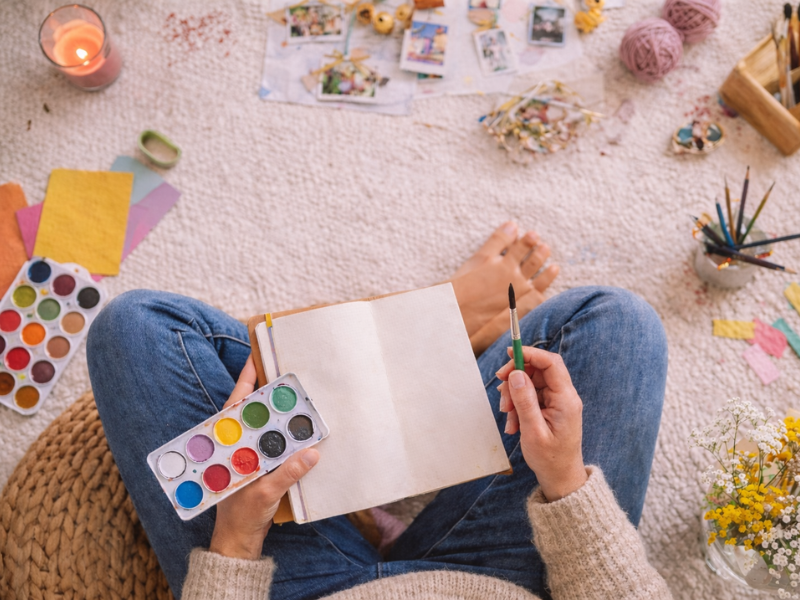
How to find your way back to your creativity, step by step
Getting your creativity back isn’t a matter of following an exact recipe. Each of us has our own pace, our own history, our own needs. Still, there are small gestures that can help you open the door. You don’t need big changes or special supplies. All you need is the willingness to start where you are, with what you have.
Listen to what you want
There’s a voice inside you that knows what you need. Sometimes it shows up as curiosity, as restlessness, as a faint desire. Maybe you feel like trying something new, or the urge to write, to move, to make something with your hands. Listening to that voice is the first step. Even if you can’t explain why something catches your attention, let yourself explore it. It doesn’t have to make sense. It only has to resonate with you.
Start small
Creativity doesn’t require grand gestures. It can start with five minutes a day. With a notebook where you jot down stray sentences, with an improvised recipe, with a box of colored pencils and a blank sheet of paper. What matters is that you begin. That you let yourself play and experiment without expectations. As you give it room, it grows on its own.
Create with no goal in mind
We’re so used to doing things with an objective that we forget the pleasure of doing something for its own sake. Creativity blooms when there’s no pressure. When it isn’t about showing, sharing, or justifying. When you simply make something because you feel like it. Because it does you good. That kind of creating is the most nourishing of all. It comes from within, without looking for approval.
Surround yourself with inspiration
Sometimes we don’t know where to start because we’re surrounded by input that drains us. Changing your environment can help wake up your creative side. Put on music that moves you, flip through books that make you dream, follow people who inspire you through their authenticity. Fill your space with things that connect you to your freest self. Inspiration is contagious, and being near it helps you remember what you’re capable of creating too.
Don’t judge yourself
One of the biggest barriers is your inner critic. That voice telling you that you don’t know how, that it’s too late, that it isn’t worth it. It’s important to learn to coexist with it without letting it freeze you. You can tell it that now isn’t its moment. That you’re exploring, that you’re learning. That you don’t need to do it perfectly. You just need to do it.
Real, everyday ways to be creative as an adult
Being creative has nothing to do with working professionally in the arts or having tons of free time. There are plenty of ways to create without pressure, starting with the simplest, most everyday things. Here are a few ideas that can fit into your life exactly as it is right now.
Keep a journal
Spending a few minutes a day writing down what you think or feel can be a powerful outlet. It doesn’t matter if you write badly or don’t know what to say. Letting the words flow is already an act of creation. You can start with loose sentences, reflections, dreams, or simply whatever you’re going through.
Decorate your space
Sometimes changing one corner of your home can give you completely new energy. You don’t need to buy anything. You can move furniture around, hang a print, paint a wall, or add a plant. Your surroundings shape your state of mind, and creating beauty around you is a form of expression too.
Cook without rules
You can play with flavors, colors, and textures. Cooking without following an exact recipe and letting your intuition lead connects you to the present moment and sharpens your ability to improvise. It’s a creative exercise in every sense.
Play, with your kids or on your own
Play isn’t just for children. Painting, building, making crafts, inventing characters or stories. All of those activities reawaken your imagination and take you back to a place where anything is possible. Playing is one of the purest forms of creating.
Take photos of everyday life
You don’t need a professional camera. Your phone is plenty. Notice the small details of your day. The light coming through the window, your coffee mug, a messy corner. Seeing the ordinary with fresh eyes is a creative act all on its own.
Frequently asked questions about creativity in adulthood
What if I’m not a creative person?
This is one of the most common beliefs, and also one of the most mistaken. We’re all creative by nature. The difference is that some of us keep it within easy reach while others have stored it so far back that we don’t even remember what it felt like. If you’ve ever imagined a story, solved a problem in an unconventional way, or made something with care just for the joy of making it, you’ve already been creative. It isn’t about knowing how to draw or write. It’s about connecting with the part of you that has ideas, that looks for new approaches, that wants to express itself.
What if I feel embarrassed?
That’s normal. Embarrassment shows up when we sense we might be judged, even by ourselves. Creativity isn’t there to be evaluated, though. It’s there to be lived. You don’t have to show it to anyone, publish it, or explain it. You can create just for yourself. To experiment. To feel better. To explore something new. The embarrassment fades once you start giving yourself permission without demands.
What do I do if I have very little time?
You don’t need free hours. You can find pockets of time that are small but real. Ten minutes when you wake up or before bed. A stretch while you drink your coffee, or instead of scrolling on your phone. You can write on the bus or the train, take photos while you walk, hum while you cook. What matters isn’t how much time you have but how you choose to use it. Creating even a little starts to add up. The loveliest part is that the more you give yourself that space, the more you find you need it.
What if I start something and then quit?
That’s part of the process too. Starting something and setting it down isn’t failure. It’s exploration. We sometimes think that not finishing means we lack discipline, when really we’re learning what we like, what we don’t, and what works for us. Every attempt counts. Every time you try, you get closer to finding what truly fills you up. You don’t need to finish everything. You just need to keep moving.
Does reconnecting with creativity make sense if my life is already very structured?
Yes. That’s exactly why it makes sense. Creativity isn’t only for people who work in the arts or live chaotic lives. It’s also for people who live with responsibilities, routines, and demands. Creativity is a way of breathing inside all of that. A way of giving yourself a space where you don’t have to answer to anyone. Where you can simply be you, without labels or expectations. Even in the middle of the chaos, there’s room to make something that’s yours alone.
Coming back to yourself is a creative act too
Creativity isn’t something you have to find out there somewhere. It’s something already in you. Asleep, maybe, quiet, waiting for you to look its way. You don’t have to make sweeping changes. You just need to start with something small. Something that reminds you who you were before all the rushing, the obligations, and the doubts. Creating is a way of coming home. To your inner home, that place where everything makes sense without needing an explanation.
Every time you do something purely because you want to, because it connects you, because it makes you feel alive, you’re activating your creativity. You’re reclaiming your voice. Your own way of seeing and living in the world, which is worth a great deal.
I’d love to hear about it. If you’ve made it this far, there’s probably a part of you that’s ready to create again, or at least ready to wonder how. What’s been inspiring you lately? What would you like to try even though you have no experience with it? What’s holding you back from starting?
Feel free to leave a comment telling me your story, your doubts, or simply what resonated with you as you read this guide. I’m certain you aren’t alone on this path, and sharing is a form of creating too.
Thank you for being here.