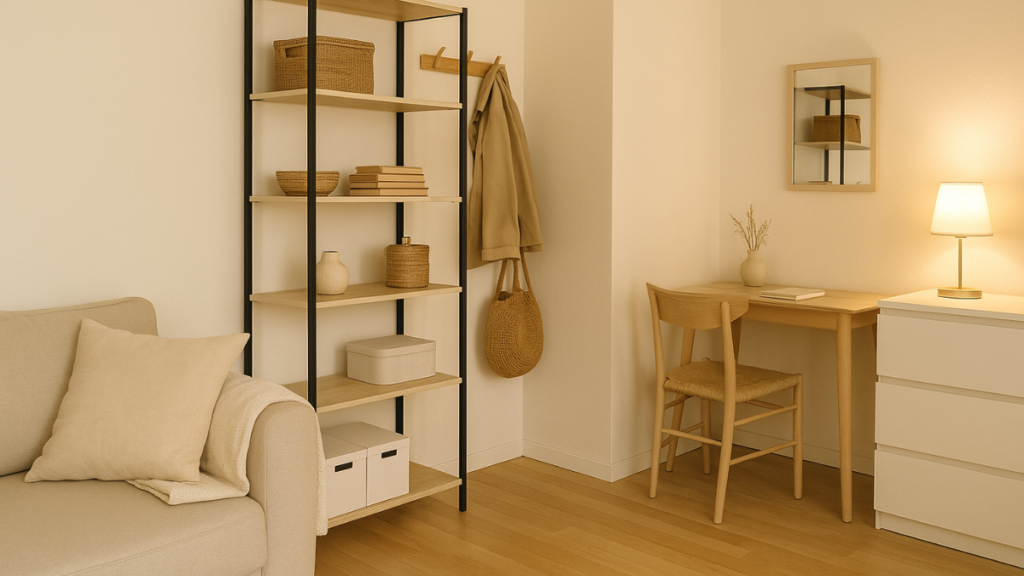
A complete guide to organizing a small apartment: deep decluttering, zone-based order, vertical storage, and cozy tricks for gaining real space without the overwhelm, plus a 7-day plan, common mistakes, and frequently asked questions.
With apartments that sometimes have odd layouts, narrow hallways, mini kitchens, and closets seemingly designed for a life with half as much stuff, it’s completely normal to feel like your home is too small even when you aren’t a messy person. Often it isn’t your fault at all. The space simply isn’t helping.
The Challenge of Living in a Few Square Feet
I like to think your home can be your safe place, even if it’s a studio or a one-bedroom. It doesn’t have to be huge to feel light, welcoming, and easy to maintain. It does need one thing, though: intention. When every object and every corner has a purpose, everything changes. The visual noise drops, your mind rests, and suddenly you want to be at home instead of feeling like something is always pending.
In a small apartment, anything that stays has to earn its place, because the space is limited and you deserve to live without navigating obstacles. If you’re reading this, it’s because you can picture your place clearer, prettier, and more like you. I love that image, and we’re going to build it step by step, realistically, with no impossible demands.
Before we go on, hold onto this question, just to orient yourself: which area of your home steals the most calm from you right now? The entryway, the kitchen, the closet, the living room, the bathroom, the hallway. Whichever it is. Because organizing a small apartment is ultimately about tackling the trouble spot you notice most day to day, not about achieving a “perfect” that lasts two hours.
Step 1: Do a Deep Declutter
The golden rule: remove first, organize second
This sounds obvious, but it’s where most people get stuck. We try to organize while surrounded by things we don’t actually use or care about, and of course any system breaks down, because you’re trying to fit too much into too little. In a small apartment, keeping things “just in case” costs you dearly, since every object takes up physical square footage and attention alike.
So yes, removing comes first. When I say remove, I don’t mean becoming an extreme minimalist. I mean keeping what makes sense for your real life, the one you live on an ordinary Tuesday, not the idealized version of you who does sunrise yoga and irons shirts while singing. What stays should help you, please you, or make your routine easier. Everything else can go, guilt-free.
The easy method that won’t overwhelm you: four boxes and a bag
This works for me because it’s fast and because it doesn’t force me to overthink. Picture setting out four large boxes or bags plus one trash bag. One is for “keeping,” because you use it or it adds something. Another is for “donate or sell,” because it’s fine but doesn’t fit your life. Another is for “recycle,” because it’s past its useful life or it’s paper, packaging, or textiles for recycling. The last one is for “not sure,” which is the most important box if you get attached or freeze up.
The trash bag is for anything broken, expired, permanently stained, or simply pointless. This isn’t about punishing yourself, it’s about clearing space.
Here’s the key detail: the “not sure” box gets an expiration date. I do it this way because otherwise that box just moves in with you and all you’ve done is relocate the chaos. A short window works best, 30 days for instance. If you haven’t missed it in 30 days, that’s a pretty clear sign you didn’t need it. If you do miss it, it stays, and there’s no drama in that.
Minimalist and cozy at once: yes, it’s possible
Plenty of people associate minimalism with cold, empty, personality-free homes. I understand where that comes from, since we’ve all seen photos that look like a catalog. To me, though, practical minimalism is something else. It’s having room to move, to clean without wrestling twenty objects, to let the house breathe. And cozy isn’t about accumulating things, it’s about creating a sense of refuge with well-chosen details.
So when you declutter, don’t keep only “the useful,” as though you were packing for a campsite. Keep what gives you well-being too. The mug you love, a nice blanket, a warm light, a throw that wraps around you, a soft scent if you like that. Things like that, used with intention, make a home. The trick is keeping them few and giving them a place. If they have no place, they aren’t cozy, they’re burden.
Decluttering by category so you actually notice a difference
In small apartments, working by category tends to beat working room by room, because it shows you the real volume of what you own. Gather all your clothes in one spot and you’ll see whether your closet is oversaturated. Gather all your food containers and you’ll understand why the lids drive you crazy.
I usually follow an order that doesn’t feel daunting at the start. I begin with visible trash and paperwork, since that gives fast results. Then clothes. Then the kitchen, with particular attention to containers, glasses, and utensils. Then the bathroom, because there are always expired products and accumulated samples. After that I move to the “miscellaneous” pile, which includes cables, small tools, and that classic drawer that seems to be a parallel dimension. I leave decor and keepsakes for last, because that’s where you get sentimental and it helps to have your decision-making muscle already warmed up.
A silly trick that’s incredibly motivating is taking a before photo. Not to post it, just for you. On low days, seeing your progress gives you energy back and reminds you that this is doable.
A natural decluttering checklist you can start today
If all you could manage today was a mini start, here’s how I’d do it. First I’d go through expired products in the kitchen and bathroom, because that’s easy and frees space quickly. Then I’d fill a donation bag with whatever you’re already sure about, and I’d leave that bag by the door so it actually leaves the house, because if it goes back in the closet, it comes back into your life. Next I’d empty one “disaster” drawer and reset it to basics, not perfect, just functional. Finally I’d clear one large surface, whether the table or a stretch of counter, to give you that sense of air that will make you want more.
Then for a couple of weeks I’d set one simple rule: if something new comes in, something similar goes out. Not to live in fear, but to avoid the classic relapse of “I organized everything and two weeks later I’m right back where I started.”
Step 2: Organize by Zone, Not by Room
Why this system is perfect for a small apartment
In a small apartment, a room is rarely only a room. The living room might be a dining room, an office, and a relaxation zone. The bedroom might double as a dressing room and storage. The entryway can turn into a small emotional storage unit where everything you don’t know what to do with piles up. If you try to organize by thinking in terms of rooms, you’ll get frustrated, because plenty of things don’t belong to any single one.
Organizing by zone is far more practical, because it means thinking in terms of functions. The arriving zone, the cooking zone, the resting zone, the working zone, the cleaning zone, the leisure zone. When each function is clear, order holds up better, because your body learns where things go without your having to think about it.
Your base zones, even in a studio
I always start by creating a landing zone near the door. It’s where you drop your keys, wallet, phone, glasses, mail, bag, and jacket. It’s the zone that saves you most, because it keeps all of that from ending up scattered across the table, the couch, or the counter. Next I create a working kitchen zone where everyday items are accessible and occasional ones go higher or lower. After that, I like having a maintenance zone for cleaning and laundry, even if it’s one small cabinet, because when those products are mixed in with everything else, the chaos multiplies. The rest zone is sacred, even if it’s only a corner, because your brain needs to associate that space with calm. If you work or study from home, you need a fixed or semi-fixed work zone, even a folding table, because if you work anywhere, work invades everything. Finally, a leisure or unwinding zone, which doesn’t have to be large but should be intentional, with your books, your blanket, or whatever makes you feel this is home.
Every zone needs a physical limit to make it easy
Here comes the concept that holds order together most: the container. I don’t mean something ugly, I mean setting a limit. It can be a tray for keys, a basket for blankets, a box for cables, drawer dividers, or a vertical organizer in the kitchen. The container tells you “this far.” When it fills up, it doesn’t spill out across the house, it warns you that it’s time to choose. It’s like an agreement with yourself, minus the drama.
The beautiful part of this approach is that it stops depending on your willpower. It depends on a system that makes things easy when you come home tired, when you’re in a rush, or when you’d rather live your life than tidy up.
The questions I ask myself so the order is real
When I put something away, I ask where I actually use it, not where it “should” go. I also ask whether I can grab it one-handed, because if I have to open three doors to put something away, I’ll end up leaving it out. And I ask one more key question: if I were exhausted, would I put this back here? If the answer is no, that spot isn’t well planned. It isn’t that I’m lazy, it’s that the system is too demanding.
The micro-habit that changes your apartment: the five-minute reset
I’m not going to tell you to deep clean every week, because we don’t live in a movie. What I will tell you is that a five-minute reset before bed works magic. In that short window, you return things to their zones. The glass goes back to the kitchen, the blanket goes back in its basket, the charger goes back in its box, the clothes go in the hamper or the closet. The next day you wake up to a lighter home, and the effect on your mood is enormous.
Step 3: Use Your Vertical Space (Practical Ideas)
When you have a small apartment, floor space is gold, so if everything lives at floor level, the place feels fuller and harder to clean. Vertical space is your best ally, because it frees up real square footage and visual square footage at the same time. I like repeating a phrase that keeps me focused: hardworking walls, clear floors. Once you achieve that, the apartment looks bigger even without changing anything else.
High shelving used thoughtfully, not for hoarding
High shelves work beautifully, on one condition: only things you don’t need daily go up there, and they go up grouped. If you send loose items up, all you’ve done is move the mess somewhere harder to reach. Use matching boxes with simple labels instead and you get clean, practical storage. Those boxes can hold cables, seasonal items, a first aid kit, stationery, or any category that’s overrunning your drawers.
Vertical kitchen: rails, racks, and organizers that genuinely help
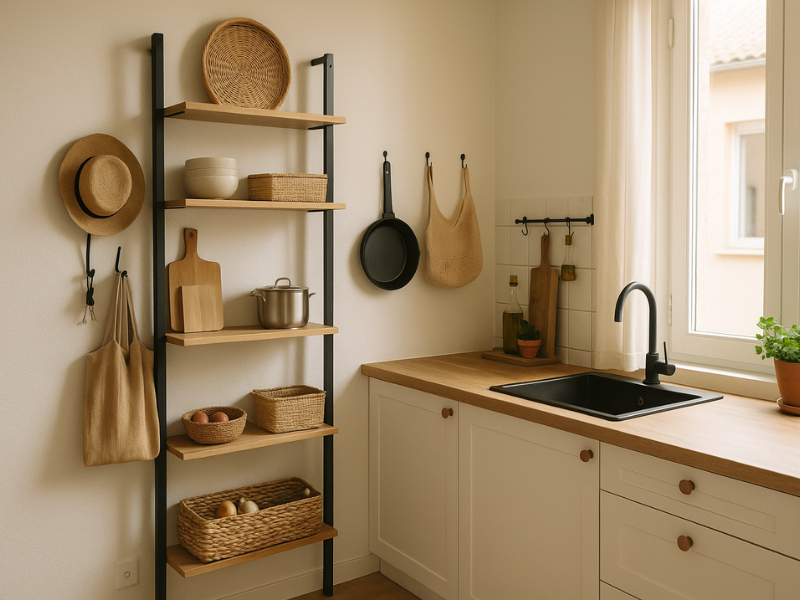
In small kitchens, hanging your most-used utensils can free entire drawers, though the key is not hanging everything. Hang fifteen things and the visual noise comes right back. Hang five or seven you use daily and the kitchen becomes more functional. Rails for towels or oven mitts also keep the counter from filling with wrinkled textiles. Inside cabinets, vertical organizers are a game changer for cutting boards, baking sheets, and lids, because they stop being an unstable stack and start being filed, visible and accessible.
Nice-looking hooks that prevent the “I’ll just set this here” habit
Hooks are one of those things that seem small but change habits. A hook behind the bathroom door, a hook in the entryway for your bag, a hook in the bedroom for the jacket you wear every day. When hanging something up is easier than draping it over a chair, order maintains itself, and that’s exactly what we’re after.
Narrow towers, awkward gaps, and corners that become useful
Many homes have gaps that seem useless, like the space between the fridge and the wall or a corner in the bathroom. A narrow tower shelf or a rolling cart can turn those gaps into useful storage for pantry items, cleaning supplies, or bathroom backups. What matters here is that whatever you store is organized by category, because if you shove things in at random simply because they fit, you won’t find anything later and you’ll end up buying duplicates, which is the classic chaos cycle.
Your own photos: how to use them to genuinely help yourself
Taking before and after photos helps enormously, and you don’t have to show your home to anyone if you don’t want to. Photograph details instead, like an organized drawer, a shelf with labeled boxes, or your newly sorted entryway. Photos also help you spot visual noise, because sometimes what your eye misses in person shows up clearly in an image.
Step 4: Furniture That Genuinely Saves Space
Here I get very practical, because in small apartments there’s furniture that promises a lot and then becomes a daily annoyance. What interests me is whatever makes life easier when you’re rushing, when you come home tired, and when you don’t feel like moving things around as though you lived in an escape room. So before choosing any space-saving piece, I always think about whether it saves room when I’m not using it, whether it’s comfortable to use daily, and whether it genuinely spares me from buying more clutter to organize around it.
In a small apartment, good furniture does two things very well or one thing extraordinarily well, without complicating your life. If it requires a ritual to open or close, if it’s too heavy, or if it forces you to remove objects before you can use it, chances are you’ll end up avoiding it, and then it stops doing its job. When a piece of furniture isn’t used the way it should be, it becomes an obstacle rather than a help.
Living and dining: where you gain the most and lose the most
The living room is usually the heart of a small apartment, and also where clutter shows up fastest, because it’s in plain sight. If there’s one area where choosing furniture with intention pays off, it’s this one.
A well-chosen extendable table is one of the most useful things there is. Closed, it takes up little and leaves you room to move. Open, it lets you eat with company, work comfortably, or handle tasks that need surface area, like wrapping gifts or prepping for the week. The key is that the mechanism be simple enough that opening it doesn’t feel like a chore. If opening it is a production, it stays closed forever.
A lift-top coffee table is also a great idea if you sometimes eat on the couch or don’t have a clear dining area. It lets you raise the surface to eat or use a laptop without hunching, and it usually has storage inside, which is gold in a small apartment. That said, make sure the interior doesn’t turn into a giant junk drawer, or you’ll lose time every time you want to put something away.
As for the couch, choose one with storage if you can. A storage sofa can hold blankets, spare pillows, or even bedding, but comfort rules. In a small apartment the couch gets heavy use, and if it’s uncomfortable, the whole home feels worse. A comfortable couch matters more to me than a couch with a thousand functions.
It also helps a great deal to choose furniture that lets you see the floor, like a TV console on legs or a wall-mounted one. That glimpse of floor makes the living room look bigger and makes cleaning easier, which small homes appreciate since dirt shows up sooner.
Bedroom: rest and storage without the overwhelm
In the bedroom, the most important thing is that it feels light, because if your rest is surrounded by chaos, your head knows it. A storage bed with a lift-up base is like having a hidden mini storage unit. It lets you keep off-season clothes, comforters, suitcases, or memory boxes, under one very clear condition: there have to be categories inside. Toss things in loose and it becomes a black hole you dread opening, and that dread translates into clutter outside it.
If a lift-up base isn’t for you, a bed with drawers works too, especially if access is easy. In some apartments dust builds up and the drawers become a battle, so it depends a bit on your floors and your routine. Whichever option you choose, what matters is that under-bed storage has limits and doesn’t become “I’ll shove everything here.”
With nightstands in a small apartment, less is usually more. A narrow nightstand, or even a wall-mounted shelf, can do the same job without eating into your walking space. If a headboard with a ledge fits, it gives you extra room for a book, your phone, glasses, or hand cream without adding another piece of furniture.
Mini kitchen: real solutions that don’t get in the way
In small kitchens, a rolling cart can be a marvel. It gives you prep surface and extra storage, and if you pick a narrow one it won’t block your path. You can also move it whenever you need to clear space. I like it because it’s flexible, and flexibility is worth a lot in a small apartment.
If you don’t have a dining area, a wall-mounted drop-leaf table is a lifesaver. It takes no space when you aren’t using it and lets you eat breakfast or lunch without balancing a plate. If you need extra seating, folding stools are a staple, since they don’t take up room when there’s no company.
Entryway and hallways: ultra-slim and intentional
Entryways and hallways call for furniture with almost no depth. A narrow console or a well-placed shelf, with a mirror above it, creates a control point for keys, wallet, and mail. The difference between “I drop everything wherever” and “everything has a place” usually comes down to this one minimal piece.
If you take your shoes off at the door, a narrow shoe bench can solve a lot, since it lets you sit, store, and keep the area visually clean. If the hallway is extremely narrow, sometimes hooks and a mirror beat any furniture that’s only going to get bumped into daily.
Small bathroom: vertical storage and clear surfaces
In small bathrooms, furniture should be discreet and vertical. An under-sink cabinet, if you don’t have one, changes your life, because it uses a gap that’s usually wasted. A shelf unit over the toilet, with baskets, gives you room for toilet paper, towels, or backups without taking floor space.
Over-the-door hooks are the classic simple trick that keeps towels from ending up on the toilet lid or hanging somewhere they shouldn’t. In a small apartment, convenience rules, and hanging something up should be the easiest thing in the world.
Step 5: Smart Organization for Closets and Drawers
This is where order becomes stable, because you’re going to build a system that lets you put things away fast and find them fast. In a small apartment, organization can’t depend on perfection, it has to depend on easy habits.
The most important part is that what you use daily is within reach and what you use occasionally lives higher up or further back. It sounds obvious, but we often store daily items in awkward spots and then leave things out because putting them away feels like too much. That reluctance is the origin of most clutter in small homes.
The clothes closet: simple categories and realistic decisions
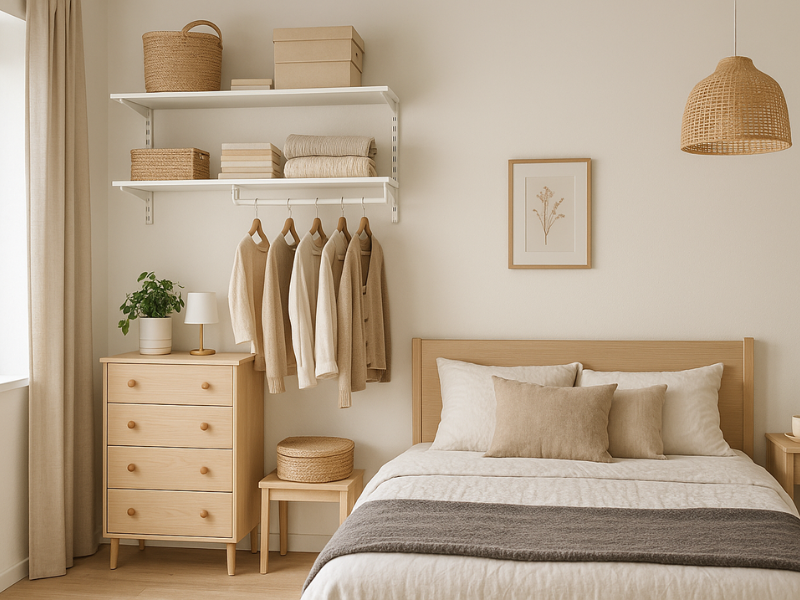
A closet works when the categories are few and clear. The minimum that tends to work for me is separating tops, pants, loungewear, workout clothes, and dressier pieces. If you have special garments like dresses or suits, that can be another category. Underwear and socks deserve their own system, because when they get mixed together you lose time every morning and you feel it.
In drawers, file folding helps enormously because you see everything at a glance. When you stack, whatever’s at the bottom disappears, which means you always wear the same things while the rest takes up space without giving anything back.
Matching hangers do more than you’d think. It isn’t an aesthetic obsession. Because they’re the same size and shape, clothes hang the same way and take up less room. That makes the closet feel less crowded and easier to move things around in without snagging.
For accessories like belts, scarves, or small bags, a box or a dedicated organizer keeps them from scattering. In a small apartment, small things create the most visual chaos when they aren’t grouped.
Seasonal swaps without your home exploding
The seasonal changeover is when many apartments spiral. My favorite way to handle it is very simple. One box for summer, one for winter, one for the in-between. I don’t need more. Inside, you can add bags by garment type if you like, but the essential thing is that everything stays grouped and doesn’t mix with your everyday clothes.
Storing by season doesn’t only free space. It makes your mornings easier, because you aren’t looking at clothes you won’t be wearing, and in a small apartment, seeing fewer options sometimes brings peace.
The junk drawer: let it exist, but keep it in check
I don’t believe in eliminating the junk drawer, I believe in domesticating it. A drawer can hold small things with no obvious home, but it needs subdivisions. If everything goes in loose, it becomes an object smoothie and opening it stresses you out.
Inside, the most practical approach is separating with small boxes. One for batteries, one for mini tools, one for basic medicine, one for stationery, one for cables. That way, when you’re looking for something, you find it without emptying the whole thing. That’s what keeps the system alive.
Kitchen: order you notice every single day
The kitchen is one of the areas where organizing by use pays off most. If you set up a small breakfast or coffee station, even on a single shelf or section of cabinet, mornings get easier. Keeping coffee, tea, mugs, spoons, and sugar or honey together saves you the classic shuffle of “I need this, now I need that.”
Food containers deserve their own system, because they’re a universal source of chaos. What works best is keeping only the ones that stack well and storing the lids upright. Also, if there’s a container with no lid or a lid with no container, I’m sorry, but that’s usually deferred trash. In a small apartment, incomplete objects take up space and produce frustration.
For spices and staples, a tiered organizer or a lazy Susan inside the cabinet keeps you from pulling out five jars to find one. When cooking is easy, you make less mess and clean up better. It’s all connected.
In a mini kitchen, the counter works better when whatever sits on it is grouped. A tray with oil, salt, and pepper, for instance, reads as calmer than those same items scattered across the surface. It’s a visual and practical trick at once.
Bathroom: clear routines and baskets by function
In the bathroom, what saves me is having one basket for daily items and another for backups. Daily means whatever you use every morning and night, and it should be within reach. Backups are refills of body wash, shampoo, toothpaste, or paper, and they can live higher up. If you share a bathroom, one basket per person prevents the classic “whose is this?” that leaves things stranded on every surface.
It’s also worth checking for expired products fairly regularly, since the bathroom is the kingdom of samples, half-used products, and “I’ll get around to it.” In a small apartment, that “I’ll get around to it” becomes permanent occupation.
Cleaning and laundry: compact and duplicate-free
Your cleaning zone can be one small cabinet, but it needs to be clear. The basics, meaning cloths, gloves, bags, and a couple of products, should be accessible. The most important thing is avoiding duplicates. If you have five products for the same job, the cabinet fills up and you don’t know which to use, and that ends in more unnecessary purchases.
For laundry, even if it’s a corner with a washer, having a hamper for dirty clothes and a basket for detergent and supplies keeps that area from becoming a disaster. In small apartments, a disaster shows up twice as much.
Step 6: Tricks to Make It Look Bigger
This isn’t about deception, it’s about helping the eye breathe. When a small apartment is visually saturated, it looks even smaller. When it’s well thought out, it can feel surprisingly spacious, even with the same square footage.
Colors: continuity and calm
Light tones tend to open a space up, though you don’t have to go pure white if you don’t like it. Off-whites, beiges, sand tones, and warm grays all work because they reflect light and create continuity. Continuity is key. If every wall has a different break, the eye perceives fragmentation and the apartment feels smaller.
If you love color, use it in details or on one small wall that doesn’t cut the space. A small apartment can have personality without looking visually loaded, and you get there by repeating a coherent palette across textiles and decorative pieces.
Lighting: the difference between “sad” and “home”
Lighting is one of the most underrated tricks. Overhead light on its own tends to leave odd shadows and a flat feeling. Add light in layers, though, and the space feels kinder. A floor lamp in the living room, a table lamp near the couch, a task light for your work area or the counter. In rest areas, warm light. Seriously, warm light changes the atmosphere dramatically.
A well-lit small apartment also looks bigger, because you can read the volumes better and there are no dark corners closing the space in.
Textiles: cozy without looking cluttered
Textiles are the quickest route to a welcoming feel, but they need to be used with intention. Light curtains that let the light through help the room breathe. A rug in the right size defines zones and creates a sense of home, though a rug that’s too small makes everything shrink. With blankets and pillows, what works for me is choosing a palette of two or three tones that repeat. That creates unity and keeps things from looking like every piece is doing its own thing.
Mirrors: well placed and purposeful
A mirror near a window or facing a light source multiplies the sense of space. In a narrow hallway, a mirror can soften that tunnel feeling, and in a dark entryway, a mirror with a warm light nearby makes the space feel far kinder.
Visual order: fewer loose pieces, more calm
Here’s an idea that always holds true. Many small things on display create noise. A few pieces with presence create calm. One nice tray grouping several items, or one medium-sized piece of art with impact, beats a thousand tiny details scattered around. In a small apartment, grouping is almost always more effective than decorating by accumulation.
Solutions for the Problem Corners of a Small Apartment
This is where we bring it all down to earth, area by area, leaving nothing out. In a small apartment, what changes your life isn’t having “more space,” it’s having each corner serve a clear function with an easy system. When the system is easy, you follow it even when you’re tired, and when you follow it while tired, order genuinely holds.
The entryway: where order either starts or falls apart
The entryway is a tiny area with an enormous amount of power. It’s where you decide whether what you bring in from outside enters with order or gets distributed across the whole home. Without a landing point, the bag ends up on the couch, the keys on the table, the mail on the counter, and the coat on a chair. The worst part is that in the moment it doesn’t seem serious, and two days later there’s a pile.
What works best is building an entryway around three very clear things. A fixed spot for keys and wallet, like a tray or a bowl. A place to hang your bag and jacket, whether wall hooks or a coat rack, on the condition that it’s the first thing you see when you walk in so the habit becomes automatic. And a specific place for shoes, even a nice basket for your everyday pairs or a narrow shoe rack. Once those three exist, clutter drops dramatically, because “I’ll just set this here for a second” loses its excuse.
If you tend to accumulate paperwork, the entryway should also have a tray or folder for mail. Not to store it for months, but to give it a waiting spot. The trick is emptying that tray once a week. Turn it into a weekly gesture and it stops being a mountain.
A mirror helps in a small entryway too, since it opens the space visually and saves you before you head out. If the entry is dark, one small warm light can change everything. You don’t need a grand fixture. Sometimes a soft light is all it takes to feel like home.
The hallway: narrow, yes, but useful if you plan it right
The hallway tends to be the forgotten corner, and at the same time the place where people try to squeeze in furniture that later gets in the way. In a narrow hallway, the rule is simple: nothing that makes you brush past it. If it brushes, it’ll wear on you. If it wears on you, you’ll end up hating it, and when you hate a piece of furniture, you abandon it and clutter appears.
What does tend to work is using the wall instead of the floor. An ultra-slim shelf can hold something in passing, or a couple of decorative pieces that don’t intrude. A long mirror can also make the hallway feel less like a tunnel, and it reflects light if there’s a window nearby. Rather than many little objects, a couple of pieces with presence usually looks cleaner, like one medium artwork or two large prints, because the eye doesn’t get tired, and when the eye doesn’t get tired, your apartment looks bigger.
If your hallway doubles as extra closet space, sometimes what you need isn’t a large piece of furniture but well-placed hooks for bags or jackets. That gives you the function without invading the path.
The living room: the multipurpose space that needs limits
In a small apartment the living room is usually everything. It’s rest, sometimes dining, sometimes an office, and it’s also where you receive guests. If the living room has no zone boundaries, it becomes the place where everything gets left “because we live here anyway.” And yes, you live there, but living shouldn’t feel like being buried under things.
What works for me is thinking of the living room as a set of mini zones. The first is the couch zone, which should be designed for genuine rest. If blankets are always strewn about, the practical answer is one basket for blankets, only one, with a clear limit. If remotes, chargers, and headphones show up everywhere, a box or tray for that category keeps them from scattering. If you tend to leave whatever you’re currently using there, a small landing spot like a tray helps it read as ordered life rather than clutter.
The second zone is invisible storage, which is nearly mandatory in a small apartment. Everything small and unattractive, like paperwork, cables, maintenance items, or games, lives better in a cabinet with doors or in matching boxes on a shelf. This isn’t hiding for the sake of hiding, it’s lowering visual noise. When the noise drops, your brain rests, and the living room looks bigger.
The third zone is eating or working, even on the same table. If the table is multipurpose, a good idea is keeping a work kit in a box or folder. That kit holds the charger, the notebook, the pen, and the essentials. When you finish, you pack it up in a minute and the table goes back to being a table. It’s a tiny gesture that makes an enormous difference in a small apartment.
If you have hobbies like crafting, gaming, or puzzles, the container is key here. One container per hobby, with a limit. If it doesn’t fit, it’s time to choose. Not to live without hobbies, but to avoid living overrun by them.
The mini kitchen: making it work on an ordinary Tuesday
A small kitchen can be very comfortable when it’s organized by use. The difference between “I manage” and “I’m losing my mind” usually lies in the counter and the most-used cabinets. In a mini space, the counter is nearly sacred. It doesn’t have to be empty, but it should be clear and hold only the essentials. When there’s too much on it, cooking becomes uncomfortable, you clean less well, and things get messier. It’s a cycle you notice fast.
I like grouping whatever lives on the counter onto a tray, because it looks cleaner and it’s practical too. Oil, salt, and pepper together on a tray don’t read as three separate objects taking up space. The coffee maker, if you use it daily, can absolutely stay out, though it’s worth putting it in a corner that doesn’t eat into your prep area.
Inside the cabinets, organizing by category and frequency is what makes a kitchen easy. Daily items should be within reach, meaning plates, glasses, main utensils, and your most-used pots and pans. Occasional items can go high or toward the back. With food containers, the most sustainable system is keeping the ones that stack well and storing lids upright. Not for looks, but because when lids sit in a pile, hunting for one undoes everything.
You can set up a very simple mini system in the fridge as well. I like having an “eat me first” zone, because it keeps things from hiding until they spoil. You don’t need to buy anything, it can be an assigned shelf or a drawer. If you freeze food, dating it saves you unpleasant surprises. It isn’t that I’m strict, it’s that I’ve already lived through the mystery of the unidentified frozen container and I’d rather not repeat it.
The sink also changes when it has a holder for the sponge and soap. It seems trivial, but when those items are lying around, the kitchen looks dirty even when it isn’t. Hanging dish towels on a hook or bar keeps them from ending up wrinkled on the counter, and that gives a constant sense of order.
The small bathroom: few things in sight and easy routines
In small bathrooms, the feeling of order depends enormously on surfaces. If the sink is covered in products, it looks saturated even if you clean daily. So what works best is giving daily items a home and storing everything else. A basket for daily items can be your best friend. In it go moisturizer, deodorant, toothbrush, toothpaste, and whatever you always use. The rest can go in a backup basket or a cabinet, and that’s it.
Under the sink, the ideal approach is dividing by function. One area for everyday products, one for backups, one for cleaning. When those get mixed, you end up buying duplicates because you can’t see what you have. In small apartments, duplicates take up space and create a feeling of chaos.
In the shower, keeping only what you genuinely use makes everything look far cleaner. If you like doing hair treatments or have special products, store them outside and bring them in when it’s time. As for towels, I say this with affection, but less is better. Two per person is usually enough, one in use and one spare. If you have more, that’s fine, so long as they don’t take over the bathroom. In a small apartment, the bathroom can’t become a textile warehouse.
The bedroom: calm, not perfection
The bedroom is where order shows up most in your well-being. Not because it has to be spotless, but because it’s your resting space. If it’s visually loaded, switching off gets harder. I like a very simple nightstand. A lamp or a warm light, a book if you’re reading one, a glass or bottle, and the charger. When the nightstand fills up, it turns into a reminder of everything pending.
The closet, as we saw, runs on simple categories with daily items within reach, and under-bed storage only works when it’s divided. Shove everything in loose and it becomes hidden chaos that drains your energy every time you open it.
If your bedroom doubles as a dressing room, it helps enormously to have a specific spot for whatever’s “in use,” like a hook or a valet stand for the jacket you wear every day. That keeps clothes from ending up on a chair. The goal isn’t getting rid of the chair, it’s getting the chair to stop being an alternative closet.
The work area: keeping it from invading your life
If you work or study from home, even in a corner, that corner needs an identity. When you work anywhere, work spreads across the whole home and the home stops feeling like rest. It helps me to have my desk, however small or foldable, stocked with the essentials permanently. An organizer for pens and paper, a box for cables or the power strip, and a tray for pending paperwork with a limit.
Cables deserve attention because they’re silent chaos. A box for the power strip and some velcro ties to bundle cables make the space look cleaner and keep you from dreading it. If you can, leave a dedicated charger in that zone, because when the charger travels around the house, it ends up on the couch, the nightstand, and the kitchen counter all at once.
Paperwork is worth reducing in a small apartment. Digitizing what you can helps, and whatever stays should live in a slim file folder with dividers. Left in piles, it becomes visual noise and background stress.
Laundry area: simple and clean
Even if your washer lives in the kitchen or the bathroom, that area needs a system. A clear hamper for dirty clothes keeps laundry from sitting on a chair or the floor. If you separate by color, two small hampers can work better than one giant one. And laundry products like detergent, stain remover, and mesh bags should live in a single basket or a single drawer. When they get spread out, the mess multiplies and you end up buying repeats.
In a small apartment, the laundry corner shows a lot because it’s usually in plain sight. The more compact and grouped it is, the calmer your day-to-day will feel.
Invisible storage: high cabinets, storage units, and the back of the closet
This is where it’s decided whether your home is light or dragging weight around. It’s very easy to stash things here “so I don’t see them” and then forget them. My system is simple and works well. Store by broad categories. Seasonal, meaning clothes, comforters, or the fan. Events, like holidays and celebrations. Maintenance, like tools or light bulbs. And keepsakes, with a limit, because otherwise the past takes up more room than the present.
Labeling helps enormously here, even with tape and a marker. It isn’t about looks, it’s about not opening ten boxes to find one thing. When you find what you’re looking for on the first try, you maintain the system effortlessly.
Common Mistakes and How to Avoid Them
The first mistake is buying organizers before decluttering. Buying bins is exciting, but if you haven’t decided what stays, all you’re doing is buying containers for your excess. The fix is decluttering first and then buying only what you genuinely need.
Another very typical mistake is keeping everything just in case. In a small apartment, “just in case” becomes a roommate who doesn’t pay rent. Physical limits are what prevent it. One box, one shelf, one basket. If it doesn’t fit, it isn’t that you’re bad at organizing, it’s that the category needs to shrink.
It’s also very common to have no landing zone at the entryway. When it’s missing, the entire home becomes the landing zone, and that’s exhausting. A tray, some hooks, and a place for shoes reduce that problem dramatically.
Another mistake is having too many small things on display. That creates visual noise even when everything is technically tidy. The solution is usually grouping, using trays, baskets, or boxes. It isn’t hiding, it’s simplifying what the eye has to process.
With lighting, the typical failure is relying only on the ceiling fixture, which tends to be cool or flat. In a small apartment, layering light with a couple of warm points makes the place look bigger and more welcoming, and it makes you want to keep it looking nice.
One final mistake that weighs heavily is having no maintenance routine. Not a strict routine, an easy one. Five minutes of daily reset and a short weekly pass. Once that exists, a small apartment maintains itself with no need for marathons.
My 7-Day Organizing Plan
This plan is designed so you won’t burn out. One noticeable goal per day, plus small tasks that build momentum. If you can’t manage a day, no problem. Pick it up the next one. The idea isn’t doing it perfectly, it’s doing it at all.
On day one I’d focus on a visual reset. Remove visible trash, gather paperwork into one tray, and clear a large surface like the table or the counter. That gesture gives you a sense of air and motivates you. I’d also spend a little time on the entryway, even if it’s only setting out a bowl for keys and deciding where the bag gets hung.
Day two goes to clothes. Pull everything out, filter, and sort by category. Prepare a donation bag and leave it ready to go out the door. I’d also take the chance to set up the underwear and sock drawer with dividers, or at least grouped so you can see it easily.
Day three is the kitchen. Check for expired products, sort containers and lids, and create a mini breakfast or coffee station. I’d also leave the counter with the essentials grouped, so cooking feels more pleasant.
Day four is for the bathroom. Check expiration dates, set up your daily basket and your backup basket, and leave the shower with only what you use. If there are extra towels, decide how many you need and store the rest elsewhere.
Day five is the living room. Define the blanket basket, the box for remotes and cables, and check the visual noise on your shelves or table. Grouping alone changes a living room enormously. If you use the table for work, get a work kit ready so you can pack up quickly.
Day six I’d dedicate to the entryway and hallway. Set up the landing zone properly, add hooks if you need them, and check that the hallway isn’t obstructed. If you can add a mirror or a warm light source, that’s the ideal day for it.
Day seven I save for the junk drawer and the maintenance zone. Subdivide the drawer with small boxes, consolidate cleaning products, and leave everything sorted by category. It’s also a good day to label boxes in high cabinets or at the back of the closet, even with simple labels.
If you live in a studio with no separate rooms, the key is zoning by function. Define areas with a rug, an open shelving unit, or a low piece of furniture. You don’t need to build walls, only to give the space clear signals about what happens where.
If you feel you have little space and a lot of stuff, the best move is starting with whatever bothers you most day to day. Usually the entryway and the kitchen. When those areas improve, you feel relief and get motivated to continue. Apply physical limits, because limits are what keep order in place. Without limits, the apartment always fills back up.
If you struggle to maintain order because you consider yourself a disaster, what you need are systems that forgive you. Open baskets for frequently used items, hooks for hanging, boxes for grouping, and the five-minute reset routine. The goal isn’t doing it perfectly, it’s making it easy.
If you want it to look bigger without renovating, the combination that works best is usually layered warm light, well-placed mirrors, fewer small things on display, and furniture that lets you see the floor. It’s a mix of visual tricks and genuine organization, ideal for a small apartment.
If you find it hard to let go of keepsakes and sentimental items, set a loving limit. One memory box per era or per person, and inside it only what genuinely moves you. What you keep out of guilt weighs a great deal. What you keep out of love gets enjoyed.
If you’re wondering whether organizers are worth buying, the answer is yes, but after decluttering. Better to buy a few with a clear purpose than to accumulate solutions that don’t fit later. In a small apartment, fewer well-chosen tools usually give better results.
Frequently Asked Questions
Why does my small apartment get messy so fast even though I tidy often?
Because in a small footprint there’s no margin for leaving things “temporarily.” If there’s no landing zone and each category has no physical limit, clutter spreads across surfaces and shows up twice as much. The solution is usually fewer “tidying sessions” and more easy systems that make it hard to create mess in the first place.
Where do I start if I feel overwhelmed and don’t know what to touch?
Start with an area that gives you immediate relief, almost always the entryway or the kitchen counter. Pick a single 15-minute goal, like clearing a surface or setting up a fixed spot for keys. In small apartments, a small change is very noticeable and gives you energy to keep going.
Is it better to organize by room or by zone?
By zone. In a small apartment, one room serves several functions, so organizing room by room always leaves things “homeless.” When you organize by function, like arriving, cooking, resting, or working, your brain grasps where things go and order holds with less effort.
What do I do if I barely have any closets?
Use vertical space and furniture with built-in storage. High shelves with boxes, over-the-door hooks, slim shelving, storage beds, and baskets for grouping categories. What matters is that everything has a container and a limit, however small.
How much do I need to get rid of before it shows?
You don’t need to clear out half your apartment. You’ll notice a huge difference by cutting duplicates, broken things, “just in case” items, and anything you haven’t used in months. In a small apartment, removing 10 or 20% of a category usually frees more than you’d imagine.
How do I know what to keep when deciding is hard?
Use a “not sure” box with a date on it. If you haven’t missed it in 30 days, you probably didn’t need it, and if you genuinely do miss it, it stays with no guilt. This takes the pressure off and prevents impulsive decisions.
What do I do about the clothes piling up on the chair?
The chair isn’t the problem, what’s missing is a station for clothes in use. Put up a hook or valet stand for “wear again” pieces and keep an accessible hamper for “needs washing.” Once those two options exist, the chair stops being an alternative closet.
How do I maintain order if I’m someone who leaves things lying around?
With systems that forgive you. Open baskets, landing trays, hooks, and boxes by category. One small habit: a five-minute reset before bed returning things to their zones. That’s far easier to sustain than cleaning marathons.
Which organizers are genuinely worth it?
The ones that create limits and visibility. Trays for grouping, baskets for blankets or cables, drawer dividers, vertical organizers for boards and lids, and labeled boxes for high storage. Skip gadgets that require too much assembly.
How do I separate work and rest areas if I live in a studio?
Zone with visual cues. A rug for the rest area, a fixed or folding table for work, and a box or tray for putting your materials away when you finish. If you can, divide with open shelving or a light screen. You don’t need walls for your head to understand it.
How do I avoid ending up back where I started?
With limits and routine. One container per category, a “something in, something out” rule for a while, and the five-minute reset. If the system is easy, it doesn’t break when you’re tired. If the system depends on motivation, it breaks the first difficult week.
Can a small apartment look cozy without being cluttered?
Yes, and it usually looks better that way. Warm light, textured textiles, a coherent palette, and a few well-chosen pieces. Cozy doesn’t mean full. Cozy means the space takes care of you.
If you’ve read this far, you already have something valuable. A way of looking at your home that isn’t about having more square footage, but about living more lightly within the square footage you have. A small apartment can be comfortable, beautiful, and welcoming when it’s organized by zone, with clear limits and systems that fit your real life.
What changes my mood most is noticing that my home isn’t demanding anything of me. That I come back, put things away without thinking, cook without fighting the counter, and rest without visual noise. That feeling is genuinely transformative, and it shows up everywhere, even in how you move around the house and how much you feel like taking care of the space.