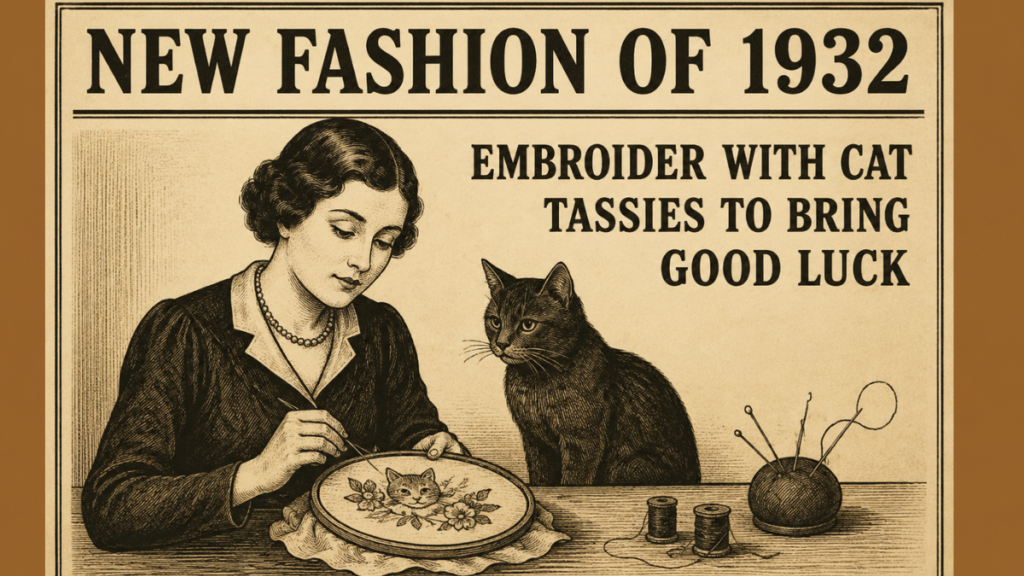
A humorous vintage-magazine dispatch on the curious fashion of 1932: stitching with cat whiskers to attract good luck. Between superstition, history, and feline comedy, revisit an era when every stitch promised fortune.
More curious stories over at The Story Workshop.
THE VINTAGE CORNER · THE ILLUSTRATED GAZETTE
New in 1932: Stitching with Cat Whiskers to Attract Good Luck
A special two-column edition: gentle superstition, improbable stitches, and a feline community demanding clear terms. A humorous dispatch with historical winks and household ethics.
The town has woken to a fashion as whimsical as it is charming: stitching with cat whiskers, always shed by feline choice, to bring good luck to hems, coasters, monograms, and embroidered hearts. The whole business, which sounds like something dreamed up over a bottle of anise, has gone from stoop gossip to headline with a trumpet. The chronicles report that on the corner of the square, one dressmaker is working discreet fishbone stitches with feline whiskers that, catching the light, grant goodwill to anyone who looks. Official statistics are lacking, but happy testimony and expectant yarn are in abundant supply.
The story begins with a cat named Marquis, a 19th-century soul trapped in the compact body of 1932. They say that after a nap worthy of a cathedral, he let a whisker fall onto the windowsill. The dressmaker of the house, a devotee of applied curiosity, picked it up with tweezers and examined it against the light. “This will stitch luck,” she announced without a hint of embarrassment. Nobody dared contradict her, since her intuition had more precedent than most books.
That same day she stitched a tiny horseshoe into the hem of a Sunday dress. The thread was obedient, the whisker unprecedented, and the stitch looked as if it had been signed by a breeze. Within a week, three neighbors claimed to have found forgotten coins. The following week, a letter arrived on time. The week after that, the streetcar ran on schedule. The rumor climbed with the elegance of ivy and, before anyone quite noticed, the whole town was combing rugs and baseboards in search of emancipated whiskers.
The first statement from the Friends of the Cat Club left no room for doubt: “Naturally shed whiskers only. Anything else is a civil sin and terrible luck.” The manifesto, hand-stitched onto the market bulletin board, collected signatures, stamps, purrs, and a drawing of a sardine. Ethics came before fashion, and that alone tells you plenty about this neighborhood.
The first commissions were modest: monograms, clovers, miniature fish. Talk of landscapes, constellations, and bordered dreams would come soon enough. First, though, one had to learn to hold a whisker the way you hold a fragile word: don’t squeeze, don’t show off, don’t break the silence that gives it its shine.
“A cat’s whisker is a comma that fell out of a meow. Stitch it in the right place and luck starts breathing.” (Notebook entry, winter of ’32)
Educated skeptics will rightly point out that amulets and stitching have been courting each other for ages: buttons sewn on backward to fend off the evil eye, handkerchiefs stitched with a promise, ribbons standing guard over letters. There’s no law, but there is custom. In certain regions, grandmothers swear, the first thread of the year had to be red. In others, the last bow of the day was meant to sleep under a pillow to guarantee sweets and bread. Within that chorus of household tactics, the feline whisker found its own contralto voice.
There’s no shortage of accounts of sailors who kept animal hair as a charm against storms, or of seamstresses’ diaries inventing signals to remember which side was the right side when sleep came calling. The libraries stay silent on stitched whiskers, academic prudence being what it is, but street memory more than compensates. Every neighborhood has a story in which a cat, looking thoroughly distracted, guides the needle toward the afternoon’s happy conclusion.
That cats bring luck is a claim that crosses centuries without breaking a sweat. That cats lend whiskers for stitching luck, on the other hand, is a 1932 novelty. Perhaps an exaggeration, perhaps a metaphor that got away from us, perhaps a need to believe that small things can tip the world simply by wanting to. This newsroom, neutral from birth, takes the most journalistic position available: verify by stitching.
Trial evenings were duly organized. A tablecloth with a whisker at each of its four corners produced friendlier coffee, according to consensus. Sheets stitched with tiny stars, each point begun with one, guaranteed mornings free of alarm. A child’s cap trimmed with whisker accents promised naps scored by pigeons. Happiness can’t be measured with a tape measure, though a smile can: the tape recorded three additional inches of upturned mouth compared with previous days.
2) Collect with tweezers, thank with a scratch behind the ears.
3) Clean gently (water and a whisper), dry on brown paper.
4) If the cat isn’t interested, the project waits.
5) A whisker that breaks is a whisker returned to the wind.
The technique, to everyone’s surprise, takes less force than a strand of silk. The first requirement is patience: whiskers are stiff and short, perfect for accent stitches and useless for endless lines. The second is touch: hold them with fine pliers or with a pianist’s fingers, letting the whisker settle into its own natural curve. The third is placement: a whisker stitches best on fabrics with body, meaning canvas, linen, and well-mannered wool, and worst on timid gauze or nervous silk.
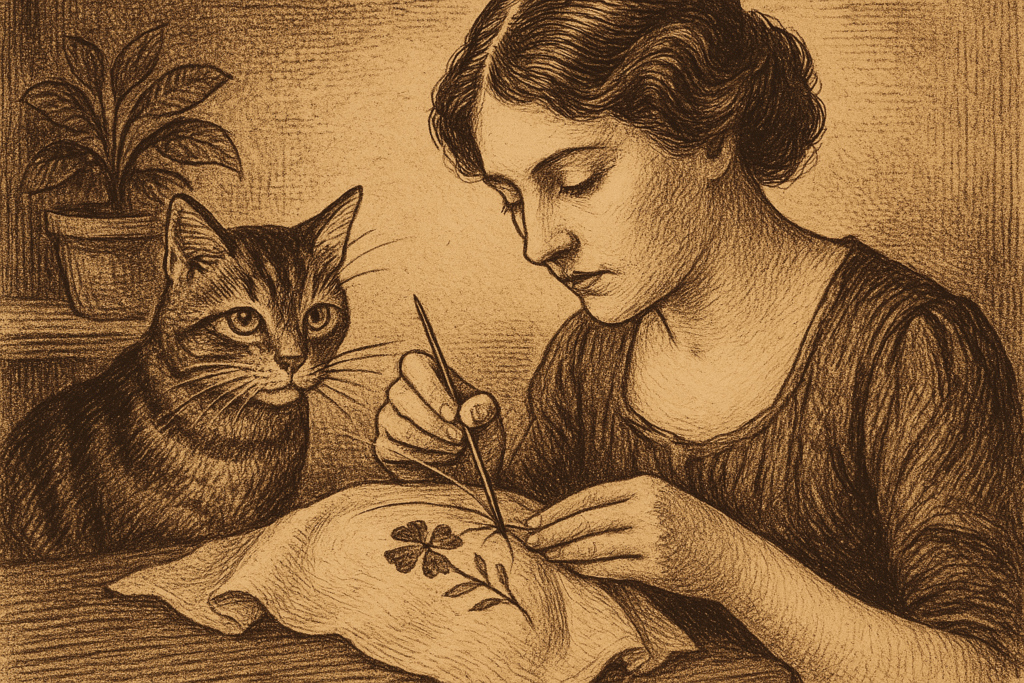
To secure it without betraying it, use fine thread matched to the fabric. The stitch that works here goes by the name “shadow stitch”: it enters and exits right along the edge of the whisker, escorting it. The goal isn’t to pierce it, since whiskers are tough and would ruin your needles, but to hold it down with the discretion of a bodyguard. Two stitches at each end usually suffice, plus one in the middle if the curve calls for it, or none at all if the whisker agrees to rest without adventure.
Designs? The first ones were symbols of good omen: horseshoes, clovers, market fish, kindly eyes, moons that never run out. Then came the daring: constellations (Orion rendered in exactly three whiskers), monograms that gleam without shouting, silhouettes of cats glimpsed from the corner of your eye. There were also experiments with invisible letters that only reveal themselves when the afternoon light comes in sideways. That particular mystery has become the signature of the finest hands.
Mistakes, which are the salt of every workroom, take the form of the listless fishhook (when the whisker droops with boredom), the irritated comma (when the stitch squeezes it), and the doubtful eyebrow (when the design can’t decide which proverb it serves). All are fixed with an ancient technique: undo the work with kind words, save the whisker for another day, and consult the cat, who tends to be patient as long as the sun comes through the window.
“Never force a whisker: it has a cat’s memory. You supply the needle, it remembers which way the wind went.” (Marginal note on pattern no. 19)
Like any fashion with a talent for conversation, this one organized itself. At the corner café, the back table declared afternoons of “patterns and purring.” Everyone brought a find, whether a domesticated whisker, a story, or a sketch, and the group debated ideal placement, prudent symbolism, and the exact number of escort stitches. The café owner, a born strategist, installed a box of “feline lost and found”: whiskers, certainly, but also feathers, pebbles, and leaves that seemed to have noticed something. Science calls that affective collecting. The neighborhood calls it pretty things.
At the market, the thread stalls improvised signs: “Whisker recommended as an accent; everything else in mercerized cotton.” Out in the square, a rumor-filled skylight hosted the first gathering of whisker embroiderers, where sample cloths were presented and technical embarrassments were laughed off with a seamstress’s grace. At the close, a chorus of neighbors with discreet guitars sang new lyrics: “If the whisker falls, let it fall by choice; if the luck arrives, let it come without a fright.”
The more serious faction of the neighborhood, comprising pencils, accountants, and one pharmacist, sent a letter to the editor arguing that good luck is a statistic: “Combine affection, patience, light, and conversation, and the probability of a happy afternoon goes up.” This newsroom published it with silent applause. Immediately afterward, a nameless cat climbed onto a counter and, with the air of a columnist, closed its eyes. It was the most widely read period of the month.
There were, of course, small controversies. One sharp-featured neighbor maintained that stitching whiskers was frivolous. Another countered that frivolity is refusing to converse. A gentleman with Sunday hair asked whether the whisker might be stitched into men’s handkerchiefs. It was approved unanimously on one condition: that the handkerchief know how to dance.
Controversial topic (but civil): which symbols bring the most calm.
Forbidden topic: plucking whiskers. The answer is no.
Delicious topic: memories of cats who taught you how to sleep.
To satisfy the reasonable-minded, a physics teacher in a kitchen apron delivered a talk titled “Mechanical Properties of the Feline Whisker and Its Application in Folk Arts.” Chalk in hand, he explained that whiskers, technically vibrissae, are stiff, sensitive, and elastic within their means: they detect air currents and, if we speak to them softly, perhaps also the whims of chance. “Let the record show,” he added, “that we are not running a clinical trial here, we are doing structural poetry.” The audience applauded with their elbows, so as not to interrupt any stitches.
The talk yielded plenty. There was debate over whether the vibration of the streetcar might disturb the charm (conclusion: the streetcar adds rhythm rather than subtracting goodwill), whether a full moon illuminates the edges better (yes, though the table lamp keeps a better schedule), and whether cats preferred to see their whiskers on tablecloths or in pockets. A committee of sleeping felines resolved by majority that wherever there’s a nap, whiskers are well spent.
Chemistry, in its kitchen edition, added a lovely detail: clean the whiskers with gauze dampened in water and a drop of vinegar, dry them between sheets of paper, and store them in an envelope with the date. Not out of obsessive control, but for the joy of telling stories from an archive. “This whisker fell the day the rain smelled like bread. This other one, when the radio said summer wouldn’t be long.” The world rests, they say, on details. The workroom has always known it.
Out of pure mischief, someone attempted to charge a whisker with static electricity to see whether it would attract luck more forcefully. Result: it attracted lint. Conclusion: luck, like cats, prefers a gentle touch and mystery without wiring.
“Technique without tenderness is a pair of scissors missing its screw: it cuts, certainly, but it doesn’t converse.” (Axiom coined over fresh bread)
The thread shops, forever ready for a quiet celebration, organized quickly. They don’t sell whiskers, heaven forbid, but they do offer accompaniment kits: modest hoops, discreet threads, needles that don’t take offense easily, and small cards printed with “whisker-friendly” designs. On the back of some packages appears a handwritten line: “Stitching with a whisker is like adding a whisper to the cloth.” They sold out in two weeks.
At the Sunday market, a stall appeared selling patterns with room for a whisker. Fish that turn without hurrying, moons willing to be outlined, stars with a gap at the tip. At closing time, the seller hands out a recipe for anise bread “because every stitch deserves a crumb.” Nobody disputes that principle.
Various forms of barter were attempted: one whisker (dated, with feline provenance) for a small ball of yarn, one cat story for a pattern, one afternoon of company for an inherited hoop. Money took no offense. It simply stepped back. Not everything has to pass across its counter.
The whole town seemed to soften. There was less impatience in line, more tolerance for badly behaved umbrellas, and a healthy epidemic of “thank you” in the bakeries. Whisker influence? A neighborhood placebo effect? Does it matter, if the afternoon ended better than it began?
2 cat stories + 1 small ball of yarn = 1 pattern with a moon.
1 sincere hug = 1 horseshoe border on your lapel.
We’ll repeat it with motherly insistence: whiskers are never plucked. They’re a sensitive part of a cat and losing them leaves the animal disoriented. Collect only the ones cats shed naturally, the way you’d pick up a leaf that fell from a tree with ambitions of becoming a bookmark. If the cat isn’t willing, don’t press the matter. If the cat is willing, say thank you with affection, decent food, and unhurried conversation.
City Hall, displaying a sense of humor that does it credit, announced it would not regulate the hobby so long as the neighborhood maintains good manners. It did, however, pass a poetic ordinance: “Loving cats is hereby strongly recommended.” The local police, who frequently rescue kittens from rooftops, applauded with helmets in hand.
The schools drafted a note for the youngest students: “Whiskers are not to be touched while still attached to the cat.” Children were told that cats are masters of napping and slow strolling, and that a whisker on the floor is a greeting rather than an obligation. The children understood on the first pass, the adults on the second, and balance carried on as usual.
Should any doubt remain, this newsroom offers a reminder in reasonable capitals: THE FASHION IS A GAME, THE CAT IS A PERSON (feline). Between the two, the most important thread is called care.
“No amount of good luck makes up for a bad gesture.” (A minimal editorial for large pockets)
Sunday shirt with a miniature horseshoe on the lower left. Reportedly the coffee never goes cold if you decide to tell a joke halfway through a sip. No scientific verification, plenty of applause.
Square tablecloth with four fish oriented to the cardinal points. Whoever sits at north pays for the bread, whoever sits at south brings the olives. This arrangement has saved friendships, they say.
Market tote with a discreet waning moon. Observers report a tendency toward finding fresh parsley even on rainy days.
Gentleman’s handkerchief with a monogram held up by a feline comma. Prevents major arguments. For minor ones, it recommends a short walk.
Child’s cap with a star at the crown. Guaranteed rotation on the carousel, provided the father isn’t in a hurry.
Needle case with a single whisker set on the diagonal. Serves as a reminder to be patient: breathe before stitching, smile after stitching, and if something won’t come out right, have a snack.
The dressmaker on the corner: “It’s an accent. It works no miracles, but it reminds the cloth that there are hands behind it.”
The watchmaker: “It brings in patient customers. The whisker means nothing to me. The quiet it brings does.”
A grandmother with wise fingers: “I laughed at first. Then I stitched a moon on my apron and the stew has asked for less salt ever since.”
A boy with a repentant slingshot: “I stopped scaring pigeons. Now I collect whiskers I find and save them for my mother.”
Marquis the cat (via human intermediary): “He has declared himself neutral. He requests open windows, folded blankets, and naps without photography.”
The librarian: “I stitched one into a bookmark. Sad endings have gone down easier ever since.”
Objection: “This is pure superstition.”
Answer: Correct, and it’s also conversation, play, affection for small details, and the wish to hold up an afternoon with something tiny that brings us home. If the luck never arrives, the time together does.
Objection: “Doesn’t it spoil the garment?”
Answer: Not when it’s done with restraint. The whisker isn’t the star, it’s a minimal signature. The garment stays a garment. The whisker is the smile.
Objection: “What if the cat gets annoyed?”
Answer: Cats are in charge. If the cat gets annoyed, the session ends. Feline authority allows no appeals.
Objection: “Does this last forever?”
Answer: Nothing lasts forever. That’s why we stitch.
“Hurry is the enemy of the whisker.” (A new proverb, approved by an overwhelming majority of feline yawns)
1) Check the floor near the cat’s favorite cushion. If there’s no whisker, don’t force reality. Come back tomorrow. Patience is the needle you never lose.
2) Choose fabric with a friendly body. A dish towel with party ambitions, a small pocket that wants to be a secret, a handkerchief that thinks it’s a map.
3) Clean and store the whisker you found. Don’t ask it for heroics. It’s small and it has a biography.
4) Sketch a minimal motif. A moon, a comma, a smiling fish. If you can’t decide, let the cat walk past and weigh in with its tail.
5) Stitch slowly. Two stitches at each end, one in the middle if needed. If the afternoon starts to crackle, stop. Crackling afternoons break stitches.
6) Wear it for the first time discreetly, alongside a snack. Luck, if it comes, prefers to find us in good company.
When the day ends, the lamp traces circles on the table and the workroom returns to its low breathing. The whisker, now stitched down, doesn’t gleam the way it did at first, but it is there. A minimal sign that says: there were hands here, there was a cat, there was conversation, there was a wish. Maybe luck consists of exactly that sum, the will to make the everyday a little lovelier. If it rains tomorrow, let it rain with a border. If the sun comes out, let it find the feline comma and take its time.
The closets, meanwhile, are learning new gestures. The Sunday shirt feels less severe, the good tablecloth feels more approachable, the pocket handkerchief looks cheerful, as though expecting a letter. In the pattern drawer, a loose page reads: “Next time, draw a constellation on the pillowcase.” The pillow yawns its approval.
The cat, any cat, settles wherever the light says to. It knows nothing about fashion, though it recognizes the calm of a house that listens to itself. Perhaps that’s why it drops, every now and then, the whisker that changes the tone of an afternoon. Not out of miracle, but out of complicity. Luck, we suspect, is a big word for small things done with care.
If anyone finds a whisker on the windowsill as this issue goes to bed, remember the pact: collect, thank, stitch quietly, offer a snack. If none turns up, no harm done. There are other ways to stitch good luck. Ask the person across from you how their day went, for instance. Sometimes that works better than a clover.
*From the desk of The Vintage Corner: no cat was bothered in the making of this issue. Every whisker used fell of its own accord. Luck, for its part, promised to return whenever it’s called politely.*