A fictional chronicle of how origami took over temples, imperial courts, and tea rooms — equal parts humor, history, and creativity.
The Creative Chronicle
Special Edition: Great Historical Moments in Craft
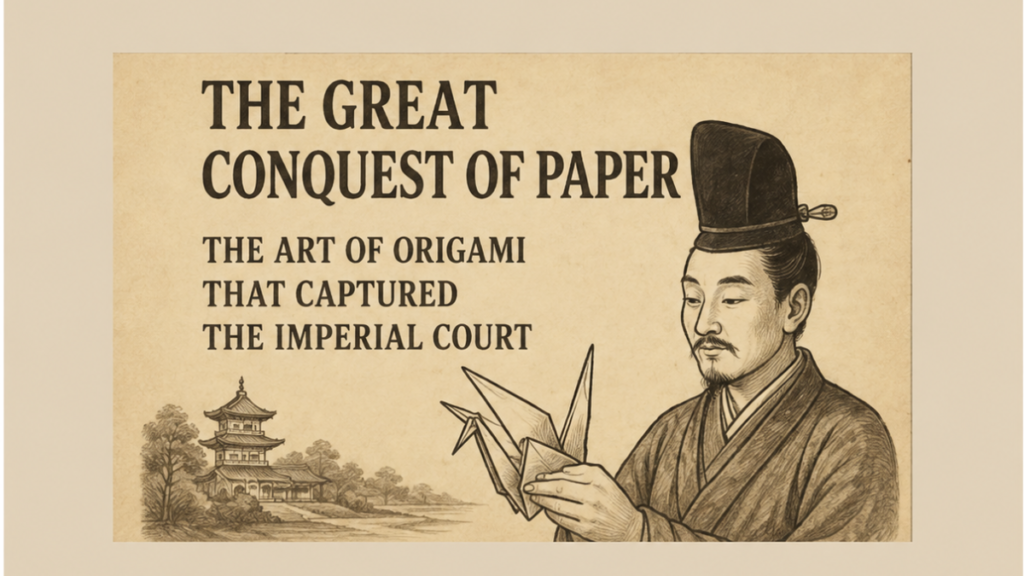
The Great Paper Conquest: How Origami Took the Imperial Court by Storm
In the early years of the 17th century, back when samurai still bickered over the precise length of their katanas and poets measured the world in haiku, a quiet artistic movement was spreading its paper wings: origami. Far from the busy markets of Kyoto, in temples where Buddhist monks practiced the strictest kind of meditation, an art form was taking shape that would change our relationship with a simple square of paper forever.
The secret annals tell us the monks were chasing enlightenment through the precision of their own hands. They folded with the patience of a sundial and the delicacy of a spring breeze. Every crease was a small act of devotion, and every crane, flower, and boat brought them one step closer to understanding the universe. Legend has it the very first origami crane was folded by a monk so meticulous that his fingers hardened like bamboo — and that when he finally looked at what he’d made, even the wind stopped to admire it.
“The very first origami crane was folded by a monk so meticulous that his fingers hardened like bamboo — and when he looked at what he’d made, even the wind stopped to admire it.”
Paper: A Treasure Worth More Than Gold
Back then, paper was no everyday object. It was a luxury reserved for temples and the nobility, made by hand from mulberry fibers, pressed and sun-dried so that every sheet carried a spirit of its own. Cuts and folds were never casual gestures: each crease had to respect the paper’s grain and strength, and a single slip could ruin hours of work. They say some artisans spent weeks perfecting one design, and that the most devoted students slept among mountains of paper, hoping to wake up with divine inspiration.
Origami’s Golden Age at the Imperial Court
It didn’t take long for origami to spread beyond the temple walls. The Japanese nobility took it up as a refined form of entertainment. “Origami tournaments” were held, where courtiers competed to fold the most flawless crane or build elaborate models of flowers and exotic birds. The chronicle of one Lord Takahashi describes a contest in which the entire court sat in silence for hours, watching a young man fold a paper dragon so intricate it seemed to breathe.
Those years produced some remarkable inventions. Artisans developed techniques that would still be considered advanced today. “Wet folding,” for instance, made it possible to create curved forms that mimicked waves or petals caught mid-motion. The “infinite crane” was a trick that let a folder unfurl a whole chain of cranes from a single square of paper. Poets and painters of the era drew inspiration from these works, weaving folding patterns into their prints and engravings, while philosophers argued over whether something so simple could really hold the soul of nature inside it.
Legends and Anecdotes: From Paper to Myth
Origami’s history is full of stories that border on the fantastic. One tells of a samurai who, bored stiff during a long night watch, folded an entire army of tiny paper soldiers. The next morning, his comrades swore that the soldiers had shifted position overnight, as if the paper had come alive under the moonlight.
Another tale features a young princess who set out to impress the emperor by building an entire forest of miniature paper trees. As the legend goes, when the emperor laid eyes on it, a wind rose up and stirred the leaves, creating the illusion of a real forest. The princess won not just the admiration of the court but an honorary title that let her open Japan’s first official origami school.
Origami in the Modern Age: An International Revival
Although origami began as an art of cutting and folding limited by the sheer expense of paper, the centuries eventually democratized it. In the 20th century, Japanese masters started teaching their techniques in the West, and designs evolved to include animals, geometric figures, and architectural structures. Some contemporary artists use millions of creases to build enormous sculptures, while others focus on the quiet perfection of a single fold — proof that the essence of origami hasn’t changed at all: patience, precision, and respect for the material.
These days, origami is studied in mathematics and engineering departments alike. Folding techniques are applied to space structures, collapsible prosthetics, and even tiny robots that mimic biology. Still, far from any laboratory, the spirit of origami lives on in the simplicity of a sheet folded by a kid in his bedroom, in the grin of someone who finally nails their first crane, and in the echo of a tradition that began centuries ago in a silent Kyoto temple.
Conclusion: An Art That Outlasts Time
And so, somewhere between real history, legend, and a healthy dose of imagination, origami earns its place as a genuine “great historical event.” Not because it toppled empires or started wars, but because it transformed the way human beings engage with material, patience, and beauty. Every fold is an act of meditation; every finished figure, a small victory over how quickly time slips away.
“Looking at a perfectly symmetrical crane, it’s hard not to feel like part of a story that spans centuries, temples, palaces, and the smallest of workshops.”
Don’t leave without stopping by The Creative Chronicle!!