Is your tiny bathroom total chaos? Discover the definitive guide to organizing a small bathroom. Foolproof tricks, vertical storage ideas, and practical solutions explained step by step to transform your space today.
Have you ever felt like your small bathroom is a battlefield in the morning? I understand completely, because I’ve also had that experience of waking up with barely enough time, rushing to wash my face, and ending up in a bad mood. Opening the cabinet and having an arsenal of half-used shampoo bottles fall on you, along with sample creams you’ll never use and that hair dryer with the eternally tangled cord, is a classic. It’s incredibly frustrating, and it’s daily reality for a lot of people. Living in a small apartment has plenty of advantages, but bathroom space usually isn’t one of them. Sometimes it seems like architects design these rooms assuming we only keep a toothbrush, a bar of soap, and one towel in them.
The truth is that in that tiny space we need to fit our skincare routine, our hair products, spare towels, the first aid supplies, and countless small everyday objects. I want to give you some excellent news to take a weight off your shoulders. The real problem isn’t the size of your bathroom, it’s how you’re managing every available inch of it. I’ve spent quite a few years optimizing tiny spaces, testing every organizer on the market and getting it wrong many times before finding what actually works.
In this ultra complete guide we’re going to go corner by corner and turn your little bathroom into an oasis of calm, order, and total functionality. Forget about messy renovations that coat everything in dust, or spending a fortune you don’t need to spend. What you’ll find here are logical, real solutions you can apply at home starting today. Make yourself a coffee, get comfortable, and get ready to discover how to make your bathroom look twice as big with a few well-considered changes.
This post contains affiliate links. If you buy through them, you’re supporting my work (at no extra cost to you)
The crucial starting point: an honest assessment of your small bathroom
Before buying any cute basket or hanging shelves like there’s no tomorrow, we have to make a mandatory stop that I consider fundamental. The biggest mistake we make when trying to organize a small space is skipping the purge phase because we’re rushing. We love hoarding just in case, keeping things we know perfectly well we’ll never use. In the bathroom this habit gets especially dangerous, because available space is minimal and fills up fast.
The total empty-out rule for seeing reality
Here’s an exercise that may feel a little dizzying at first, though I promise it’s completely liberating for your mind and your home. Take absolutely everything out of your bathroom right now. Empty the drawers completely, clear the entire counter, pull out what’s under the sink, and put it all on the bed or the dining table.
Seeing that whole mountain of products together creates a visual impact I consider completely necessary for snapping into action. That’s the moment you realize how many duplicated, expired, or simply useless things were stealing your sacred space.
When physical space is limited, every object you decide to keep in your bathroom has to earn its right to take up room. If a product doesn’t add value on a daily or weekly basis, it’s working against you and you should get rid of it as soon as possible so you can breathe.
The truth about free samples and half-used products
Let’s talk plainly about something that happens to all of us at home. Think about how many cream samples, hotel shampoos, and perfume vials you’ve had stashed at the back of a drawer for months or years.
We keep them thinking they’ll be great for a short trip, but then the trips come along and you end up putting your usual products into small bottles because you trust those more. Those samples stay tucked in a corner, gathering dust and taking up the spot where your everyday moisturizer could be.
Exactly the same thing happens with bottles that have barely an inch of product left at the bottom. We feel bad throwing them out because they cost money at the time, but the reality is you’ve been using a different shampoo for months that you like better and that leaves your hair looking nicer.
My advice here is radical but effective. If a product is nearly finished and you like it, use it intensively until it’s gone this very week. If you don’t like it or it’s expired, toss it without guilt, because it’s doing nothing for you.
Remember that cosmetics have an expiration date once opened. Check the open jar symbol on the label to see whether they’re still in good shape before putting them back.
Sorting by category and frequency of use
Once you’re left only with what you truly use and need in daily life, it’s time to categorize everything. Don’t make the mistake of putting things back into drawers without a logical order, because you’ll be back in chaos within two days.
Divide your belongings into well-defined groups so you know exactly what you have. You can make one group for daily hygiene products like face wash, toothbrush, and deodorant. Another group can be your hair routine with the dryer, the flat iron, mousses, and serums.
Makeup and frequently used cosmetics should go together in another spot. Backup stock, like new body wash, toilet paper, and extra toothpaste, forms another category. First aid supplies and feminine hygiene products get stored separately.
Always apply the proximity rule with logic. What you use every day of the week should be in the quickest, most comfortable spot to reach, ideally between eye level and hand level so you don’t have to crouch.
What you use once a week can go a step beyond in the cabinets. Backups or occasional-use products should occupy the least accessible zones, like the highest part of the shelves or the back of the vanity where it’s harder to reach.
| Area | Common problem | Recommended solution | Main benefit |
|---|---|---|---|
| Initial assessment | Useless products piling up | Empty everything and purge | Reclaim space fast |
| Half-used products and samples | Overflowing drawers | Toss the expired, use what works | Less visual clutter |
| Sorting | Everything mixed together | Organize by category and frequency | Find everything faster |
| Vertical storage | No floor space | Install floating shelves | Put your walls to work |
| Above the toilet | Wasted space | Add narrow shelves | More storage with no floor footprint |
| Rails and accessories | Crowded counter | Use kitchen rails and hooks | Keep surfaces clear |
| Above the door | Empty zone | Add a high shelf | Store backups and extras |
| Under the sink | Chaos around the plumbing | Modular organizers | Multiply your capacity |
| Drawers | Things sliding around | Divide with bins | Order that holds |
| Cabinet doors | Unused surface | Hang organizers and hooks | Gain hidden space |
| Shower area | Too many bottles and moisture | Tension shelving and baskets | Order and easier cleaning |
| Visual style | Too many colors and packages | Use matching refillable bottles | Spa feel and openness |
| Rental apartment | No drilling allowed | Heavy-duty adhesives and hooks | Organizing without a drill |
| Towels | They take up too much room | Hotel-style rolling | Saves visual and physical space |
| Towel drawers | Hard to reach | Vertical Marie Kondo method | See everything at a glance |
| Feeling cramped | Dark colors | Use whites and neutrals | Visual openness |
| Lack of light | Small dark bathroom | Large mirrors plus LED lighting | A brighter space |
| Daily clutter | Things left out of place | The two-minute rule | Effortless order |
| Crowded counter | Too many products on display | Keep only the essentials out | Faster cleaning |
| Maintenance | The chaos returns | A quick monthly review | Order that lasts |
The power of vertical storage: conquer your walls
When your bathroom floor is so small you can barely move your feet without tripping over the scale or the trash can, the only logical direction to look is up. The walls of small bathrooms are usually large surfaces going to waste out of fear of overloading the room.
We think hanging things will crowd the space, but done thoughtfully the effect is the opposite, because you free up the floor and the counter. That creates an immediate sense of visual openness and lightness you’ll appreciate every morning.
Floating shelves and shelving above the toilet
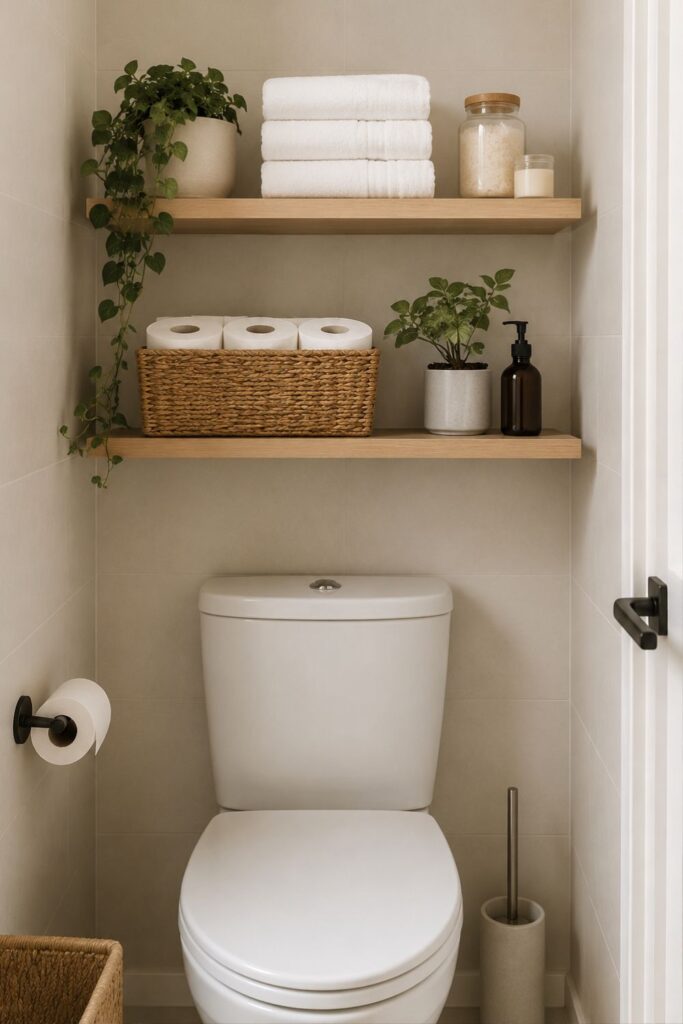
The space right above the toilet is one of the great forgotten areas in standard interior design, which strikes me as a real shame because it’s a gold mine for storage.
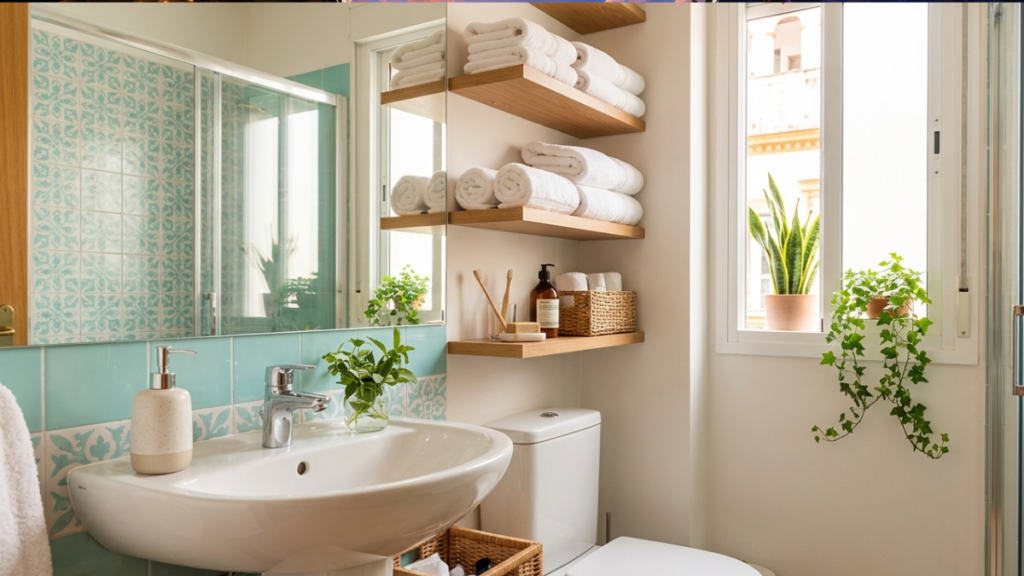
Adding a couple of floating shelves in light wood or white gives you a wonderful surface. You can put neatly folded towels there, rolls of toilet paper inside pretty baskets, or even a glass jar of bath salts for decoration.
When choosing floating shelves for this spot, make sure they aren’t too deep so you don’t bump your head standing up. Six to eight inches of depth is more than enough for most everyday bathroom items.
With no visible brackets, the look stays clean and minimal, which I consider essential when square footage is this tight.
Kitchen rails repurposed for the bathroom
One of my favorite tricks, thanks to its low cost and enormous versatility, is using kitchen accessories in the bathroom without a second thought. The stainless steel rails normally used for hanging kitchen utensils or spices work beautifully on bathroom walls if you give them a chance.
You can install a rail like this near the sink or the shower and hang small plastic or metal containers from it with simple hooks. In those containers you can organize makeup brushes, your comb, razors, or reusable cotton rounds. Since they’re suspended on the wall, you leave the sink surface completely clear, which makes daily wiping down much easier.
Using the space above the door
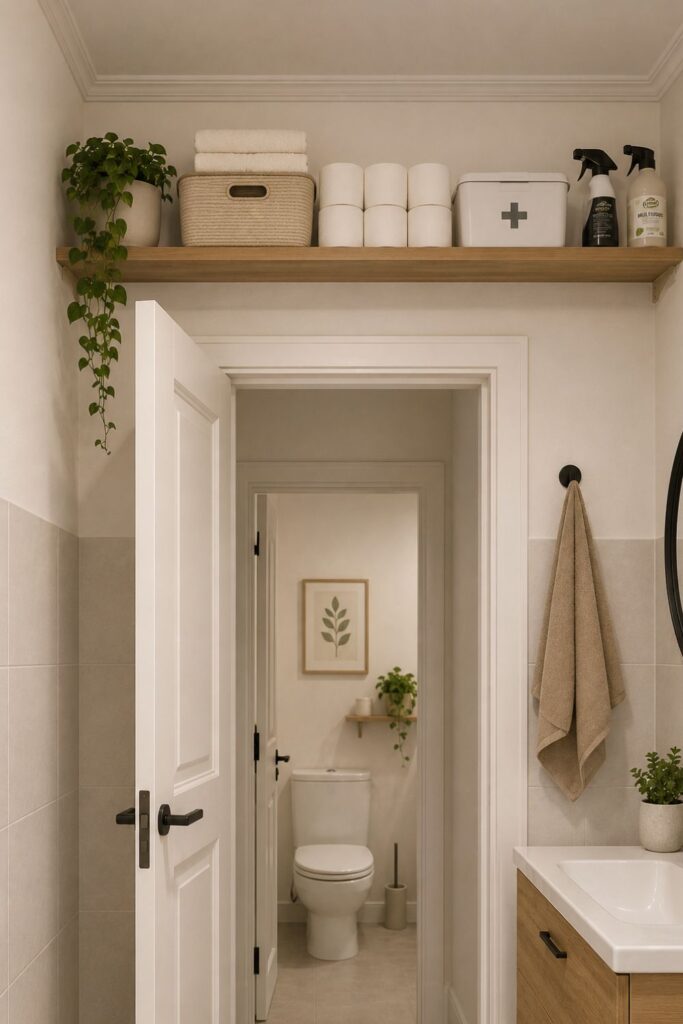
If you look up right before walking out of your bathroom, you’ll see a fairly large empty gap between the top of the door frame and the ceiling, usually about twelve to sixteen inches. That corner is perfect for a shelf running wall to wall.
Since it’s hard to reach day to day, it isn’t the right place for your daily creams, but it’s ideal for storing things you only need occasionally. You can keep beach towels there in winter, boxes of medication you don’t use daily, backup toilet paper, or the cleaning products specific to the bathroom.
Being so high up, it goes completely unnoticed by guests and frees up precious space lower down in the room.
Secrets for getting the most out of your vanity
The cabinet holding your sink is usually the main storage container in a bathroom, yet it frequently turns into a bottomless pit where things disappear from sight and pile up with no rhyme or reason. Whether you have wide drawers or a cabinet with hinged doors, there are very smart ways to multiply its interior capacity.
The great challenge of pipes and traps
The main enemy of order inside the vanity is the drain and the water supply lines. They take up the center of the space and keep us from placing big bins or full-width shelves. To solve this puzzle, modular organizers and pull-out solutions are your best allies.
If your vanity has doors, I recommend installing modular shelving designed specifically for under a sink. These units have shelves made of individual pieces you can remove or add to work around the drain pipe, letting you create two levels of storage on the sides and below the pipe.
If your budget is tight, just use clear plastic bins of different heights that you can fit around the pipes like a game of Tetris.
Divided drawers: the key to keeping things put
If you’re lucky enough to have drawers in your vanity, you know that every time you open and close them, everything inside slides toward the back or mixes together. The solution to this daily chaos is strict compartmentalizing.
You don’t need to buy expensive designer organizers. Kitchen silverware trays, clean shoe boxes, or the clear plastic containers sold at any discount store work perfectly. The key is measuring the width, depth, and height of your drawer carefully before buying anything.
Fill the drawer completely with these small containers so they fit snugly and don’t shift when you open it. Then assign each compartment a fixed job: one for lipsticks, one for hair ties, one for eye creams, and so on. Once every little thing has a set place, keeping order becomes automatic.
Hanging organizers for the inside of cabinet doors
If your vanity has hinged doors instead of drawers, you’re wasting a very valuable interior surface. The inside face of the doors is the perfect place for lightweight storage solutions.
You can add small adhesive plastic shelves or magnetic hooks for hanging things like the hair dryer, the flat iron, or a curling wand. There are also fabric organizers with clear pockets that hang from the top edge of the door on flat hooks. In those pockets you can stash hairspray, mousse, or brushes. Open the door and everything is instantly visible, with no crouching down to rummage at the back of the cabinet.
Clever solutions for the shower and tub area
The shower is another critical point where visual and physical clutter tends to reign. It’s very common to see shower floors flooded with bottles of body wash, shampoo, masks, and loofahs sitting directly on the floor or in the corners of the tub.
That isn’t just uncomfortable and unattractive, it also makes cleaning harder and encourages mildew thanks to water pooling under the bottles.
Corner tension shelving
If you share the bathroom with a partner or your family and everyone uses a different shampoo or treatment, the number of bottles in the shower multiplies fast. For those cases, tension shelving units that run from the edge of the shower pan or tub up to the ceiling are a wonderful solution.
These units consist of a vertical steel or aluminum pole held in place by pressure, with no need to drill into the tile. They come with several wire baskets you can adjust up and down the pole.
Placed in a dead corner of the shower, they use very valuable vertical space and let every member of the family have their own shelf for their products. Being wire, water drains perfectly and bottles dry fast, preventing moisture problems.
Mesh baskets with heavy-duty suction cups
If you prefer something more discreet, or you only need room for a couple of bottles, baskets with vacuum suction cups are a fantastic option. Just make sure to choose good quality cups, the kind you tighten by turning a screw, since traditional plastic suction cups eventually let go in the middle of the night with a horrifying crash.
Place these baskets at a comfortable height where they won’t get in the way while you shower. A good trick is putting them on the wall opposite the showerhead so they don’t take a constant stream of water, which keeps both the bottles and the basket cleaner for longer.
The trick of identical refillable bottles
This is a secret that completely transforms the look of any small bathroom. Commercial shampoo bottles come in every shape, size, and loud color imaginable. When you have five or six different bottles in the shower, the visual noise is tremendous and makes the space look messy even when it’s clean.
The solution is buying a set of matching refillable pump bottles, ideally in amber, clear, or minimal white plastic. Fill them with your favorite shampoo, conditioner, and body wash, then add a pretty waterproof label to identify them.
The visual change is instant: your shower goes from looking like a supermarket aisle to feeling like a luxury spa cabin. With a pump, you also use the product more efficiently and stop dropping bottles while trying to open them with wet hands.
No-drill accessories: your best allies if you rent
One of the biggest limitations we face when renting is the ban on drilling into bathroom tile. Landlords tend to be very strict about this, and rightly so, since a drilled tile is hard to repair.
Fortunately, the market now offers wonderful solutions that hold with incredible strength without a drill.
Heavy-duty adhesives and technical double-sided tape
Forget those old adhesive hooks that fell off the moment you hung a damp towel on them. Today there are polymer adhesives and industrial-grade double-sided tapes that hold astonishing weight and stand up perfectly to the humidity and steam of a bathroom.
You can find towel bars, toilet paper holders, and even full shelves that mount with special adhesive plates. The key to making them work is surface prep: clean the tile thoroughly with rubbing alcohol to remove any grease or soap residue, let it dry completely, press the accessory on firmly, and, most importantly, strictly respect the curing time the manufacturer recommends (usually 24 to 48 hours) before hanging any weight on it.
Hooks over the shower door or the bathroom door
Another excellent option that requires zero installation is over-the-door hooks that hang directly on the top edge of a door or a glass shower panel.
A double hook on the shower panel lets you keep your towel or robe right there as you step out, so you don’t drip across the floor. On the main bathroom door, a multi-hook rack gives you a fantastic place to hang the clothes you’re about to put on, or the whole family’s bath towels, without using up any wall space.
The art of folding towels to gain visual and physical space
Towels are one of the bulkiest things in a bathroom. Store them stacked the traditional way, one on top of another, and you’ll fill an entire shelf with just three or four towels. On top of that, when you try to grab the one at the bottom of the pile, you’ll almost certainly knock the rest out of place.
The hotel or spa rolling method
For small bathrooms, the definitive way to store towels is rolling them instead of folding them into squares. Fold the towel in half lengthwise, then roll it compactly from one end until you have a firm cylinder.
This system has wonderful advantages. For one, towels take up far less physical space with the fabric compressed. For another, they look beautiful and convey a sense of order and care that’s very pleasant.
You can put these rolled towels in a woven basket on a shelf, or stack them in a pyramid directly on a shelf. Best of all, you can grab any towel without the rest of the pile collapsing.
Vertical folding in drawers
If you decide to keep hand towels or washcloths in a deep drawer, the vertical folding inspired by the Marie Kondo method is your best option. It means folding the towel so it stands up on its own inside the drawer, like files in an office cabinet.
When you open the drawer, you see the edge of every available towel at a glance. You won’t have to lift some to get to others, which keeps your order intact for weeks. This system also lets you arrange towel colors attractively, creating a very tidy, clean visual effect every time you open the drawer.
Lighting and color: visual tricks for expanding the space
Order isn’t only achieved by organizing physical objects, it’s also built through visual perception. A perfectly organized bathroom that’s dark, painted a dull color, or poorly lit will still feel cramped and oppressive.
With small changes to the decor, we can trick the eye into perceiving the space as much larger and airier.
The rule of white and bright neutrals
In very small spaces, white is the undisputed king. It reflects light and maximizes brightness, and it also conveys a sense of cleanliness and hygiene that’s essential in a bathroom.
If all-white feels too cold or clinical to you, go with light neutrals like beige, pearl gray, sand, or very soft pastels. Apply these colors not only on the walls but also in your main textiles, like the shower curtain and the towels.
Keeping a unified, light color palette removes visual barriers and blurs the room’s boundaries, creating the optical effect that the walls are farther away than they really are.
Multiplying light with strategic mirrors
The mirror over the sink is a required element in any bathroom, but in a small one we can turn it into a tool for massive expansion. Instead of a small mirror with a thick frame that boxes in its own space, go for a large mirror, ideally frameless, that covers a significant part of the wall.
If your bathroom allows it, a mirror running from the countertop to the ceiling will completely double the visual depth of the room. It reflects the available light, whether natural if you’re lucky enough to have a window or artificial, making the whole bathroom feel far more open and bright.
Another excellent option is a mirrored medicine cabinet, updated with a modern design and very slim profiles. It gives you ideal storage for medications and daily creams right behind the glass while keeping your surfaces clear.
Layered lighting to eliminate shadows
A single bulb in the middle of the ceiling tends to cast hard shadows in the corners and on your own face when you look in the mirror, which makes the bathroom feel smaller and gloomier. The ideal is creating a lighting scheme with several layers.
Keep a general ceiling light with recessed neutral or cool fixtures, then add soft task lighting around the mirror. Adhesive LED strips behind the mirror frame create beautiful ambient light with no shadows, ideal for doing your makeup or shaving in the morning.
At night, that indirect light also creates a very relaxing atmosphere, perfect for unwinding in the shower after a long day at work.
Simple daily habits for keeping order effortlessly
You can apply every trick in this guide, buy the best baskets, and hang the biggest mirror in the world, but if you don’t change certain daily habits, your small bathroom will be chaos again within days. Keeping order in a small home doesn’t require hours and hours of cleaning, it requires building three-second gestures into your routine.
The two-minute rule after your morning routine
Mornings tend to be chaotic, and it’s normal that in the rush to get to work you leave the hair dryer on the toilet lid, the toothpaste uncapped by the faucet, and used cotton rounds on the counter. The problem is that when you come home tired in the evening, walking into that scene creates instant visual stress.
Here’s the two-minute habit I suggest: before walking out of the bathroom once you’re ready, spend exactly one hundred twenty seconds putting everything back in its assigned place. Cap the toothpaste, hang the hair dryer on its hook, put your brushes back in their container.
In a space this small, tidying takes almost no time when you do it immediately. When you get home in the evening, your bathroom will greet you with a sense of order that invites you to relax.
Keeping the counter completely clear as a rule
The counter around the sink should be free working space, not a warehouse for bottles. Try to keep it as clear as possible. As a general rule, the only things on it should be the hand soap dispenser and, at most, a nice cup with your daily toothbrushes.
Everything else needs a home inside the drawers or on your vertical shelves. A clear counter doesn’t just make the bathroom look instantly tidy, it also cuts your cleaning time in half, because one pass with a damp cloth is enough without lifting and moving ten different bottles every time.
A quick review once a month
Needs change, and products run out or accumulate without our noticing. To keep chaos from quietly recolonizing your cabinets, schedule a quick ten-minute review once a month.
Use a weekend moment to open the drawers, toss the empty bottles, check for expired medications, and see whether the current layout still works well for you.
This small maintenance task will keep you from having to do another massive deep clean later, and your organizing system will keep running like clockwork indefinitely.
Frequently asked questions about organizing a small bathroom
How can I organize the bathroom if there’s no cabinet under the sink?
This situation is very common in older apartments or in powder rooms with pedestal or wall-mounted sinks and no surrounding cabinet. In these cases, you have to get creative with the space left under the sink itself. One excellent solution is placing a couple of large lidded wicker or rattan baskets directly on the floor, tucked around the pedestal if there is one. In these baskets you can store toilet paper or clean towels, keeping them protected from dust and out of sight. There are also semicircular metal shelving units designed specifically to wrap around a sink pedestal, giving you two or three very useful levels without taking up extra space anywhere else in the room.
Which bins or organizers hold up best to bathroom humidity?
The bathroom is the dampest room in the house, so choosing the right materials for your organizers is crucial so they don’t warp or start to smell. Avoid untreated cardboard boxes at all costs, since they’ll absorb shower steam, lose their shape, and eventually grow mildew. The best materials are clear polypropylene plastic, which also lets you see inside without opening the bin, acrylic, glass for small containers, and metals with rust-resistant treatments or stainless steel. If you like the warmth of natural fibers, go with bamboo, which naturally resists humidity very well, or synthetic fiber baskets that look like wicker but rinse clean under the faucet.
How do I organize the bathroom if I share it with my partner and we have completely different routines?
The secret to sharing a tiny bathroom without arguments is strict territory division. You need to split the space evenly and permanently, with one drawer each or half the cabinet each. It’s essential that each person takes responsibility for keeping their own zone tidy and respecting the other’s space. For shared areas like the shower or the counter, decide together which products live there, like hand soap or a shared shampoo, and which go back to each person’s private zone after use. Individual pouches for makeup or shaving supplies help enormously too, because you take yours out in the morning, do your routine, and put the whole thing back in your zone when you’re done.
Where can I keep the laundry hamper if there’s no floor space in the bathroom?
The laundry hamper tends to be a bulky item that eats up much of the available floor space. If your bathroom is so small there’s no humanly possible way to fit one, you have several smart alternatives. One option is a fabric laundry bag that hangs behind the bathroom door on flat hooks, the same way over-the-door shoe organizers do. These bags usually have a zipper at the bottom so you can empty them straight into the washer. Another alternative is moving the hamper to another room where space is less critical, like inside a bedroom closet, the laundry area, or a hallway nook you’re not using. There’s no law saying dirty laundry has to live in the bathroom.
Is a shower curtain or a glass panel better in a small bathroom?
From a purely organizational and visual standpoint, a clear glass panel is the undisputed winner. Being completely transparent, it lets light flow through the whole bathroom and doesn’t slice the room in half, so the space is perceived as much larger and more continuous. If your budget is limited, though, or you rent and can’t install a panel, you can get a similar effect with the right shower curtain. Choose a light, white, or translucent curtain, and avoid large dark prints that create a visual wall. A fantastic trick is mounting the curtain rod as high as possible, near the ceiling, rather than right above the edge of the tub. That visually stretches the height of the bathroom and gives a sense of far grander space.
Your turn to transform and organize your small bathroom
At this point, you have in your hands all the information, design tricks, and organizing strategies you need to take charge of your bathroom and turn it into the tidy, bright, pleasant space you deserve.
Remember that you don’t have to do it all at once or spend a fortune in one go. You can start this very weekend with the purge phase and organizing a single vanity drawer. You’ll see how that small change motivates you to keep going with the rest of the room.
I’d love to hear about your experience and trade ideas. Leave me a comment below telling me about your situation. I read and personally answer every one. Let’s help each other squeeze the most out of the space in our homes.