A creative chronicle in old-magazine style about the day nobody tied off the thread and the world didn’t end. Humor, household history, and crafting told as breaking news.
THE CREATIVE CHRONICLE · CRAFTING GAZETTE
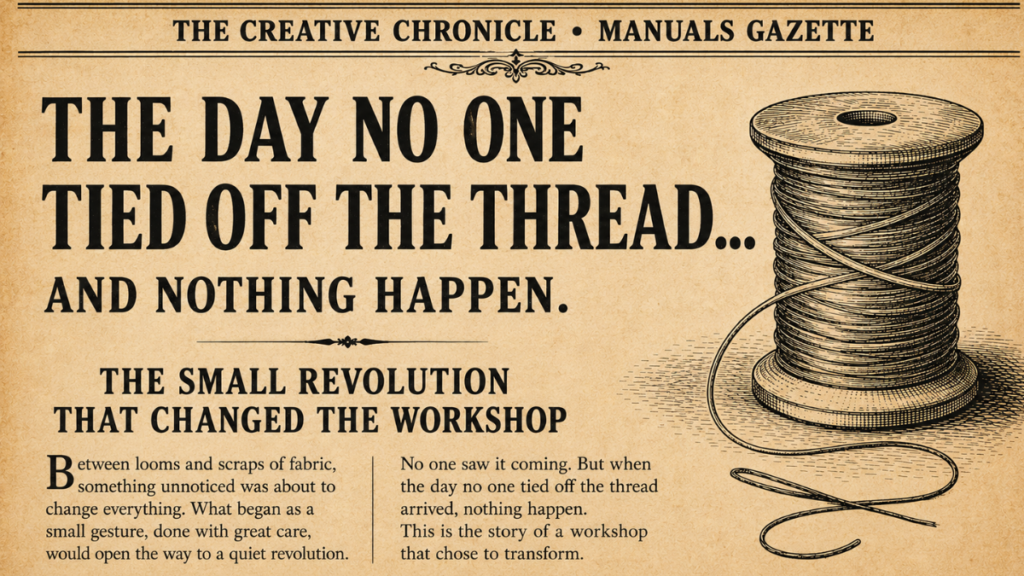
The day someone decided not to tie off the thread
and the world didn’t end
An extraordinary account of the incident that shook workrooms, sewing baskets, and consciences, proving that even the oldest commandments can be broken without apocalyptic consequences
At 5:42 p.m. on a seemingly harmless afternoon, someone whose name the archive has chosen to protect made a decision that would have been unthinkable just a few decades earlier: she finished her stitching and did not tie off the thread. The silence was immediate. The world held its breath. Nothing happened.
For centuries, tying off the thread has been considered an invisible pillar of household order. It never appeared in any constitution or catechism, yet it was taught with the same gravity. “Tie it off properly,” grandmothers said. “Or the whole thing comes undone.” Tying off wasn’t merely a technique. It was a moral declaration.
So when the protagonist of this chronicle set her needle on the table, looked at the finished work, and consciously decided not to secure that final stitch, the entire workroom seemed to tilt a few degrees toward the abyss. The thimble fell on its side. The yarn stopped rolling. Even the lamp flickered, as if it had doubts.
According to eyewitnesses, there was a moment of hesitation. Her hand hovered back over the fabric. The thread hung there, defiant, like a sentence with no period at the end. Then came the truly revolutionary part: the hand withdrew.
Five minutes passed. Ten. Half an hour. The stitching stayed exactly where it was. The pillow did not disintegrate. No cross stitch fled in terror. Far from rebelling, the fabric remained calm, almost grateful.
Word spread from mouth to mouth. Upstairs, someone asked whether it was true. At the neighborhood notions shop, people spoke of a “dangerous precedent.” One veteran embroiderer claimed the same thing had happened back in 1963, though nobody dared put it in writing.
Textile historians we consulted recall that tying off the thread began as a practical necessity: fragile fabrics, uneven threads, harsh washing. Over time, though, the technique hardened into dogma. Like every dogma, it stopped asking itself why.
What this episode demonstrates isn’t that tying off is useless, but that sewing, like life, tolerates more imperfection than we usually admit. Sometimes the thread doesn’t slip out. Sometimes the world doesn’t end.
Since the incident, other cases have been recorded. Small ones. Discreet ones. A button sewn on in a hurry. An edge left unsecured. None has caused a catastrophe worth reporting.
The editorial board of this gazette isn’t proposing that we abolish tying off, but something bolder: questioning it. Asking whether every stitch requires absolute control, or whether a few can be left loose, reminding us that not everything has to be closed in order to work.
“An unfinished thread isn’t carelessness. It’s trust.” Handwritten note found in a sewing box that had been left open
As this edition goes to press, the protagonist of the incident is still sewing. Sometimes she ties off. Sometimes she doesn’t. The world, so far, keeps on turning.
Don’t miss all the stories in our creative chronicle!