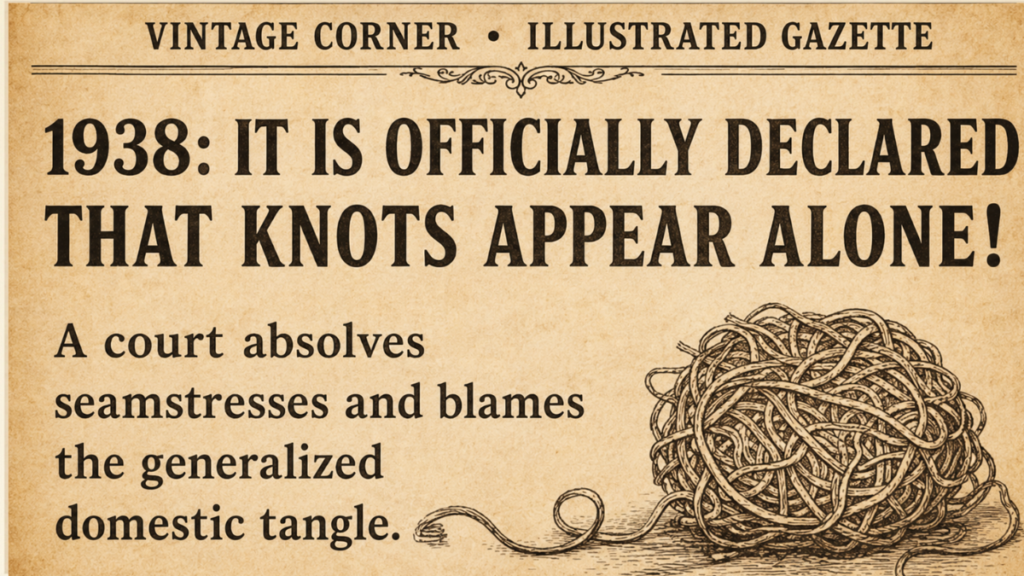
A humorous, old-magazine-style chronicle revealing the historic 1938 decree that confirmed knots appear on their own. Sewing, household mystery, and vintage humor for every pair of creative hands.
VINTAGE CORNER · ILLUSTRATED GAZETTE
1938: Knots Are Officially Declared to Appear on Their Own
A special two-column edition: minutes, testimony, and household science. Textile humor with real technique for surviving a tangle without losing your composure
In an emergency session attended by the thimble, the big shears, and a visibly nervous spool of cotton, the Committee on Household Affairs has issued a statement that shakes the sewing room to its foundations: “Knots are officially declared to appear on their own.” The measure, awaited by generations of sewists, aims to put an end to unfair blame, to “you must have yanked it,” and to the suspicious look that lands on innocent hands. According to the minutes, a knot is “a spontaneous phenomenon, sudden in its arrival, partial to pockets, and especially fond of black thread.”
The meeting opened with the kind of silence that announces either a storm or a confession. The thread, wound with excessive pride, sat in the middle of the table like someone showing off a clean record. Beside it, the large-eye needle stared at the ceiling, trying to recall how many times it had been accused of “tangling things on purpose.” The thimble, as always, called for order: “We came here for the truth, even if it stings.”
The agenda was read aloud: (1) Inexplicable tangles, (2) Knots that show up after thread has been put away in perfect condition, (3) The case of the spool that knotted itself inside a closed drawer, (4) Preventive measures that stop short of superstition, (5) Snack break. The snack break was approved unanimously before the debate began, in case things turned prickly.
The first witness was a veteran bobbin with a label from another decade. It testified calmly: “I was stored properly. I was wrapped with care. I was laid down in the sewing box. Even so, the next morning I woke up with a triple knot that was not mine.” Photographic evidence was submitted: a tangle so artistic that the newsroom considered framing it.
The big shears, which only speak when it matters, delivered the verdict: “Had this been a human hand, there would have been cuts. This is the work of fate or of physics.” Intrigued, the committee opened a folder. Out came a stamped document: the famous “Preliminary Report on the Autonomy of the Knot,” dated and written in unsteady ink.
When the conclusion was read, the whole room sighed. The minutes described the phenomenon as “domestic self-knotting,” caused by an explosive mix of hurry, static electricity, thread memory, and the universal law stating that small things escape the moment you look away. The thimble, moved, banged the table: “At last, the sewist is cleared of a historic charge!”
“Thread doesn’t tangle. Thread conspires.” Inscription found on the back of a pattern, 1938.
Until 1938, the knot was treated as a moral failing. It would appear, and someone would immediately say, “you must have done something.” Grandmothers, who have seen it all, began to suspect that the same person could not always be at fault. If the knot repeated itself in different houses, in different towns, with different hands, then maybe the knot was independent.
The Vintage Corner archives contain an early mention from 1912: “Today the thread did something strange.” Another appears in 1921: “The yarn ball woke up with a bow, as if it had been out all night.” In 1930, for the first time, we find the sentence that sparked the revolution: “It wasn’t me.” That humble, brave statement opened the door to a real investigation.
The committee flagged a key point: the knot has a weakness for moments of distraction. When the doorbell rings, when the needle drops, when the cat decides to weigh in, or when the coffee calls in that voice that means right now. The knot uses those seconds to make a theatrical entrance. How? Nobody knows for certain. Everybody has seen it happen.
So 1938 marks the historic turn: the knot stops being an “accident” and becomes a “phenomenon.” It is granted an existence of its own, and blaming whoever happens to be closest to the sewing box is prohibited by decree. Household justice, at long last, is set straight.
2) The phrase “you tangled it” is hereby abolished.
3) Breathing before pulling on thread is strongly recommended.
4) Black thread is entitled to extra rest.
5) A snack is guaranteed in the event of a triple knot.
The neighborhood scientists, who tend to be the wisest, explained the matter without embarrassing anyone. As thread moves, it builds up tiny twists. Those twists look for a way out, like opinions nobody said out loud. If the thread is loose, if the ball rolls, if the bobbin drops, the twist finds a way to cross itself. When two crossings fall in love, a knot is born.
Static electricity, especially in winter and in fabrics that rub with enthusiasm, adds to the drama. Charged thread sticks to itself like someone who can’t bear to part with their own gossip. “Long jumps” play a role too: those stretches of thread we leave dangling because we’ll trim them later. The committee declared them “official runways for the knot.”
The “Drawer Effect” also came up. You put the thread away in flawless condition, close the drawer, and when you open it again it looks like someone held a wedding in there. According to the minutes, this happens because of the house’s micro-vibrations: footsteps, doors, traffic in the distance, even conversations. The thread listens. The thread shifts. The knot seizes the moment.
What about the cat? The cat appears in the report as an “incidental agent.” It doesn’t always participate, but when it does, it participates with gusto. The committee recommended shielding yarn from feline attention with boxes, lids, or snack-based treaties. “Diplomacy works better than yelling,” the thimble clarified.
“If thread can wind, it winds. If it can’t, it tangles. When it tangles, it teaches you something.” Sewing room proverb.
The dressmaker down the hall: “I saw it happen. I set the thread down for two seconds. Two. I came back and there was a knot. Nobody was there. Not even the cat. What more proof do you people want?”
The retired tailor: “We used to blame the apprentices. What an injustice. I’m glad the knot is finally stepping into the light and owning up.”
A girl with a brand-new hoop: “I don’t get mad. I just undo it and move on. I would like the knot to apologize, though.”
The notions shop owner: “When your thread snaps because you pulled, that isn’t bad luck. That’s the knot laughing.”
The ball of yarn (written statement): “All I ever wanted was to be a scarf.”
The measuring tape: “This confirms my theory: whatever gets stretched eventually rebels.”
– The yarn ball rolls toward the edge of the table (it wants adventure).
– You tell yourself, “one second and I’ll be right back.”
– The cat raises an eyebrow.
– The black thread “gets shorter” for no reason.
1) Cut your thread short enough. When you’re hand sewing, work with lengths you can manage. Thread that’s too long is a serialized novel that ends in tragedy.
2) Contain the yarn. A mug, a bowl, a small pouch. A loose ball of yarn thinks it’s a soccer ball, and the knot thinks it’s the referee.
3) Undo before you pull. Yanking in frustration is an open invitation for the knot to multiply. Better: find the crossing, loosen it, breathe, undo it.
4) Let twist escape. Let the needle spin if the thread asks for it. Sometimes thread needs to unwind its personality.
5) Organize the sewing box. Small boxes, pouches, labels. Chaos is a spa day for the knot.
6) If it won’t budge, grab a fine needle or a pin. To open a knot without breaking fibers, use a fine needle plus patience.
7) Good light, clear table. The knot draws its power from darkness. A lamp is an honorable officer of the law.
2) Find the center: locate the tightest crossing in the tangle.
3) Loosen it: slide a fine needle into the middle and work it open.
4) Back the thread out: ease the tail backward, gently, never fast.
5) Repeat until it gives up: keep going until the knot surrenders out of boredom.
The committee devoted an entire chapter to black thread, that tragic figure of the sewing box. “It always runs out first.” “It always tangles more.” “It always turns up when you didn’t call for it.” The conclusion was that black thread suffers discrimination through overuse: outlines, rush repairs, buttons, emergencies. It lives in a permanent state of alert.
Black is also harder to spot when it falls, and whatever goes unnoticed is easier to step on. Whatever gets stepped on gets resentful. One expert ruled: “Black thread isn’t difficult. It’s exhausted.” The proposal was to create a “rest fund” for black: a dedicated spool, its own compartment, even a small ceremony of thanks.
The most applauded idea was instituting “Black Thread Day,” a workday with no outlines at all, given over to earth tones or soft blue. Black thread, in return, promised to behave better. There is no evidence it kept that promise, but the sentiment was touching.
By popular request, a final clause was added: “If black thread tangles, speak to it respectfully. Remind it that it is indispensable. Offer it tea.”
“There’s no sewing without black. There’s no black without drama.” Modern saying, attributed to a notions shop owner with tired eyes.
After the official declaration, a symbolic tribunal opened to hear from the accused: the knot. Naturally, the knot did not appear. Knots rarely show their faces. Experience spoke in its place: every hand went up, every hand told its story, every hand remembered a moment when thread behaved as though it had a will of its own.
The verdict was surprisingly compassionate: “The knot is inevitable, but not invincible.” Cursing more than three times in a row was banned (a public health measure), and swapping insults for proverbs was recommended. “A knot in sight calls for patience in the elbow,” for example. According to the minutes, humor reduces a tangle’s resistance.
Reconciliation was celebrated with cookies. The official cup of coffee was poured without hurry, and the sewing room recovered its balance. Someone hung a sign: “If a knot appears, it isn’t a failure. It’s a pause.” By the next day the sign already had thread stuck to it, proof that life was carrying on.
Ever since, at Vintage Corner, it is considered elegant to announce out loud: “A knot has appeared. Back in a minute.” Nobody questions it, because that is what 1938 left us: the innocence of hands.
Some decrees age badly, while others stay true no matter how the calendar changes. The one from 1938 belongs to the second group, because knots keep appearing with the same freshness as bread disappearing at somebody else’s house. Fabrics change, fashions change, shears change, yet the knot keeps its talent for surprise.
Maybe it isn’t an enemy so much as a reminder: there’s no project without a pause, no garment without patience, no human hand that doesn’t deserve forgiveness when thread turns theatrical. The knot forces you to slow down, to look closely, to undo what looked permanent. In a century built on hurry, that’s almost revolutionary.
So today, from this reprinted old gazette, we confirm the statement: knots appear on their own. Guilt, on the other hand, never has to appear at all. If a knot shows up, put on coffee. If it insists, call a friend. If it goes triple, remember the supreme law of the sewing room: the world doesn’t end over a tangle, it just delays the snack.
Signed, in ink and yarn: Vintage Corner.
*From the Vintage Corner newsroom: minutes closed. The knot will keep appearing, but at least it’s no longer in charge.*
Don’t miss everything that’s new in our newsroom!