A funny, nostalgic vintage-magazine dispatch on the most talked-about wedding in the textile world: the embroidery hoop and a 16-count Aida join their lives in cross stitch. Humor, sewing, and love among threads in a craft story with real soul.
THE VINTAGE CORNER · THE ILLUSTRATED GAZETTE
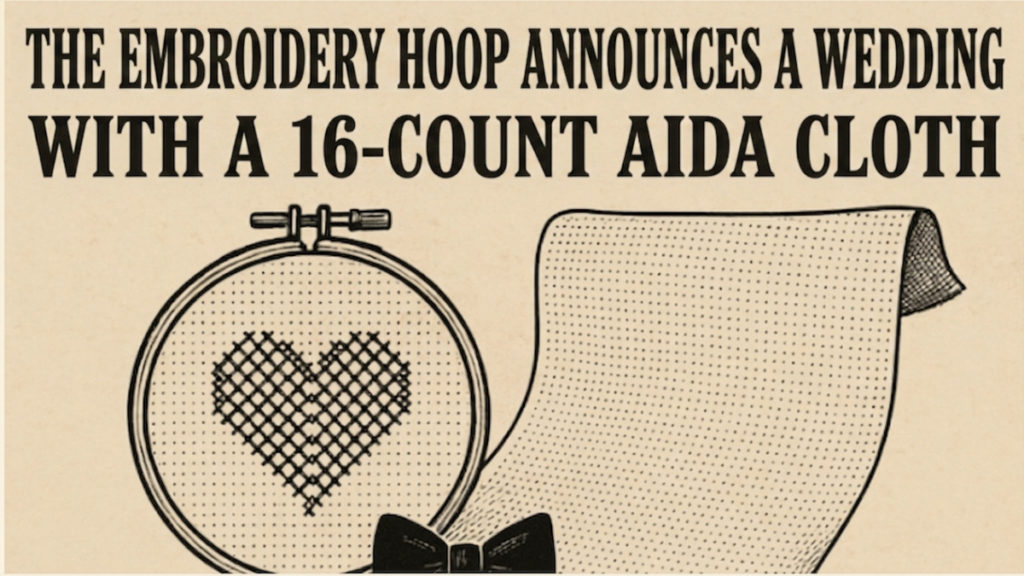
Nov 23 at 3:18 p.m.: The Hoop Announces Its Wedding to a 16-Count Aida
A special two-column edition: a workroom wedding report, cross stitch protocol, and music for needles. Textile humor, a little technique, and emotion laid out on a grid.
With the discretion of a stitch and all the pomp of a notions shop, the embroidery hoop, well-seasoned oak with an honest hinge and a screw with a strong sense of duty, has announced its wedding to a 16-count Aida, a fine grid with the manners of a lady who can hold a motif without losing her composure. The ceremony will take place in the hall of quiet afternoons, under an adjustable lamp and with witnesses of stranded cotton in civilized shades. Punctuality, good spirits, and clean hands are respectfully requested.

The announcement came mid-afternoon, when the light learns to speak in sepia. The hoop, moved by the occasion, tightened its screw just enough for the air to click in approval. The Aida, with its architecture of 16 stitches per inch, responded by drawing itself taut like someone straightening up for a portrait. There was a tablecloth silence, and a spoon struck a cup three times. The neighborhood understood that a story was being born.
The tape measure, formal and solemn, read out the preamble: “Given that the hoop was created to support vocations and the Aida was woven to support crosses, this union is agreed by acclamation to guarantee emotional stability for the threads, legibility for the pattern, and social peace for the parlor.” There was brief applause, since in a workroom people applaud sparingly so the tension doesn’t wobble.
The thimble, best man in iron, promised to intervene should any opinions turn prickly. The blunt-tipped needle, maid of honor, offered to guide guests to their color-coded seats. The threads, six-strand cotton floss, formed a discreet choir and swore to respect the color scheme without staging any yarn-based mutinies.
The wall clock, which is never late, marked the exact minute: 3:18 p.m. This dispatch notes the hour because some moments deserve a numbered square. Nobody knows why it happened then. Perhaps the sun found the right angle on the weave, perhaps the house smelled of bread and somebody said “now.”
“A hoop without cloth is a promise. An Aida without a hoop is a map with no frame. Together they turn afternoons into declarations of love written in X’s.” (Notions shop aphorism)
The hoop. Well-raised wood, softened edges, a screw that never brags. Its cardinal virtue is the right tension: firm the way an embrace holds you, not the way an embrace smothers you. In its youth it held doilies with monograms. In maturity it holds landscapes that look dreamed up by an old radio. Its greatest pride is leaving the cloth like a courteous drum. Its greatest fear is someone removing the fabric without loosening it first.
The 16-count Aida. A gridded weave with squares that are visible yet delicate, striking a balance between the tenderness of 14 and the audacity of 18. In the words of the textile librarian, “it’s the round handwriting of stitching”: easy to read, even better to write. It offers definition without pedantry, accepts complex motifs without stress, and lets the back of the work keep an orderly life, the kind known only to those who press with care.
They met over a Sunday tablecloth, when the hoop, in search of purpose, rolled a millimeter and brushed the corner of the Aida. The contact was louder than a tango. Ever since, they’ve shared afternoons of rehearsal: tighten, stitch a corner, loosen, tighten again. The thimble recorded their sighs in millimeters of pressure. The iron certified their good breeding with steam.
If the couple had a motto, it would be: “Stay calm, adjust a little, carry on.” In that order. They apply it to everything: to unexpected knots, to changes in the light, to the snails that occasionally come in through the window and decide to weigh in on design.
Wooden hoop: 8 to 10 inches, the diameter of confidences.
Tapestry needle: blunt tip, size 24, it doesn’t wound, it persuades.
Threads: stranded cotton, 2 strands for 16 count, 1 strand for outlining whispers.
The invitation recommends arriving with clean hands: mild soap, warm water, and a promise not to touch anything in a hurry. The dress code calls for aprons with pockets and sleeves rolled up as far as memory allows. Phones on thread-silent mode, laughter at full volume. Needles are asked to plan their route across the cloth with simple maps, and threads not to tangle themselves in other people’s conversations.
The rite is familiar: the hoop, taut and generous, receives the Aida with a gesture that says “I’ve got you.” The cloth responds by letting the pattern settle like a friendly shadow. The blunt-tipped needle opens a path between the regular holes, the threads cross in X’s like a shared vow, and the back of the work comes out clean as a freshly swept courtyard. In that dance, the whole house learns to breathe.
Warm drinks will be served: tea that wants a hug, coffee with a memory of long conversations, and cookies that don’t shed too many crumbs. The official tablecloth has been protected with brown paper, in case emotion spills a drop of enthusiasm. On the windowsill, two geraniums will serve as the vegetable choir, because at a workroom wedding some plant is always singing.
For anyone feeling nervous, there’s a “tension test” corner where each guest can stretch a scrap and listen for whether it sounds like a drum. Too loud, loosen it. No sound at all, tighten it. Life, translated into a screw.
“No amount of hurry makes up for a crooked cross, and no crooked cross can’t be fixed with patience.” (A grandmother’s maxim)
1) Preparation. Wash the fabric if needed, press on a warm setting, and cut with a generous margin. Serge or zigzag the edges to prevent any adventures with loose threads. Mark the center with two basting threads laid in a cross, like a well-mannered compass.
2) Tension. Mount the Aida in the hoop and tighten gradually. Tap the drum: it should answer with “yes,” not with “enough!” The screw, tuned to half a turn of poetry.
3) Threading. Two strands for the main filling, one for details and outlines. The size 24 needle asks to enter straight and exit humbly. No licking the thread and no theatrics: cut it cleanly and start with a loop start or an invisible anchor on the back.
4) Direction. Choose one consistent diagonal for your first half crosses (////) and close them all on the opposite diagonal (\\\\). Fidelity of direction: the sheen of the cotton will repay you with a lasting marriage.
5) A kind reverse. Avoid long jumps. If you must travel, take short routes and secure them with small passing stitches. The back never appears in the photo, but it holds the memory.
6) Rest. Every few inches, release the hoop and let the weave rest. The cloth breathes, the fingers come back. Long weddings have an intermission too.
A turned cross, leave it as a “mischievous kiss” or unpick it in good humor.
A furtive stain, cold water, whispered soap, and sunlight that doesn’t shout.
Shifting tension, loosen the screw and your forehead, then redo a small section.
The stranded cotton arrived in numbered outfits, each with its own character: party red, always two steps ahead; kitchen blue, forever offering to hold a cup; courtyard green, bringing news of the plants. White, as understudy groom, has permission to appear whenever the light runs short. Black asked that its mourning not be overused, though it happily agreed to outline eyes and commas.
The tapestry needle, older sister of the ordinary needle, gave a brief speech: “I don’t wound, I guide.” She reminded everyone that her blunt tip is a peace treaty with the weave and her generous eye a door with no pins in it. The thimble led the ovation, taking the opportunity to remind guests to ask each fabric for its hand before crossing it.
The patterns were seated by family: alphabets, flowers, houses with chimney smoke, inviting teacups, unstoppable constellations. Each brought its instructions on paper that smelled of a drawer. The textile librarian borrowed one, photocopied it with permission, and returned it blessed with a rubber band so the years wouldn’t come apart.
The guest hoops, round, square, drum, and table-mounted, formed an aisle for the couple. Some showed off gold screws, others wood of honorable origin. They greeted one another with a soft creak on tightening, which in the language of notions means: “how good to see you well.”
“There’s no guest more dangerous than a badly wound thread. Untangle it before it starts offering opinions.” (Note on the invitation)
To start, warm ranges: bread ochres, creams of light, greens that never get cross. For the main course, honest accents: two reds, one blue, and a shy yellow. For dessert, chocolate backstitch for a fine outline and French knots dusted with powdered sugar. To drink, water in a big pitcher and coffee with no hurry.
The music will be handled by a rhythmic needle: a soft tap-tap on the weave, the whisper of thread pulling taut, the faint click of the screw asking for adjustment. Anyone bringing a guitar should know that loops don’t take well to fast tempos. Stitching prefers waltzes to sprints.
As evening falls, there’ll be a dance of crosses, with pairs of strands ready to cross in the same direction. Guests are advised not to mix fibers of questionable judgment. Cotton and linen dance elegantly. Bulky wool needs a different dance floor.
At intermission, a toast to the grandmothers who taught us to count Aida with a fingertip, and another to the young hands now resting their elbows on the table to learn the miracle of the X.
3) Drops of coffee in a thick cup. 4) A brief laugh while unpicking a cross.
5) A long silence as a motif is finished.
As at any notable wedding, a debate broke out. The hoop always camp argued that uniform tension preserves the health of the Aida and the dignity of your wrist. The sometimes faction claimed that on the smallest details a bare hand negotiates the angles better. A minority never group cited wood-free traditions.
Agreement arrived through diplomacy: on 16-count Aida, the hoop is home, and if you need to step out for a moment, you step out without making a scene. The screw holds no grudges. The Aida, for her part, promised not to crease out of spite, and the iron offered couples therapy with warm steam.
Another matter lit up the room: start at the center or in a corner? Center orthodoxy won by majority, with a poetic concession to those who see the world from the upper left. Basting the axes like cardinal points was recommended so the map doesn’t wander off.
Finally the group took up the question of prewashing. Those who practice it, methodical and forward-thinking, laid out its advantages. Those who don’t, impatient and optimistic, defended the charm of that first blast of steam on brand-new cloth. This newsroom proposes responsible freedom and a kind detergent.
“Aida is no dogma. It’s a public square made of little squares, and nearly every procession fits.” (Neighborhood correspondent)
The registry, posted at the notions shop, includes humble treasures: spare needles, a small box for floss, scissors with heron-fine points, pins that don’t bend, a lamp with a swan neck, and a folder for patterns that resist the archives. They’ll also accept wooden frames with decent glass and acid-free paper, since posterity deserves its chance.
For practical minds, an envelope of time has been set up: anyone who’d rather not buy things can donate half an hour of company and conversation. The hoop and the Aida hold that the most useful gifts are the ones that turn into afternoons.
Someone has promised a wall hanger, someone else a bag with a well-mannered zipper, another a new pincushion with a soft seat. Somebody offered a mug that passes no judgment, which is the most valuable of all. The house cat promises discreet supervision, provided nobody moves its cushion.
Poems, proverbs, textile jokes, and cake recipes are accepted in separate envelopes. All of it adds invisible stitches to the trousseau of the spirit.
If you bring flowers, make sure the pollen has no ambitions of staining.
The expenses column includes honest thread, cloth with a noble little square, a hoop without vanity, a needle that doesn’t make a scene, and coffee. The value column, by contrast, includes conversations at half volume, eyes learning to measure by sight, breathing that syncs up with the X, children who ask questions, grandparents who tell stories, and a house discovering that the most expensive decoration is the one made with time.
The numbers were run with a soft pencil and reached a conclusion with no decimal column: the wedding comes out cheap if every guest brings one small story and leaves a bit of their hurry at the door. The Aida contributed her order, the hoop his constancy. The table supplied the rest.
In an era running at factory speed, stopping to cross two strands over a millimeter of cloth borders on heresy. So be it. This newsroom endorses any heresy that leaves a little warmth behind. No market quotes better than a handmade pillow when the cold returns.
For posterity, an inventory: cost of thread, sustainable joy; cost of cloth, a serene map; cost of the hoop, a repeatable embrace; cost of the light, one sunset. Returns: incalculable, though measured in “we finished it together.”
“Craft doesn’t save you money. It saves you sadness.” (Note on the notions shop wall)
The neighbor who never had time came, and stayed to close the last crosses along the border. The student who spends too long looking at screens came, and discovered that red 321 matches his scarf. The baker came with flour on his hands and left half a warm loaf for the intermission. The music teacher came and said that cross stitch keeps time in four, and she wasn’t wrong.
The cat passed through twice: once to smell the hoop, and again to fall asleep behind the lamp like a backup lamp. A blackbird remarked from the window that the squares reminded him of the vegetable garden. The wind tried to make off with a pattern, and the tape convinced it that today wasn’t the day.
There were discreet selfies, not out of vanity, but so everyone would remember on the way home that X’s are learned better in company. There were calls to distant cousins: “I’m saving you a thread,” “Send me a photo,” “I’ll send you a recipe.” There were toasts to those who couldn’t make it and promises to mail them a scrap of border to stitch from afar.
When the clock struck an hour with no name, neither afternoon nor evening, that interlude that smells of bread and lamplight, someone placed the final cross of the central motif. Nobody cheered. There was only that opening-night silence which is every house’s favorite music.
“May the pattern know how to wait.” “May the iron always be diplomatic.”
14-count Aida is a gentle school: it forgives hesitation, welcomes tired eyes, grants exemptions. 18-count is the conservatory: it demands a steady hand and rewards you with impeccable definition. 16-count, today’s bride, is a balanced conversation: detail without a magnifier, rhythm without fatigue, an outline that sings without shouting. In medium frames it delivers discreet miracles. In large ones it builds landscapes that hold up to company.
For a first-time stitcher, 16 lets you learn the whole choreography without tripping over the dress. For anyone coming back to it, 16 keeps its promises of precision without demanding penance. At night it takes kindly to ordinary lamps. By day it shows off a weave that’s tight yet legible.
The arithmetic helps too: two strands cover each square perfectly, one defined strand marks the outline, and three strands are for snowy areas with blanket ambitions, if you’re feeling showy. The back of the work, treated well, comes out like a map of side roads inviting you to get pleasantly lost.
In short, 16 count is commitment, which is a pretty word for saying this marriage has a future.
As the ceremony closed, the Aida, her motif now centered, asked to rest between two sheets of cardboard, like someone sleeping between friendly pages. The hoop, proud, loosened his screw and promised to be ready for the next afternoon. The iron, in a final act of matronly duty, glided steam across with slow breathing. The frame, a last-minute guest, opened its wooden arms and said, “whenever you’re ready.”
The piece was hung above the sideboard, flanked by two antique pitchers and a plant that demands nothing. Seeing it, the house recovered a murmur it had lost, the one that says “things are made by hand here.” Neighbors, family, and delivery drivers passed through. Every one of them asked a question, and every one of them stayed a little longer.
They say real weddings are where everyday life begins. The same holds for workroom weddings. The hoop and the Aida, now married, announced a shared project for the winter: an alphabet with teacups, a calendar of the seasons, a map of the neighborhood, who knows. The best part of a plan isn’t the roadmap, it’s the cleared table.
If you, reader, come across an orphaned hoop or a shy Aida, you know the formula by now: wash your hands, adjust the screw, count to the center, cross your strands. At 3:18 p.m., if you can manage it. That hour brings good shade. If the cross comes out crooked, don’t blame the day. Blame the hurry, which was never invited.
*From the desk of The Vintage Corner: the record is closed. The hoop and the Aida are rehearsing their second piece. This dispatch will return when the crosses call for champagne.*
Don’t miss all the stories from our workshop!