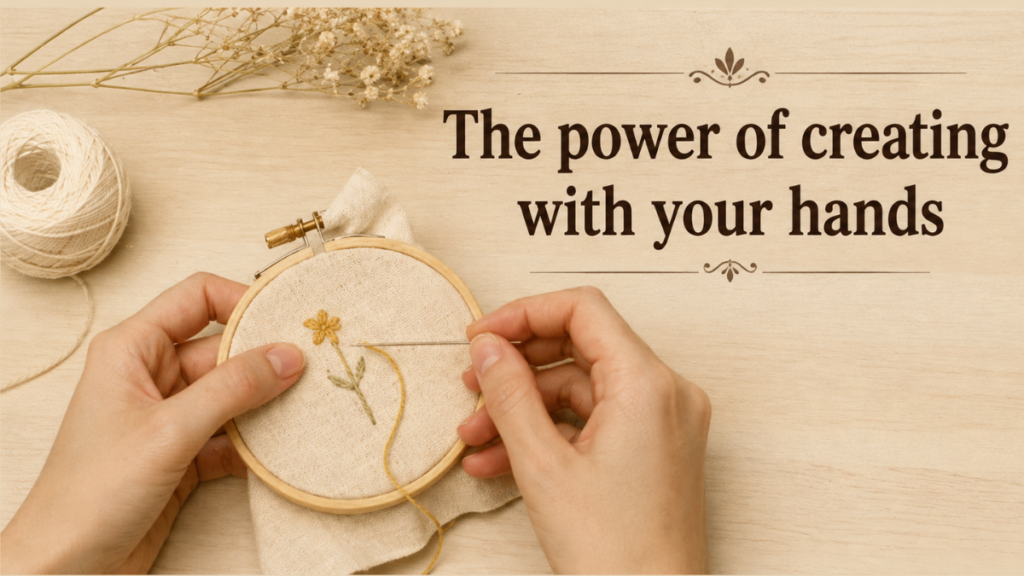
Discover why making something with your hands connects you to the deepest part of yourself. A reflection on calm, creativity, and the healing power of creating with love.
There’s something almost magical in the simple act of using your hands, in picking up a thread, a needle, a lump of clay, a paintbrush, or a ball of bread dough and beginning to shape something that didn’t exist before. In a world moving far too fast, where everything feels urgent and surface-level, stopping to make something by hand becomes an act of calm and connection.
I’ve always felt that when I work with my hands, something inside me settles. It’s as though the mind quiets down and the heart finds a gentler, more human rhythm. Over time I came to understand that the feeling was no accident. Making something with your hands connects you to something deeper, to a part of yourself that doesn’t speak in words. It’s an intimate conversation with who you are.
The Silent Language of Hands
Hands have always been an extension of the soul. They reflect who we are: our strength, our tenderness, our patience, the history of everything we’ve lived. Our hands hold memory. For centuries they’ve woven, cooked, embroidered, planted, and caressed.
When we use them to create, we aren’t only making something pretty. We’re reviving an ancestral bond with making, with the earth, and with life itself. It’s a silent language, yet it’s loaded with meaning.
Some emotions can’t be put into words, but they can be embroidered, sculpted, or knitted. Making something with your hands means speaking another language, one that doesn’t route through the head but through the heart.
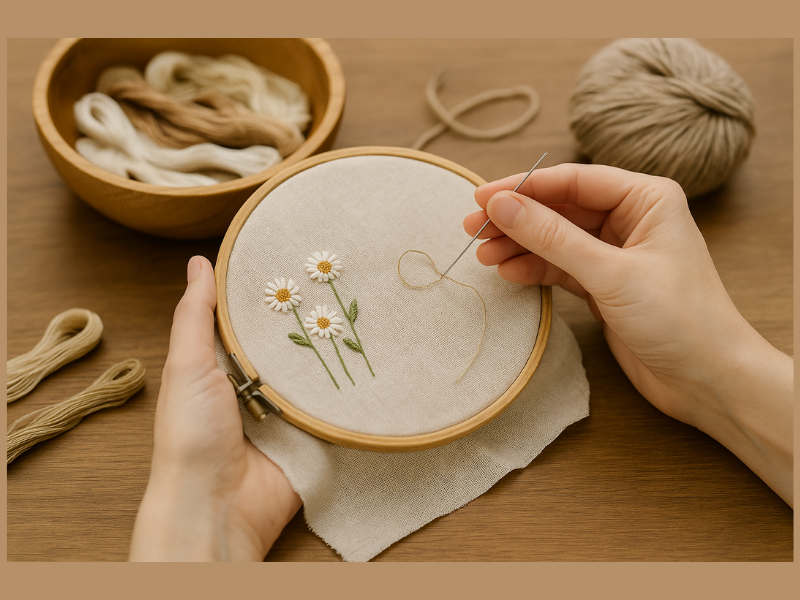
The Power of the Tangible in a Digital World
We live surrounded by screens, by a constant stream of information, by things that come and go in seconds. Somewhere in all that immediacy, something gets lost: the tangible. Digital is fast, but it leaves no physical trace.
When you make something with your hands, you create something that genuinely exists. You touch it, you smell it, you watch it grow bit by bit. That has a healing effect, at least for me.
Every stitch, every brushstroke, every knot is a way of saying “I’m here, right now.” It’s a way of inhabiting the present again, of feeling rooted. That’s why so many people find relief in crafting or in art. Hands know what the mind forgets so easily: that life is best enjoyed slowly, with attention.
Making Things Is a Form of Meditation
When you embroider, paint, or knit, your mind slips into a state of gentle focus. You aren’t thinking, you’re flowing. Your attention lands on the rhythm, on the sound of thread passing through fabric, on the texture of whatever you’re holding.
That effortless attention looks a great deal like meditation. You don’t need absolute silence or any special posture. All you need is to let your hands keep the beat.
I notice it every time I embroider. My worries dissolve almost before I realize it. It’s as if my hands were also working on my thoughts, untangling them little by little. Making something by hand is a way of meditating without meaning to, a way of being present in the moment without forcing it.
The Connection Between Hands and Heart
There’s a reason we say something “touches our heart” when it moves us. Hands are a direct extension of that energy, and whatever you make with them carries the imprint of what you feel.
That’s why, when you give a handmade gift, you aren’t only handing over an object. You’re handing over a piece of yourself. Every knot, every line, every detail was made with intention, and the person receiving it can sense that. Creating with your hands is a form of care. Care for others, yes, but above all care for yourself.
The Value of the Process, Not Just the Result
For a long time I thought what mattered was the finished piece. If the embroidery came out perfect, if the colors worked together, then it was worth showing. Over the years I learned that the real value lives in the process.
Every stitch, even the crooked ones, is part of the journey. What you make with your hands isn’t an exam, it’s a conversation with yourself. That dialogue teaches you patience, humility, and the importance of time. It reminds you that imperfect things can be beautiful too.
In a world that pushes you to hurry, sitting down to sew, to knit, or to work a piece of clay is a quiet declaration: you move at your own pace, and that is an act of power.
The Ancestral Wisdom of Working by Hand
Our ancestors understood this. They had no therapy and no social media, but they had the act of making. They wove, carved, cooked, sewed, and farmed, and in those simple acts they found meaning, connection, and calm. Every culture has had its own way of honoring handwork. In Japan, for instance, there’s the concept of “te-ate,” which means healing with the hands. In many traditions, embroidering, spinning, or kneading were almost spiritual acts.
These days, surrounded by technology as we are, we still need that direct contact with materials. Thread, wool, clay, paint, and wood return us to the body, to the present, and to what matters.
Working with your hands reconnects you to yourself
When you make something by hand, you’re creating from somewhere inside you. You aren’t merely copying or reproducing, you’re expressing. You reconnect with your intuition, your sensitivity, and your natural creativity. It doesn’t matter if you’ve never done it before. What matters is letting yourself go.
I’ve watched plenty of people discover themselves while sewing or knitting for the very first time. Every stitch opens an inner door. Creating isn’t only about producing something, it’s about knowing yourself.
The Emotions Behind the Act of Creating
Every time you work with your hands, emotions surface. Sometimes joy, sometimes nostalgia. A simple seam might remind you of your grandmother, or a color might carry you straight back to childhood.
Those emotions don’t show up by chance. They’re there to be felt and, at times, to be healed. That’s why so many people find a kind of therapy in art and crafting. You don’t have to understand it. You only have to be present and let your hands do what your heart needs.
Making Something That Lasts
In an era when everything feels fleeting, making something with your hands carries enormous value. What you make stays. You can hold it, keep it, give it away.
A hand-knitted scarf isn’t simply a garment. It’s time, intention, and affection turned into something you can wear. A piece of embroidery can last for decades, or even pass from one generation to the next.
Every time you make something, you leave a small mark on the world. It may seem like very little. It’s actually a great deal.
How to Start If You’ve Never Made Anything by Hand
If you feel the pull to create but have no idea where to begin, the first step is letting go of the fear. You don’t need talent or experience, only the desire. Start with something small and approachable. A simple piece of embroidery, a clay figure, a recipe that involves kneading, or a small crochet project.
The goal isn’t perfection, it’s enjoyment. Find a quiet corner, put on music, light a candle, breathe, and let your hands work. Before long you’ll notice something inside you settling.
The Physical and Emotional Benefits of Handwork
Beyond the emotional side, hands-on activities bring real benefits to your body and your mind:
- They reduce stress and anxiety.
- They improve focus and memory.
- They strengthen coordination and fine motor skills.
- They boost self-esteem when you see the results of your effort.
- They build patience and a higher tolerance for frustration.
Most of all, though, they give you back your sense of wonder. They remind you that you can create, transform, and shape beauty with your own two hands.
How to Care for What You Make
Looking after what you make is part of the process too. Just as you gave it your time in the making, it deserves your attention afterward. If it’s textile, store it clean and dry. If it’s clay or wood, protect it from moisture and sunlight. If you’re giving it away, send it off with a note or a story.
Caring for what you’ve made is a way of continuing to honor the time, the energy, and the love you put into it.
Frequently Asked Questions
Why is working with my hands so relaxing?
Because it brings you back to the present. When you use your hands, body and mind sync up. You stop thinking about the future or the past and you simply are.
What if I’m not any good at it?
It doesn’t matter. Skill comes with practice, but the sense of well-being arrives on day one. The beauty is in the process, not the result.
Which craft should I try as a beginner?
Pick whatever draws you in visually or through its texture. Embroidery, knitting, painting, or working with clay are all good starting points. Begin with small projects you can finish quickly.
Why does finishing something handmade feel so satisfying?
Because you’re turning energy into matter. You go from an idea to something real. That feeling of accomplishment and fullness is profoundly human.
Creating as a Form of Healing
Sometimes we don’t realize how badly we need silence, calm, and the chance to make something without overthinking it. When you sink into a hands-on task, something inside you comes back into balance.
I’ve seen people going through hard times find relief in knitting, embroidering, or painting. Not because it solved their problems, but because in the making they could stop for a moment and breathe. Handwork isn’t a distraction. It’s a form of healing.
The Beauty of the Imperfect
One of the great lessons of working by hand is learning to accept imperfection. Every uneven stitch, every mistake, every knot is part of the charm.
In Japan there’s the concept of wabi-sabi, which celebrates the beauty of what’s imperfect, impermanent, and natural. That philosophy fits handmade work perfectly. Your hands aren’t chasing perfection, they’re after something true.
Making something with your hands connects you to a part of yourself that sometimes falls asleep amid the noise and the rush. It’s a way of feeling again, of remembering that you can create and transform.
Every handmade project, however small, is a bridge between body, mind, and soul. It gives you back your sense of time, reminds you what effort is worth, and teaches you to enjoy the present. When you need to reconnect, don’t go looking outside yourself. Sit down, breathe, and let your hands speak. They know the way.
So what about you? How do you feel when you make something with your hands? Is there an activity that helps you unplug or feel more like yourself? I’d love for you to share it in the comments. Together we can inspire one another and keep weaving this little space of calm and creativity.