A playful vintage-magazine dispatch about a needle gone missing at The Vintage Corner. Humor, domestic mystery, and stitches of wit in a story that sews smiles out of thread and patience.
THE VINTAGE CORNER · THE ILLUSTRATED GAZETTE
Missing Needle, Reward: One Skein of Wool
A special two-column edition: classified ad, neighborhood inquiry, and domestic epic. A humorous dispatch with real sewing clues and light fiction.
Yesterday afternoon, following an intense session of hemming and confidences, the celebrated Needle No. 7 vanished from the big table. A veteran of cardigans and the unsung hero of invisible hems, she was last seen resting with a nap-like air against a tomato-shaped pincushion. Silence ever since. A reward is offered: one skein of caramel-colored merino wool, soft as a well-delivered apology. Tips, rumors, and conspiracy theories may be submitted at the newsroom or at the bakery, which opens earlier.
The first alarm came from the tape measure at 6:43 p.m., official workroom time. “We’re four inches from finishing and an entire needle short,” she declared, extending herself with the drama of a stage curtain. Beside her, the thimble struck the wooden table three times, a ritual for good fortune, and ordered a search of pockets, sleeves, and the mysterious folds of the tablecloth that harbors orphan threads.
The spool of thread, incapable of whispering, shouted its innocence from the edge of the abyss. “I have not moved since naptime,” it insisted. The pincushion, blushing, admitted it might have dozed off. “I’m a tomato, not an alarm clock,” it said with vegetable honesty. At this point someone suggested consulting the lamp. The lamp, who sees everything, clarified that it had stepped away for a second to change a bulb. “One does not change a bulb in the middle of a stitch,” the thimble muttered, and it was entered into the record.
The cutting table offered its battle scars in the form of scratches. “Patterns and histories have been forged on my surface,” it grumbled theatrically. “Had I sensed suspicious movement, I would know.” It was examined under magnification: lint, yes; clues, none. On the floor lay a trail of crumbs leading to the window. False alarm. They came from a sheep-shaped cookie.
The preliminary investigation ended on a classic hypothesis: the needle hid herself out of modesty. “Shy needles practice intermittent invisibility,” explained a yellowed manual retrieved from the shelf. The ritual search followed: blow across the fabric, lift the patterns carefully, summon her with an old courtyard tune. Nothing. No. 7 remained at large.
“Every needle dreams of going unnoticed and every thread dreams of being seen. Sewing is the daily reconciliation of both whims.” (Workroom maxim)
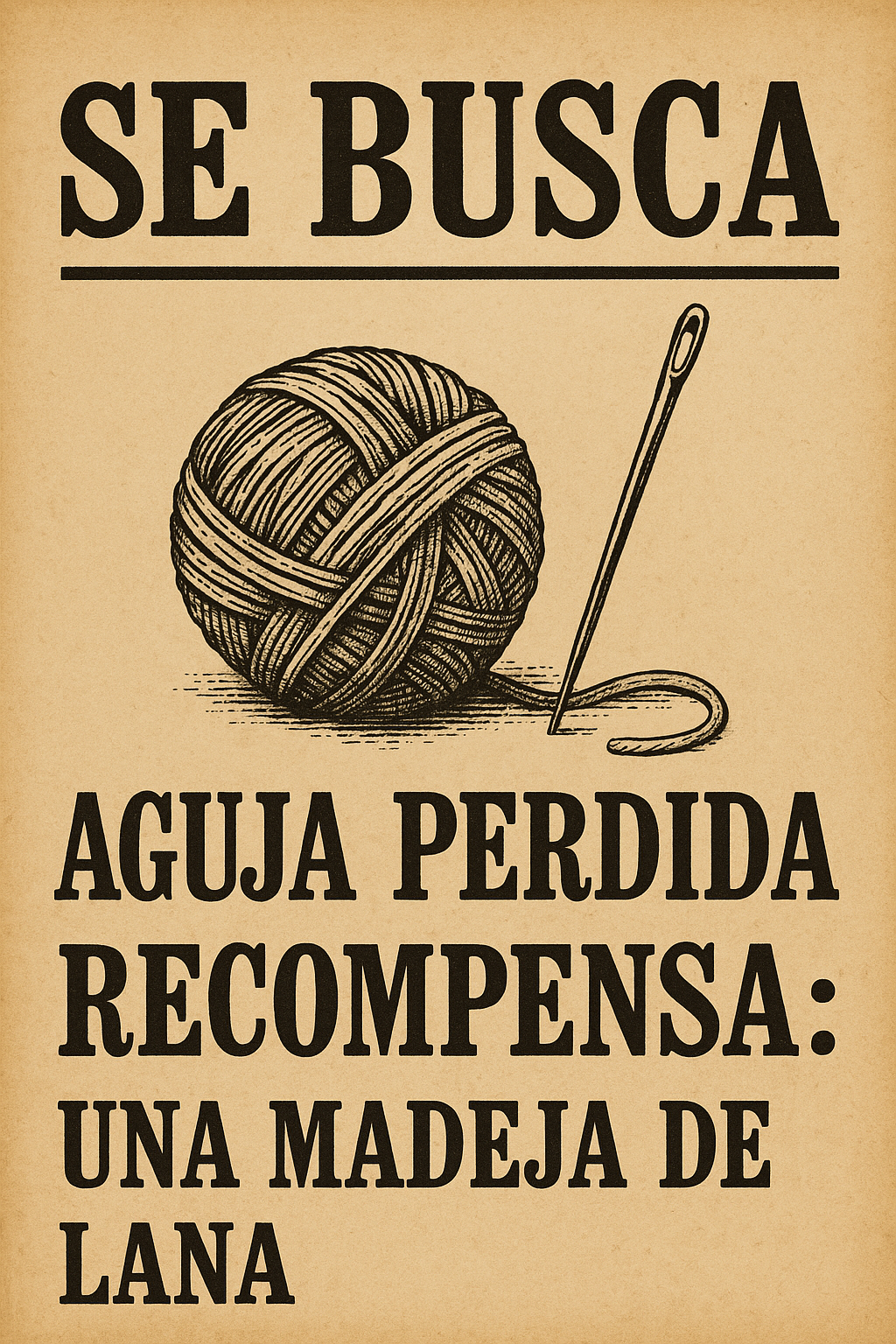
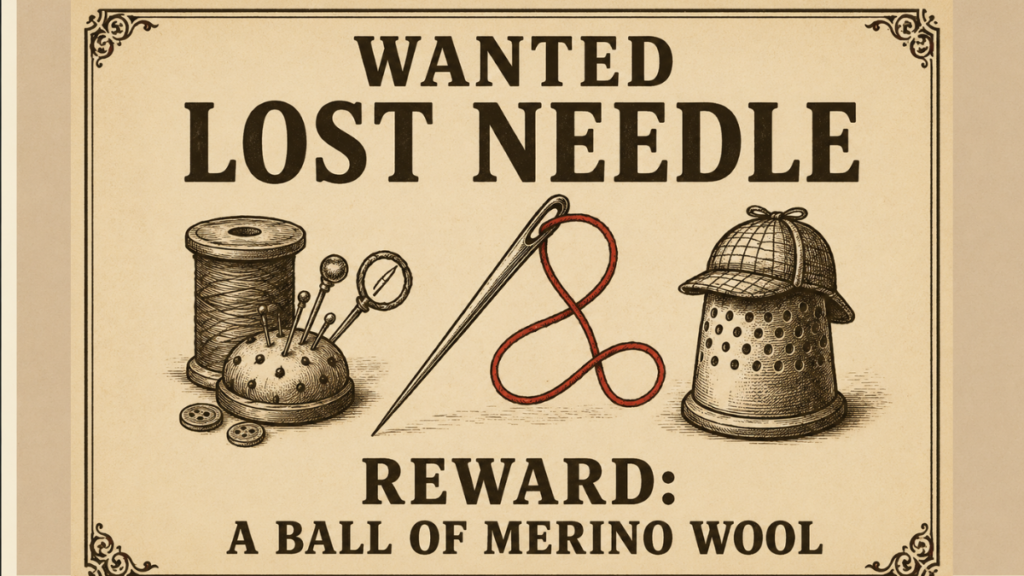
By the end of the afternoon, posters had been printed in solemn type: MISSING, NEEDLE NO. 7. They went up on the front door, on the bulletin board at the produce shop, and at the bus stop, where everything gets discussed with real talent. The description was precise: “Slender frame, kind eye, loyal temperament; prone to disappearing beneath napkins whenever a tango plays.” The reward was detailed with gastronomic elegance: “One skein of caramel-colored merino wool, the kind that calls for a snack.”
The first calls came in immediately. A mother-of-pearl button swore it had seen the needle traveling along a windowsill like a tightrope walker. A zipper claimed to have heard a suspicious jingle near the travel sewing kit. A reissue-minded spool of thread, deeply attached to nostalgia, reported a flight toward better times. “Back when hems obeyed on the first try,” it specified, with a certain melancholy.
There were pranks as well. An antique brooch sent a postcard depicting the needle in a swimsuit, sunbathing on a terrycloth towel. This newsroom appreciates the humor, though it would like to note that there are sleeves still unfinished. Around that hour, more elaborate theories began arriving: that she’d been kidnapped by a jealous pincushion, that she’d been recruited by a secret order of nocturnal seamstresses, that she’d gone off in search of the Lost Bobbins, that legendary society which appears whenever patience runs out.
Faced with reasonable chaos, the thimble issued a protocol of calm. “Pockets will be searched wearing gloves, cushions will be turned with solemnity, and the broom will be questioned without aggression,” it announced. The mood settled like a cup of tea that has decided to rest.
2) Pass a magnet with courtesy: attract, never coerce.
3) Cough lightly while moving the fabric: a shy needle gives herself away.
4) Do not panic: panic doesn’t sew.
The panel of experts, made up of the large shears, the French curve, and a magnifying glass with a past in stamp collecting, moved to the couch. That unfathomable continent of warm coins, deceased receipts, and pens that no longer write. Local legend holds that every small object will visit the couch at least once in its useful life. “If the needle chose that destination, she’ll have had her reasons,” offered the magnifying glass, who tends to think on everyone else’s behalf.
The maneuver known as “shake without mussing” was performed. The couch responded with a yawn. Down came a rain of benevolent crumbs, two loose beads that went looking for their necklace with dignity, a tin thimble from back when everything was beginning, and a widowed earring who promised to testify if we found its partner. The needle, however, was not there.
The couch was acquitted for lack of evidence and surplus of lint. The broom, for its part, submitted a lengthy report arguing that it had never, under any circumstances, decided to swallow a needle for sport. “I collect dry leaves and gossip, nothing more,” it concluded. Its sincerity proved convincing.
A few eyes then turned toward the doormat, that imperturbable confidant of homecomings. The doormat stayed true to its nature and kept a silence philosophers would envy. Not one yes, not one no, only a sigh of fibers when a boot dared cross it without manners.
“Objects that disappear learn a secret geography: they know shortcuts no map can hold.” (Aphorism of the Corner)
Needle No. 7 is no ordinary needle. She arrived at the workroom inside a case with the ambitions of an orchestra, chosen for her generous eye, perfect for unruly threads and tired hours. She darned coats discreetly, tamed hems tenderly, and crossed winter nights like an arrow that knew something about embraces. She was there in a dress that danced its first wedding and in a shirt that survived its third summer. A résumé of stitches without a single snag.
Over after-dinner conversation, the needle preferred to listen. She liked the murmur of cups, the clink of teaspoons, the way a ball of yarn loses its fear once the talk turns honest. She had one flaw: a tendency to hide beneath napkins, perhaps out of shyness, perhaps out of a very human wish to be found. This newsroom passes no judgment. It celebrates mysteries that call for light.
There was a day, and the blankets remember it, when the needle rescued a family afternoon by sewing on a legendary button that had refused to play its part. She did it with a crossed stitch, firm and exact, that would deserve a medal if the world understood domestic honors. The button has been greeting people ever since.
There were quarrels too. No. 7 argued with the shears over sharp matters, since the shears sometimes cut where the needle wishes to sew. They reconciled in front of the iron, which mediated with tempered steam. “Nothing gets broken here, things get mended here,” it pronounced, and peace spread out again like a well-made bed.
The neighborhood physics teacher, an enthusiastic quilter, delivered a spontaneous seminar titled “Quantum Mechanics of the Pin.” He argued that, at household scale, there exist microportals called “tablecloth gaps” that connect to parallel dimensions known as “behind the radiator” and “between the leg and the wall.” “If the needle found a resonant gap, she could have switched universes for a second and gotten stuck on the other side,” he theorized, waving the chalk as though weaving with it.
The theory was received with respect and coffee. A practical dressmaker countered that, in her experience, the most frequent dimension is called “under the magazine” and requires no doctorate. The professor gracefully conceded the point and proposed a synthesis: look under the magazine first, then check the radiator. For once, science and sewing shook hands without asking for credentials.
The search continued. Magazines were lifted away with movements worthy of ballet. Among their pages appeared a clipping of croquette recipes, two postcards from a very blue summer, and a pattern for an apron with a large pocket “just in case.” The pattern was adopted as doctrine: small pockets are schools of loss.
In a burst of creativity, a luminous trap was set: a beam of sunlight directed by mirror onto the table, meant to tempt the needle’s metallic vanity. Nothing. The sun preferred playing with the dust the way it does in old paintings, and the needle, if she was there, practiced invisibility with professional success.
“The best flashlight for finding things is patience. The second best is a flashlight.” (Note in the margin)
A specialized patrol was appointed to inspect pockets, led by a hand with a gift for finding old movie tickets. Jackets were searched, along with Sunday robes, walking coats, and that apron which keeps stories about soup. Out came a pencil that could still write hopes, a streetcar ticket with an endearing date, a lock of red thread that refused to testify, and a couple of candies nobody had the heart to throw away.
In the fourth pocket of the blue coat, a needle was found. It turned out to be No. 5, of nervous temperament. “Search no further, I volunteer,” she said in a soprano voice. The thimble thanked her for the gesture and convinced her that every tool has its moment. No. 5 returned to the case with slightly wounded dignity and sincere applause from the yarn, which always admires courage.
In a secret pocket, one of those born of desire rather than of sewing, a note was found: “If anyone reads this, know that the needle dreams of seeing the ocean.” Signed, “A scarf that traveled.” The entire workroom promised an excursion as soon as weather and budget allowed. The needle wasn’t found, but a plan was.
The patrol concluded that pockets are independent countries with shifting borders. For future campaigns, it recommended declaring an amnesty for objects and establishing the custom of emptying them every equinox, with ceremony and old radio music.
Whatever you forgot you put there remembers you.
Before sewing a new pocket, decide which memories it deserves.
The rug, a grand lady inherited from an aunt who could tell novels in installments, was elegantly implicated. It was lifted by the corners, like a theater curtain about to perform its bravest act. Underneath lay a parallel world: dust with a memory, a paper clip with ambitions of becoming a fishhook, a marble that resembled a globe, and the business card of a cobbler who no longer exists. The needle did not appear.
That was when the broom proposed a method revealed only in emergencies: sweep toward the light. “If the needle wishes to be found, she’ll shine.” The broom, fluent in the language of floors, swept with ceremonious motions. Nothing. By this point, No. 7 was starting to feel like an urban legend, like the neighbor who tunes a piano behind everyone’s back.
Spirits held up, though. A grandmother experienced in miniature wars said, “When a needle wants to come back, she does it at coffee time.” Coffee was made. The aroma put the afternoon in order, and for a few minutes the worry dissolved into teaspoons. She didn’t return, but the world went back to its usual size.
The rug was pardoned with honors. Someone promised it a thorough cleaning at the first honest ray of spring. The rug, which doesn’t speak but does appreciate, seemed lighter when it settled back into its usual place.
“Serenity is the thimble of the spirit: it spares you the pricks while you look for what’s missing.” (After-dinner maxim)
Just when it seemed we’d be writing an open ending, the lamp, that distracted witness, remembered there’s a forgotten fold in the curtain. It was examined with the solemnity of a cathedral. There, holding the hem in place with a grace unbecoming of her trade, was Needle No. 7, running a strand through as though answering an overdue letter. She appeared to have taken refuge there to watch the sunset discreetly.
There was a brief silence, the kind that precedes great applause. The thimble cleared its throat, the tape measure marked the beat of the return, and the cutting table stretched like a satisfied cat. The needle was returned to her case amid small cheers. “She wasn’t lost, she was on duty,” declared the curtain, proud of its unexpected role.
The record was entered: “Recovered at 8:11 p.m., in perfect shine, holding no grudges, eager to sew.” The skein of caramel merino was handed over in a brief ceremony, tied with a figure-eight bow. The needle, modest as ever, accepted the reward not for herself but for the sweater already underway. “Nothing makes me happier than getting back to work while everyone is smiling,” she is said to have said. We may have made that up, though it’s worth believing.
The workroom recovered its order. Sleeping projects woke without complaint, the pockets returned what wasn’t theirs, and the couch nobly admitted it had nearly swallowed her out of habit, then held back at the last moment. “We all have temptations,” it philosophized. There is a proposal to invite it to Friday snack time as a reward for good behavior.
Coffee summons happy endings, though rarely punctual ones.
Tools don’t get lost: they take unpaid vacation.
The skein of caramel merino was converted, by consensus and enthusiasm, into a walking scarf. Every row carried an anecdote from the search, knitted in a low voice. “Here’s where the couch learned manners,” said one line. “Here’s where the doormat kept its heroic silence,” said another. “Here’s where we laughed when she turned up in the curtain,” said all of them. When it was finished, the scarf smelled of an afternoon rescued and of a home that knows how to be found.
No. 7, back in her case, rested with dignity. A small sleeve was made for her with embroidered initials, O and L for “our lady,” because some objects earn their titles with useful stitches. The entire case seemed to straighten up a little, the way photographs do when they finally find the right frame.
From this newsroom, we encourage readers to share their own illustrious disappearances: scissors with a taste for travel, safety pins that took their name literally, buttons with an instinct for freedom. Every loss brings a story and every search brings company. Add a snack and it’s better still.
Let the fundamental conclusion not be forgotten: workrooms, like homes, rest on objects with intention and people with patience. When something is missing, perhaps what’s truly missing is that little while spent looking together. Sometimes the needle comes back because we called her. Other times because we stopped fighting the afternoon and finally listened to it.
*From the desk of The Vintage Corner: “Missing needle” has been found. The reward has been knitted. The moral, now framed: sweep toward the light and save your pockets for memories worth keeping.*
Don’t miss our Story Workshop!