Discover the fascinating story of crochet in the 1920s: how one simple hook sparked a quiet revolution in women’s fashion. A creative dispatch in the vintage-magazine style, full of humor, history, and handmade elegance.
THE CREATIVE CHRONICLE · THE ILLUSTRATED GAZETTE
The Crochet Revolution of 1920: How Crochet Changed Women’s Fashion
A special two-column edition: jazz smoke, flapper dresses, and one crochet hook raised as a banner of freedom. A humorous dispatch with genuine historical curiosity and light fiction.
There was a year, or perhaps an entire decade, when the world decided to shorten hems, cut hair, defy clocks and, without asking anyone’s permission, turn a humble crochet hook into a megaphone of style. In the parlors where jazz smothered good manners and set ankles alight, crochet stopped being an after-dinner pastime and declared itself a quiet revolution: short stitch, bold gesture, and a constellation of dresses that moved like a fresh breeze. That, dear readers, was no mere fashion. It was news.
The apocryphal files of this newsroom claim that a cotton thread, weary of living in the shadow of the great industrial fabrics, slid one night across a dressmaker’s table and whispered, “Give me a hook and I’ll give you a dance.” The dressmaker, who also played piano at a speakeasy, obliged. Thus was born the first crocheted Charleston dress, with fringe capable of answering every syncopation in real time. It was spotted in three cabarets, six staircases, one streetcar, and the imagination of half the city.
The anecdote, which appears in no manual though it certainly should, spread faster than butter on warm bread. All at once, dressmakers’ tables woke up crowned with balls of mercerized cotton, and hooks in sizes 3 and 4, once so timid, began peeking out of handbags and pockets like elite fountain pens. “A different silhouette is being written here,” they seemed to say.
The first consequence was audible: the salon gatherings inherited from the 19th century, with their long speeches and polite yawns, shrank to the length of a chain stitch. Where there had been oratory, now there were swatches. Where there had been prudence, now there was trial and error, experiment and spark. Crochet, for reasons only the pulse understands, gave hands back the right to interrupt the tongue.
The distinguished tailors, gracious but a touch envious, muttered that all this was “whimsical handicraft.” The flappers answered with an irrefutable argument: they turned up on the dance floor in dresses that seemed to sketch music. “Whimsy,” said the tailors. “Poise,” replied the stitches.
“With a crochet hook in her hand, every woman is a newsroom: she manufactures headlines out of thread and a Sunday afternoon.” (Improvised editorial, 1922)
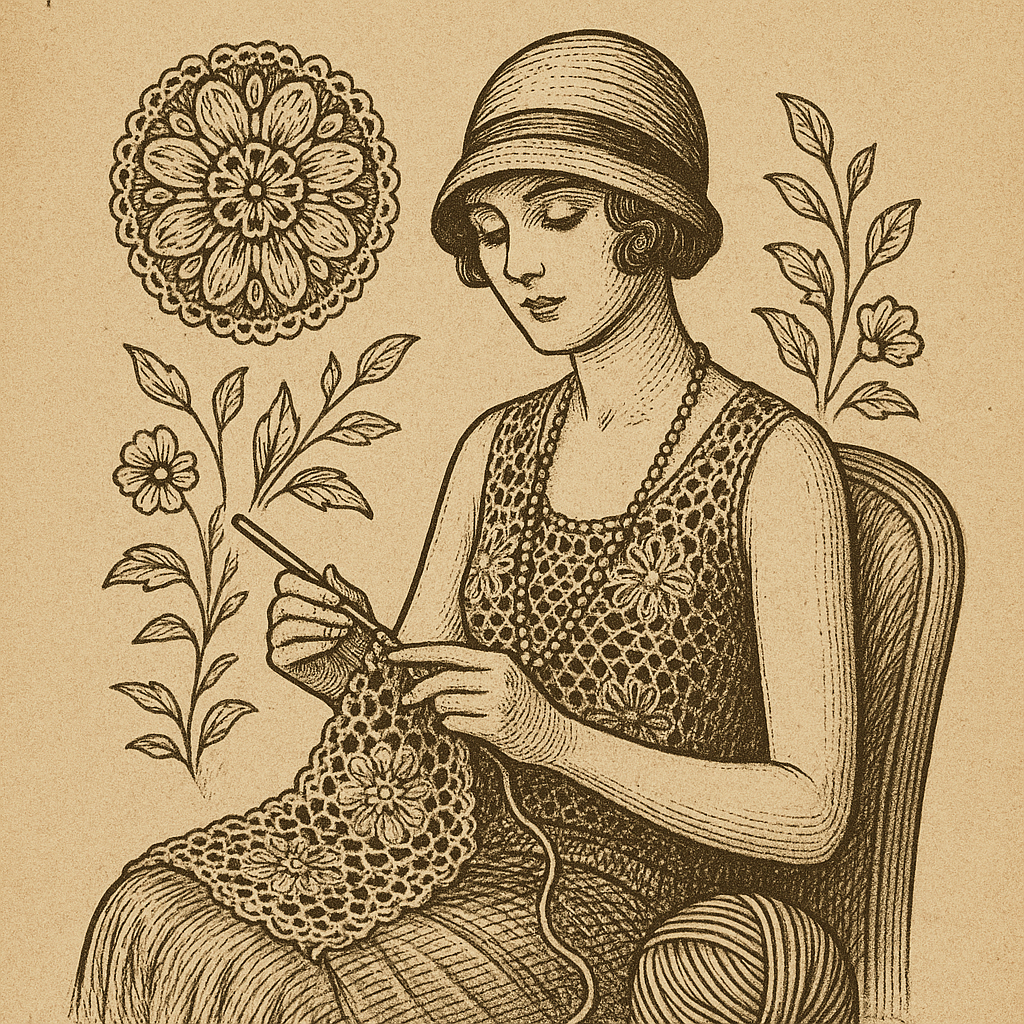
Crochet didn’t only decorate. It edited the silhouette. It lightened waistlines, allowed for an unbothered stride, and let the shoulders loose. A new alphabet of stitches took hold: chain to begin, single crochet to bring order, double crochet to sing, and that celestial invention called the pineapple stitch, declared in 1923 the official fruit of the speakeasy dance floors (a fact confirmed by no ministry and by a great many ankles).
On the cutting table, the tape measure became sheet music. Dressmakers noted down measurements and meters at once: “two rows of double crochet, four of mesh, one of shells to breathe.” Constriction fled the scene, the moralists hid under their beds, and out into the street came a fashion that needed no permission, only good company and a song that could count to four.
The straight drop of the flapper dress found its ideal accomplice in crochet. Where flat fabric called for scissors, crochet offered elastic patience. Where a hem refused to cooperate, a shell edging asked for the floor and tuned the border with the discretion of a violinist. It was a peace treaty between craft and modernity, that rare accord that lasts about as long as a good summer and leaves behind photographs that survive the winter.
Some said it was reckless to trust the evening to a fabric made of small gaps. The counter-report was decisive: those gaps were full of air, and air, when it tastes of music, holds up dignity better than any whalebone stay.
There was no printed manifesto and no barricade. There was, however, a secret alliance among stitches. Double crochet and half double crochet met behind closed doors with the chain stitch and agreed to strike for impossible openings. “Freedom is negotiated one stitch at a time,” they concluded. The corsets, informed by the press, requested a round table. The crochet hook, with diplomatic courtesy, replied: “A table, yes. Whalebone, no.”
The results were visible in shop windows and at street fairs. Crocheted blouses, with puffed sleeves or no sleeves but plenty of attitude, took the lead on Sunday afternoons. Skirts trotted above fishnet stockings and, suddenly, the adjective “scandalous” lost its edge. It was replaced by “cheerful,” which is a more honest way of saying the same thing without picking a fight.
The serious newspapers, who are entitled to their nerves too, ran editorials warning of the dangers of “hollow fabric.” This newsroom, loyal to empirical verification, ran several trials involving electric fans, stern glares, and elderly aunts. Crochet weathered every storm with elegance.
On the outskirts of the city, villages took up the novelty in their own fashion. Sunday shawls appeared with borders that knew how to tell a story, along with discreet mantillas that turned into song as evening fell. Nobody declared open rebellion, but every afternoon tea changed the subject.
“Crochet democratized sparkle: every house had a hook and a wish for something new.” (Local dispatch, 1924)
A revolution requires logistics, and this one found it in the size of its own tool. Crochet fit in handbags, in coat pockets, in the quiet cheer of the streetcar. Lines grew less impatient and after-dinner conversations grew longer. Seasons were measured in rows and love affairs in inches of edging.
In one particular railcar, the Traveling Hook Club was founded by acclamation. Its bylaws called for courtesy with elbows, sharing yarn in a pinch and, above all, never undoing somebody else’s work even when it sat “on the brink of perfection.” The club published a small bulletin of patterns that fit on a single page, under a noble motto: “If you can count it, you can crochet it.”
Portability changed the household economy too. Spontaneous little workshops sprang up, where four neighbors turned an ordinary afternoon into an impromptu fashion show. One brought the yarn, one set the table, one knew how to fix a mistake without raising suspicion, and one lifted the whole affair with a cake that still has defenders today.
This time the tailors didn’t protest. They ordered crocheted trim for collars and cuffs, discovered that jackets survive winter better when a bit of lace regards them fondly, and adopted, not without some embarrassment, the habit of carrying a hidden hook for emergencies of prestige.
2) If a chain is lost, adopt another.
3) Criticism is delivered in single crochet, congratulations in double.
4) Focused silence is permitted: it counts as conversation.
The textile merchants, people attuned to any passing breeze, smelled opportunity. Shop windows appeared with towers of yarn arranged by the colors of weather: shy pinks, blues that looked freshly laundered, greens that promised parks. Patterns were printed on cheap paper and on expensive paper, Sunday supplements were handed out on the subject of “the modern woman and her diligent hook,” and one confused financier tried to sell shares in a company promising “yarn that grows on its own.” It went nowhere, though it did supply us with some much-needed laughter.
Crochet work generated a peculiar sort of household accounting: expenses justified as an investment in serenity. “Today I bought yarn, tomorrow I buy patience,” read planners in a firm hand. Some homes converted their entertaining budget into a fringe budget, while others combined the two intelligently: entertaining with fringe included, which is what happens when conversation becomes an unforgettable garment.
The smuggling of fringe, a small and affectionate trade, crossed neighborhoods discreetly. Now and then a spare edging traveled in a coat pocket and rescued a dress right at the corner. A courier service was even founded, promising “deliveries with a secure stitch before the music starts.” Its slogan still floats in the mirrors of certain ballrooms.
There were scams, naturally. Incomplete patterns, promises of miracles in three rows, mysterious yarns that bled color the instant they met rain. The community responded with what it does best: lists, syncopated recommendations, warnings passed along in hallways. The network held itself up, as good networks do.
“When a pattern fails, the neighborhood corrects it. When it works, the neighborhood dances it.” (Marginal note in a 1926 notebook)
If a visitor from the future asked what the technical secret of those dresses was, we’d answer without blinking: mesh. Mesh of double crochet and chain, mesh with coquettish pineapples, mesh with fans that could say “come back” without using a voice. Mesh allowed for air, for movement, and for a geometry forgiving of haste. On that foundation, each dressmaker made her statement: silk fringe for magic, beads for light, and a cut that looked demure at rest and, on the first downbeat, announced its convictions.
The boldest workshops experimented with mixed fibers: a little linen to strip away pretension, a strand of rayon to invite a shimmer. No combination tried to replace the hook. They all wanted to dance with it. The mistakes, and there were mistakes, some enormous, dissolved into shared patience: undo, breathe, redo, that choreography by which small wars are won.
The illustrated magazines showed ladies on terraces in dresses that resembled maps. Beneath each photo ran a caption with humor: “Do consult your hook before promising anyone your Saturday.” “If your pineapple stitch turns tragic, send it packing and come back with coffee.” That pedagogy of the smile taught thousands to start at the beginning and not get lost on page three.
At the sewing schools, a few visionary headmistresses folded crochet into the curriculum, not as decoration but as a language of design. “The stitch thinks,” they wrote on the blackboard. Delighted, the students took notes that looked like sheet music. The mathematics faculty examined those notes and discovered, far too late, that art had gotten ahead of them once again.
2) Waist merely hinted at with a gentle elastic, or none at all if the beat prefers it.
3) Fan edging; silk fringe the length of an honest laugh.
4) Dress rehearsal in front of the mirror: if the dress breathes with you, it’s ready.
The guardians of respectability, a nervous but well-meaning bunch, filed formal complaints: “Crochet incites geometric disorder.” In response, several dressmakers organized an exhibition with mannequins arranged by stitch density. One inspector was so moved by a perfectly symmetrical edging that he dropped his report on the floor. “There is discipline in this nonchalance,” he murmured. Nobody contradicted him.
The industrial designers, meanwhile, tried to claim the phenomenon with machines that imitated the stitch at high speed. Beautiful garments came out, certainly, but the murmur of conversation was missing. The customers, being wise, bought a few out of curiosity and went right back to the workshops for the garment that told a story. This wasn’t nostalgia. It was a preference for verifiable emotion.
In houses where time was measured in buckets and braziers, crochet offered an attainable luxury: yarn, a hook, and a window. It required no permission and no steady electricity. A chair, a wish, and a pattern that made sense to those particular hands were enough. Fashion slipped down narrow hallways and descended into courtyards with the freshness of things that don’t charge admission.
Some voices demanded solemnity. Crochet smiled and answered with vests that went with everything and flirtatious collars that rescued tired suits. In more than one office, Monday felt less like Monday thanks to a new edging that nobody could name and everybody understood.
“This isn’t frivolity. It’s the right to lightness after a long week.” (Letter to the editor, 1927)
The crochet revolution changed no laws, but it transformed customs. It let thousands earn a few coins without leaving home, combined work and caregiving without asking permission, and created spaces for conversation where laughter was both input and output. Girls learned from their elders without embarrassment or catechism. Boys, when they dared, discovered that stitches are also a matter of memory and patience.
Crochet introduced a new kind of belonging, too. Informal groups, the Thursday crew, the women on the park bench, the factory workers on break, recognized one another by the way they held a hook and the way they celebrated a stitch well resolved. That light fraternity carried a lot of people through rough days. No statistic records it, though memory insists.
In the economy of small details, crochet was a master. It saved worn-out dresses, reinvented sad coats, turned defeated tablecloths into optimistic skirts. In hard times, aesthetic repair was an act of dignity. Nobody went out to put on a show. Everybody went out better accompanied.
The cafés noticed. There was an uptick in customers requesting a table with good light and gentle quiet. In exchange, they left tips in the form of crocheted coasters that still surface now and then in old boxes, like coins from a country that no longer exists.
By the close of the decade, certain stitches were here to stay. Filet crochet, with its obedient little squares, made it possible to spell out letters and promises. The jasmine stitch, christened over a pot of tea, offered texture without arrogance. Shells earned permanent residency on cuffs and hems. Those alphabets passed from hand to hand like stew recipes.
Industrial fashion marched on and crochet went its own way. Every few years its demise was announced, the way people forecast the extinction of dinner-table conversation. Every few years it reappeared, renewed: hippies, beach summers, country weddings, runways that grew suspicious of themselves and made peace with time. The secret was adaptability. The hook listens to what the hands are asking for.
Today, and forgive us this leap through time, some people translate patterns into digital charts and others write algorithms that mimic stitches. All are welcome, but bear this in mind: the hook does not impress easily. It demands a steady pulse, a sense of humor, and the willingness to unravel without drama when the moment calls for it.
If a thread could speak, and we believe it can, it would say that the 1920s taught it to take up the street without an escort. It hasn’t forgotten the way home, or the way to the dance floor, ever since. That duality teaches something: you can be useful without giving up joy, and you can shine without asking permission.
Years went by, hairstyles changed, clubs closed and others opened. What remained was a repertoire of gestures we still recognize: the way of holding a conversation while the fingers work, the certainty that a handmade garment keeps the rhythm of whoever made it, the conviction that the most interesting fashion isn’t bought, it’s cooked.
In the sepia photographs, the flappers look at us as if they knew something we’ve forgotten. Perhaps this: freedom fits in a handbag when it takes the shape of a hook and a ball of yarn. It also fits on a kitchen table, given a good afternoon and a radio for company. Stitches don’t change the world. They change how we inhabit it. Sometimes that’s enough.
Our newsroom, which doesn’t crochet but does admire, offers one piece of advice to contemporary readers: if you come across a pattern from the twenties, don’t treat it as a relic. Take it out into the street. Add a pocket, strip away the solemnity, give it a laugh. Crochet doesn’t age. It learns.
Should anyone ask why you keep crocheting in such a distracted century, cite this dispatch or write your own. Remember the motto of the Traveling Hook Club: “If you can count it, you can crochet it.” The rest, the fringe, the dancing, the light coming through the window, will follow on its own.
*From the desk of “The Creative Chronicle”: quiet revolutions are told in chain stitches. This edition was printed in coffee-colored ink with Sunday patience.*
Don’t miss the latest from our Creative Chronicle.